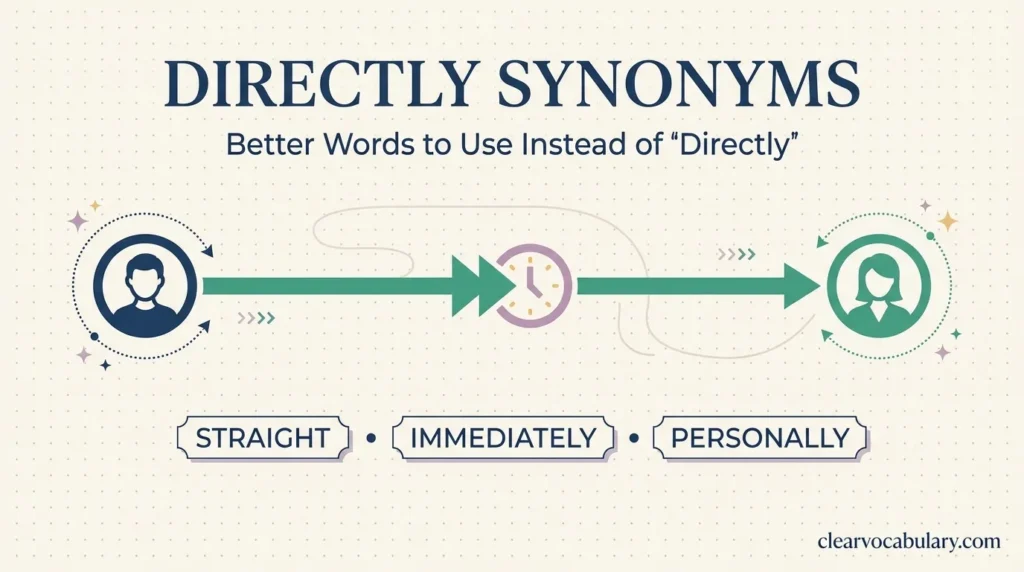

The best synonym for “directly” depends on its meaning: straight for a path, immediately for time, and personally for no middleman.
“Directly” has three main senses, and each has different synonyms. Use straight or right for a path, immediately or at once for time, and personally or firsthand for involvement without a go-between. The word you pick depends on which sense you mean.
Most people searching for directly synonyms want a fresh word for a sentence they are already writing. “Directly” is flexible, which is exactly why replacing it can be tricky. A word that fits “go directly to the office” will fail in “I’ll call you directly” or “directly opposite the station.”
This guide separates the senses, lists legitimate alternatives for each, and shows where a swap changes the tone or the meaning.
Quick Answer
| If “directly” means… | Best alternatives |
|---|---|
| In a straight line or without detours | straight, right, straight away (informal in this sense) |
| Immediately | immediately, at once, right away, promptly, instantly |
| Without a middleman | personally, firsthand, in person, straight |
| Exactly or precisely (position) | right, exactly, squarely, immediately (as in “immediately opposite”) |
| Frankly or openly | frankly, plainly, bluntly, candidly, openly |
| Soon (chiefly British, informal) | shortly, presently, in a moment |
There is no single best synonym. The right choice depends on context.
Meaning of “Directly”
Directly is an adverb. Its core idea is no deviation, delay, or intermediary. It comes from the adjective direct, and the sense you intend depends on what is being skipped: a detour, a wait, or a go-between.
It can also act as a conjunction in British English, meaning “as soon as” (“Directly she arrived, the meeting began”). This use is informal and fairly old-fashioned, so it is rarely worth recommending to learners.
Prototype Meaning
The most typical meaning of “directly” is by the shortest or most straightforward route, with nothing in between. Most people picture a person going somewhere without stopping, or a message passing from one person to another without help. The time sense (“immediately”) and the position sense (“directly above”) are extensions of that idea.
Connotative Meaning
“Directly” is mostly neutral. In some contexts it feels slightly positive because it suggests efficiency and honesty (“She answered directly”). When describing speech, it can lean toward blunt or forceful, depending on tone, as in “He told her directly that the work was unacceptable.” Words like bluntly push that edge further, while candidly sounds more positive.
Synonyms of “Directly” by Meaning
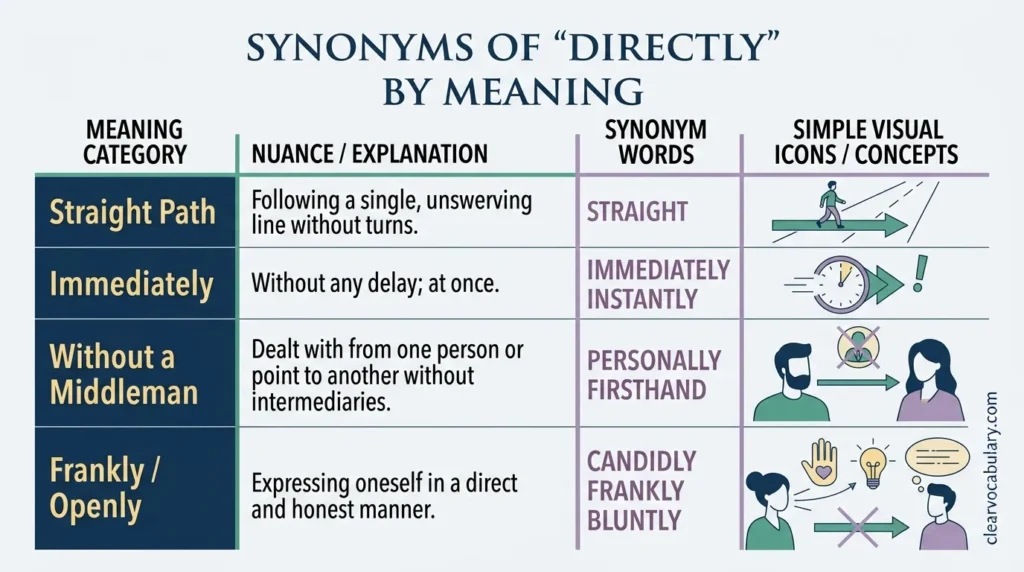
1. Directly = in a straight line, without detour
- Straight: The most natural everyday choice. The road goes straight to the harbour.
- Right: Informal and common in spoken English. Come right home after school.
- Straight away is usually about time, not path, so treat it carefully here.
Example: “The train goes directly to Lahore.” → “The train goes straight to Lahore.” (Both work. “Non-stop” is a related but different idea about stops.)
2. Directly = immediately
- Immediately: Neutral and widely used. Call me immediately.
- At once: Slightly formal. Please come at once.
- Right away: Conversational. I’ll do it right away.
- Promptly: Suggests efficiency, especially at work. She replied promptly.
- Instantly: Stronger, suggesting almost no delay. The lights came on instantly.
Directly in the time sense is less common in modern American English than immediately. It can sound slightly formal or dated.
3. Directly = without an intermediary
- Personally: The person themselves is involved. The manager handled the complaint personally.
- Firsthand: Experience gained without secondhand reports. She saw the damage firsthand.
- In person: Physically present. You can submit it in person.
- Straight: Informal. Ask him straight.
Example: “You can contact the supplier directly.” → “You can contact the supplier yourself/personally.” Personally shifts the emphasis toward the person involved rather than the absence of a middleman, so it is a close alternative but not identical.
4. Directly = exactly, in position
- Right: The café is right opposite the school.
- Exactly / precisely: Exactly opposite the station.
- Squarely: The light fell squarely on the stage.
- Immediately: The shop is immediately next to the bank.
5. Directly = frankly, openly
- Frankly, plainly, candidly, openly, bluntly
Example: “He spoke directly about the risks.” → “He spoke candidly about the risks.” Candidly is warmer. Bluntly is harsher.
6. Directly = soon (informal, mainly British)
- Shortly, presently, in a moment
I’ll be with you directly. → I’ll be with you shortly. Note that presently can mean “soon” or “now,” depending on region, so check your audience.
Synonym Comparison Table
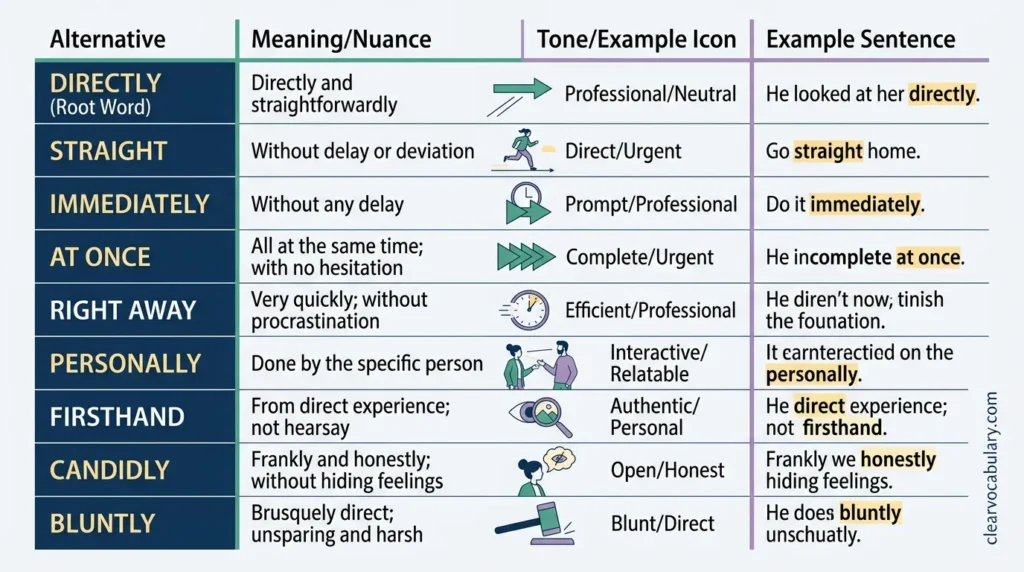
| Word | Sense | Tone | Example |
|---|---|---|---|
| straight | path / no middleman | neutral to informal | The pipe runs straight to the tank. |
| immediately | time | neutral | Please reply immediately. |
| at once | time | slightly formal | Leave at once. |
| right away | time | casual | I’ll send it right away. |
| personally | no middleman | neutral to formal | She thanked him personally. |
| firsthand | experience | neutral | He learned it firsthand. |
| candidly | speaking | warm, honest | She spoke candidly about it. |
| bluntly | speaking | harsh | He said it bluntly. |
Which Word Should You Use?
- In emails and workplace writing: Use immediately, promptly, or personally. Please contact the vendor directly is also perfectly natural and clear.
- In casual speech: Right away and straight sound the most natural.
- In formal writing: At once, personally, and candidly suit the tone.
- In instructions or directions: Straight and right are clear and short.
Keep “directly” when it already reads clearly. A synonym is only an improvement if it fits the meaning better or avoids repetition.
Grammar and Word Forms
| Word | Part of Speech | Word Forms | Grammar / Use | Example |
|---|---|---|---|---|
| direct | adjective | more direct, most direct | Describes a noun | A direct flight leaves at noon. |
| direct | verb | directs, directed, directing | Takes an object | She directed the project. |
| directly | adverb | more directly, most directly | Modifies verbs, adjectives, or phrases | He looked directly at me. |
| directness | noun | directnesses (rare) | Names the quality | I admire her directness. |
Word Formation
direct (root) → directly (adverb) → directness (noun)
Related standard forms include indirect → indirectly, direction, director, and redirect.
Pronunciation
| Word | Syllables | Pronunciation |
|---|---|---|
| directly | 3 | /dəˈrektli/ or /daɪˈrektli/ |
Both “di-” pronunciations are accepted. The stress falls on the second syllable. The variant with /daɪ/ is common in American English, and /dɪ/ or /də/ is common in British English, though both occur in each region.
Etymology
Direct comes from the Latin directus, meaning “straight” or “set straight,” from dirigere (“to set in a straight line”). The sense of directly as “immediately” developed from the idea of going straight to something without delay.
Real-Life Examples
- Please send the form directly to the admissions office.
- The sun was shining directly into my eyes.
- He answered the question directly, without any excuses.
- We’ll head straight home after the meeting.
- I spoke to the manager personally about the issue.
- The patient’s symptoms are directly related to the medication.
Common Collocations and Expressions
- directly related to / directly linked to
- directly opposite / directly above / directly below
- contact someone directly
- look directly at
- directly affect / directly involved
Common Mistakes
❌ Incorrect: The two options are directly similar.
✅ Correct: The two options are very similar.
Directly does not simply mean “very.” It needs a sense of straightness, immediacy, or lack of intermediary.
❌ Incorrect: She directly didn’t answer.
✅ Correct: She didn’t answer directly.
Adverbs of manner usually follow the verb, or the verb and object, in negative sentences.
❌ Incorrect: I’ll do it directly, in a few days.
✅ Correct: I’ll do it shortly, in a few days.
If you mean “soon,” directly can sound confusing in many varieties of English. Use shortly instead.
British English vs American English
The “soon” sense (I’ll be there directly) and the conjunction use (Directly he left, it rained) are more typical of British English and are now uncommon. American English tends to prefer immediately or right away for the time sense. The standard senses of “without a detour” and “without an intermediary” are used equally in both.
Antonyms of “Directly”
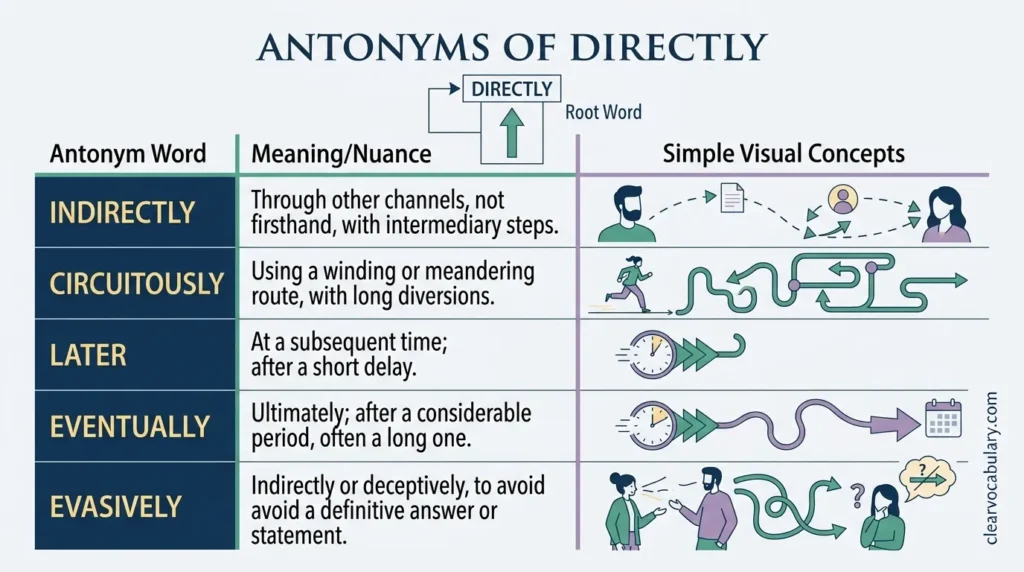
- Indirectly: by a roundabout or intermediate route. The policy affected us indirectly.
- Circuitously: by a winding route (formal). The path ran circuitously through the hills.
- Eventually / later: for the time sense. She replied later.
- Evasively: for the speaking sense. He answered evasively.
Sentence Transformations
Original: Contact the vendor directly.
Alternative: Contact the vendor yourself.
The meaning stays close, and the tone is slightly more personal.
Original: She came directly after the meeting.
Alternative: She came right after the meeting.
“Right” is more casual.
Original: He spoke directly about his mistakes.
Alternative: He spoke candidly about his mistakes.
“Candidly” adds a warmer, more honest tone.
Practice: Choose the Correct Word
- The bakery is ______ opposite the bus stop. (right / presently / bluntly)
- Please reply ______; the deadline is today. (immediately / indirectly / candidly)
- She told him ______ that the plan wouldn’t work. (circuitously / bluntly / firsthand)
- I saw the accident ______. (firsthand / indirectly / evasively)
Answers
- right: it expresses exact position.
- immediately: it matches the urgent time sense.
- bluntly: it fits speaking in a frank, direct way.
- firsthand: it means experienced personally, without a middleman.
FAQs
What is the best synonym for “directly”?
It depends on the meaning. Straight fits a path, immediately fits time, and personally fits cases without a middleman.
Does “directly” mean “immediately”?
It can, but this use is less common in modern American English. Immediately is usually clearer.
Is “directly” the same as “straight”?
Sometimes. Both can describe a path without detours, but straight is more informal and does not cover all the senses of directly.
What is the opposite of “directly”?
Indirectly is the standard antonym.
How do you pronounce “directly”?
Usually /dəˈrektli/ or /daɪˈrektli/, with stress on the second syllable.
Can I start a sentence with “directly”?
In modern English this is uncommon. It appears mainly in the older British conjunction sense.
Is “directly” formal or informal?
It is neutral and works in both everyday and professional writing.
Conclusion
The best directly synonyms depend on what “directly” means in your sentence. Choose straight for a path, immediately or at once for time, personally or firsthand for the absence of a middleman, and candidly or bluntly for open speech. When none of these fits better than the original, keep “directly”: it is clear, neutral, and widely understood.