

The best synonyms for ponder are contemplate, consider, reflect on, mull over, and deliberate. Which one fits depends on how deep, how long, and how serious the thinking is.
To ponder means to think about something carefully and for some time, usually before reaching an answer or decision. People ponder a job offer, a difficult question, or what to do next. Many words sit close to it, but they are not interchangeable. “Mull over” sounds casual, “deliberate” sounds formal, and “brood” sounds sad. This guide shows you the difference so you can pick the right word every time.
Quick Answer
| Need | Best choice |
|---|---|
| Everyday, relaxed | think about, mull over |
| Formal or academic | contemplate, deliberate, reflect on |
| Weighing a decision | consider, weigh up, deliberate |
| Quiet, dreamy thinking | muse, meditate on |
| Repeating the same worry | ruminate, brood |
Meaning of Ponder
Ponder is mainly a verb. It means to think about something deeply, carefully, and without hurry.
- She pondered the offer for a week before replying.
- He sat by the window, pondering what to do next.
It can take a direct object (“ponder the question”) or work on its own (“he paused to ponder”). It is often followed by over or on, as in “ponder over the problem.”
Prototype Meaning
When most people hear ponder, they picture someone pausing to think hard about a question that has no quick answer. That slow, careful thinking is the core of the word. It does not mean thinking fast, worrying, or daydreaming.
Connotative Meaning
Ponder is generally neutral to positive. It suggests a thoughtful, serious person who takes time rather than rushing. It rarely carries a negative tone. If you want a negative flavour, brood or ruminate fit better. Compare:
- He pondered his options. (thoughtful)
- He brooded over his mistakes. (gloomy)
Synonyms for Ponder
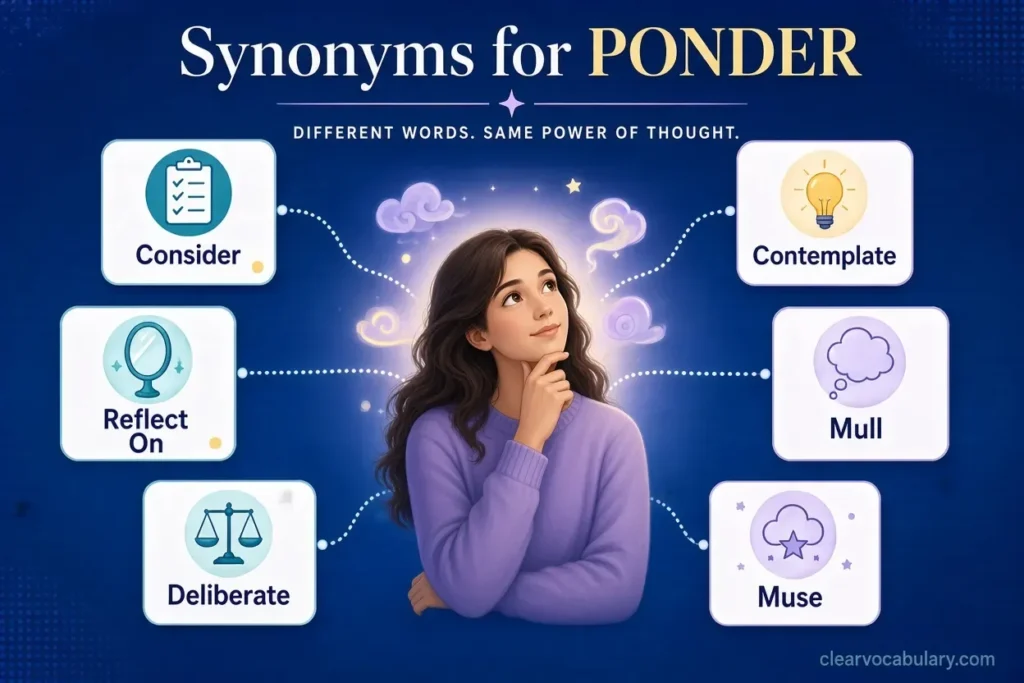
These alternatives are grouped by the kind of thinking they describe, so you can pick the right one.
Close synonyms (general careful thinking)
- Consider: to think about something before deciding. Please consider my proposal.
- Think about / think over: the plainest everyday option. I need to think it over.
- Reflect on: to think back on something, often past events or experiences. She reflected on the year.
- Contemplate: to think about something deeply, sometimes for a long time. He contemplated a career change.
Informal alternatives
- Mull over: to think about something slowly and thoroughly. I’ll mull it over tonight.
- Chew over: to think about something at length, often with a problem. They chewed it over for hours.
- Turn over (in your mind): to think about something from several angles.
Formal alternatives
- Deliberate: to think carefully, often before a formal decision. The jury deliberated for two days.
- Cogitate: a formal, sometimes humorous word for thinking hard. He cogitated on the problem.
- Meditate on: to think deeply and quietly about one subject.
Dreamy or reflective alternatives
- Muse: to think in a quiet, absorbed way, often without a fixed goal. She mused about her childhood.
Weighing a decision
- Weigh (up): to compare options or pros and cons. He weighed up the risks.
Negative or repetitive thinking
- Ruminate: to think about something over and over, sometimes in an unproductive way.
- Brood: to think about something unhappy for a long time.
Related but not true synonyms
- Wonder about: to be curious, not necessarily to think hard. It is lighter than ponder.
- Speculate: to guess without firm evidence. It does not mean careful thought.
- Analyze: to examine in detail, which is more technical than reflective.
Synonym Comparison Table
| Word | Meaning | Tone / Context | Example |
|---|---|---|---|
| Consider | Think about before deciding | Neutral, everyday and formal | Consider the costs first. |
| Contemplate | Think deeply, often at length | Serious, formal | She contemplated moving abroad. |
| Reflect on | Think back or think seriously | Thoughtful, personal | He reflected on his mistakes. |
| Mull over | Think slowly and thoroughly | Casual | I’m still mulling it over. |
| Deliberate | Weigh carefully before deciding | Formal, official | The board deliberated all day. |
| Muse | Think quietly and dreamily | Literary, gentle | He mused about the past. |
| Ruminate | Think repeatedly about something | Can be negative | She ruminated on the argument. |
| Brood | Dwell on something unhappy | Negative | He brooded for days. |
Which Word Should You Use?
- In conversation: think about or mull over sounds natural. “Let me mull it over” is friendly and relaxed.
- In formal or academic writing: contemplate, reflect on, or consider sounds more suitable.
- For a decision with options: weigh, consider, or deliberate highlight the comparing.
- For emotional or past events: reflect on works well. Use brood only when the mood is unhappy.
- In creative writing: muse adds a quiet, literary feel.
In many sentences, ponder itself is the best fit when you want to suggest careful, unhurried thought.
Sentence Transformations
Original: She pondered whether to accept the job.
Alternative: She considered whether to accept the job. (more neutral)
Original: He pondered the meaning of the poem.
Alternative: He reflected on the meaning of the poem. (more personal)
Original: They pondered their next move.
Alternative: They mulled over their next move. (more casual)
Grammar and Word Forms
| Word | Part of Speech | Word Forms | Grammar / Use | Example |
|---|---|---|---|---|
| ponder | Verb | ponder, ponders, pondered, pondered, pondering | Used with or without an object; often followed by over or on | She pondered the question. |
| pondering | Noun / verb form | pondering, ponderings | Can name the act of thinking | His ponderings filled a notebook. |
Word Formation
Related words in the same family include:
ponder → ponderous → ponderously
- Ponderous (adjective) usually means heavy, slow, or dull, not “thoughtful,” so be careful with it.
- Imponderable means something that cannot be measured or properly assessed. It is often used as a noun, as in “life’s imponderables.”
READ MORE 👉: Ocean Synonyms: Better Words by Meaning and Context
Pronunciation
| Word | Syllables | Pronunciation |
|---|---|---|
| ponder | 2 (pon-der) | UK: /ˈpɒndə/ · US: /ˈpɑːndər/ |
The stress falls on the first syllable: PON-der.
Etymology / Word History
Ponder comes from the Latin verb ponderare, meaning “to weigh,” which is related to pondus, meaning “weight.” It reached English through Old French. The idea of weighing explains the modern meaning well: when you ponder, you weigh a question in your mind. Words like ponderous and imponderable come from the same source.
Common Collocations and Expressions
- ponder the question / the meaning / the options
- ponder over / ponder on a decision
- ponder the future
- stop to ponder
- ponder long and hard
- ponder one’s next move
Real-Life Examples
- Before signing the lease, Hana took a weekend to ponder her options.
- The students were asked to contemplate how technology has changed communication.
- I’ll mull it over and let you know on Monday.
- After the meeting, the committee deliberated before announcing its decision.
- He often mused about what life might have been like in another city.
Common Mistakes
❌ Incorrect: She pondered about a solution quickly and moved on.
✅ Correct: She pondered a solution. (or: She pondered over a solution.)
Ponder usually takes a direct object or over/on. “Ponder about” is less standard.
❌ Incorrect: He gave a ponderous reply, so I knew he’d thought about it.
✅ Correct: He gave a thoughtful reply, so I knew he’d thought about it.
Ponderous means heavy, slow, or laboured. It does not mean “thoughtful.”
❌ Incorrect: She brooded about whether to take the job.
✅ Correct: She pondered whether to take the job.
Brood suggests unhappy dwelling, so it does not suit a neutral decision.
Antonyms of Ponder
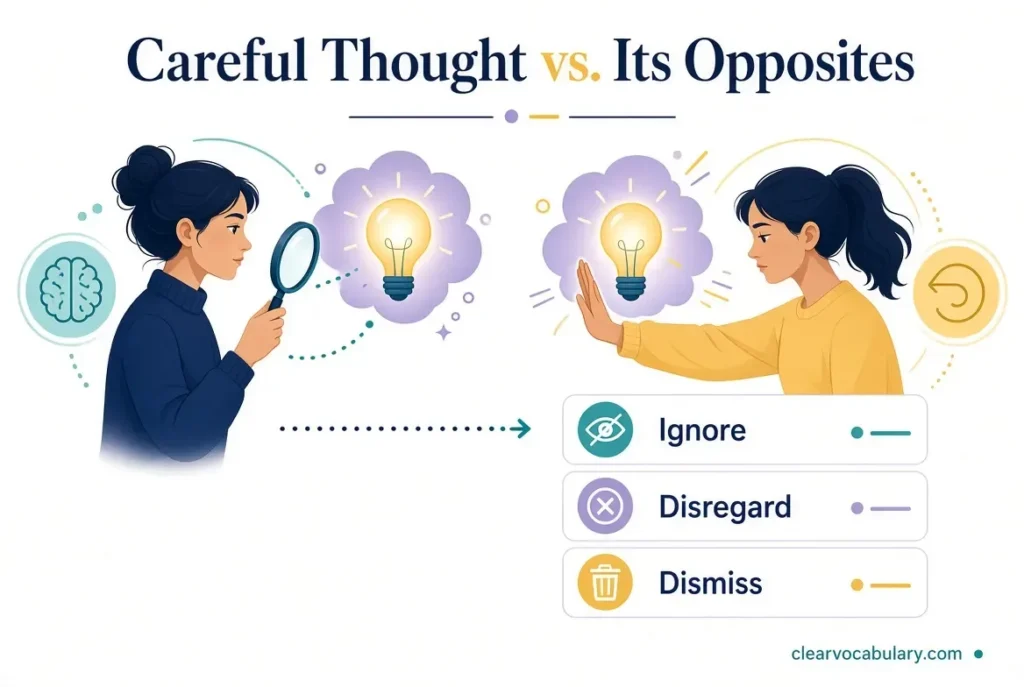
- Ignore: to pay no attention. He ignored the warning.
- Disregard: to treat as unimportant. She disregarded their advice.
- Dismiss: to put aside quickly. They dismissed the idea.
- Overlook: to fail to notice or consider.
There is no single perfect opposite, so choose the one that matches the sentence. Acting without thinking is sometimes described as acting on impulse.
Practice: Choose the Correct Word
1. The jury will ______ for several hours before reaching a verdict.
a) muse b) deliberate c) brood
2. “I need some time to ______ it over,” she said.
a) mull b) ignore c) dismiss
3. He ______ for days about the mistake he made, unable to move on.
a) considered b) brooded c) weighed
4. The philosopher sat quietly and ______ about the nature of time.
a) deliberated b) chewed c) mused
Answers
- b) deliberate: it fits formal group decisions like a jury’s.
- a) mull: “mull it over” is a fixed casual phrase.
- b) brooded: unhappy, repeated thinking.
- c) mused: quiet, absorbed thought without a fixed goal.
FAQs
What is the best synonym for ponder?
Consider and contemplate are the most useful. Consider is more everyday, and contemplate is deeper and more formal.
Is ponder formal or informal?
It sits in the middle. It is common in writing and speech but sounds a little more thoughtful than “think about.”
What is the difference between ponder and contemplate?
Both mean thinking carefully. Contemplate often suggests deeper, longer, or more serious thought, and can also mean “look at thoughtfully.” Ponder focuses on weighing a question or decision.
Is “ponder over” correct?
Yes. Ponder over and ponder on are both used. Ponder can also take a direct object without a preposition.
What does ponderous mean?
It usually means heavy, slow, or tediously dull, as in “a ponderous speech.” It is not the adjective for someone who ponders.
What is the opposite of ponder?
Common opposites are ignore, disregard, and dismiss, depending on the context.
How do you pronounce ponder?
It has two syllables, with stress on the first: PON-der.
Conclusion
Ponder describes slow, careful thinking. Choose consider or think about for everyday use, mull over for a casual tone, contemplate, reflect on, or deliberate for formal writing, and muse for a quiet, dreamy tone. Save ruminate and brood for thinking that repeats or turns gloomy. Matching the word to the kind of thinking makes your writing clearer and more natural.