

The best synonyms for aggressive depend on the meaning: use hostile, belligerent, or combative for attacking behavior; assertive, forceful, or driven for determined action; and pushy or domineering when someone is overly forceful with others.
Looking for the right aggressive synonyms can be tricky because aggressive does not always mean angry or violent. It can describe hostile behavior, but it can also mean determined, forceful, ambitious, or highly energetic.
For example, an aggressive driver may be dangerous, while an aggressive business strategy may simply be bold and ambitious.
This guide explains the different meanings of aggressive, groups the most useful alternatives by meaning, and shows you which word works best in different situations.
Quick Answer
| Meaning of “Aggressive” | Best Synonyms | Example |
|---|---|---|
| Hostile or attacking | hostile, belligerent, combative | His behavior became hostile. |
| Forceful or determined | assertive, forceful, driven | She took a forceful approach. |
| Pushy or overbearing | pushy, domineering, bullying | His pushy behavior annoyed the team. |
| Intense or extreme | intense, vigorous, hard-hitting | The company used an aggressive strategy. |
Important: These words are not always interchangeable. The best synonym depends on the exact context.
What Does “Aggressive” Mean?
Aggressive is an adjective that generally describes behavior, action, or an approach that is unusually forceful.
It has several common meanings.
1. Hostile or Ready to Attack
In its most negative sense, aggressive describes someone who is angry, threatening, confrontational, or willing to fight.
Example:
The man became aggressive after the argument.
Here, hostile, belligerent, or combative may be better alternatives.
2. Forceful or Determined
In business, sports, and other goal-oriented contexts, aggressive can describe someone or something highly determined to succeed.
Example:
The company adopted an aggressive expansion strategy.
Here, words such as forceful, driven, ambitious, or bold may fit better.
3. Pushy or Overbearing
Sometimes aggressive describes someone who tries too strongly to control, persuade, or influence other people.
Example:
The salesperson was too aggressive.
Depending on the intended meaning, pushy, overbearing, or domineering may be more precise.
4. Intense or Extreme
In technical, business, medical, or strategic contexts, aggressive can mean unusually strong, intensive, or rapid.
Example:
The doctors recommended an aggressive treatment plan.
Here, intensive or vigorous may sometimes be more appropriate, depending on the context.
Synonyms for Aggressive by Meaning
1. Aggressive = Hostile or Attacking
Use these words when aggressive refers to anger, conflict, threats, or readiness to fight.
- Hostile: unfriendly and opposed to someone or something.
- Belligerent: openly hostile and ready to fight.
- Combative: eager to argue, fight, or engage in conflict.
- Confrontational: likely to create or directly engage in conflict.
- Antagonistic: actively opposed or unfriendly.
- Pugnacious: naturally inclined to fight or argue.
- Bellicose: strongly warlike or eager to fight.
- Quarrelsome: frequently arguing or looking for disputes.
- Contentious: likely to cause or become involved in arguments.
- Truculent: aggressively defiant or harsh.
Example:
His aggressive response made the discussion worse.
Possible alternatives:
- His hostile response made the discussion worse.
- His confrontational response made the discussion worse.
- His combative response made the discussion worse.
2. Aggressive = Forceful, Determined, or Ambitious
When aggressive means energetic, confident, or strongly motivated, these alternatives are usually more positive.
- Assertive: confident and direct without being hostile.
- Forceful: strong and effective in action or expression.
- Driven: strongly motivated to achieve a goal.
- Ambitious: strongly determined to achieve success.
- Competitive: eager to win or outperform others.
- Enterprising: willing to take initiative and pursue opportunities.
- Proactive: taking action instead of waiting for something to happen.
- Bold: willing to take risks or act confidently.
- Dynamic: energetic and active.
- Vigorous: showing strong energy or effort.
Example:
The company has an aggressive growth strategy.
Depending on the intended tone, you could write:
- The company has an ambitious growth strategy.
- The company has a bold growth strategy.
- The company has a forceful growth strategy.
3. Aggressive = Pushy or Overbearing
These words are useful when someone is being too forceful with other people.
- Pushy: trying too hard to persuade or get something.
- Domineering: trying to control others in an overbearing way.
- Overbearing: excessively controlling or forceful.
- Bullying: using intimidation or fear to control someone.
- Bossy: constantly telling others what to do.
- Intrusive: interfering too much in other people’s affairs.
Example:
The salesperson was aggressive and kept pressuring the customer.
A more precise alternative might be:
The salesperson was pushy and kept pressuring the customer.
4. Aggressive = Intense or Extreme
In some contexts, aggressive means unusually strong, intensive, or highly active.
Useful alternatives include:
- Intense
- Vigorous
- Forceful
- Hard-hitting
- Intensive
- Strong
- Rapid, when the context specifically involves speed or expansion
Example:
The company pursued an aggressive expansion strategy.
A context-specific alternative could be:
The company pursued a rapid expansion strategy.
However, rapid is not a direct synonym for aggressive in every situation. It only works when the intended meaning involves speed.
Related but Not Exact Synonyms
Some words are closely associated with aggressive but should not automatically be treated as exact synonyms.
| Word | How It Differs |
|---|---|
| Domineering | Focuses on controlling others rather than attacking them. |
| Bullying | Specifically involves intimidation or abuse of power. |
| Militant | Often describes aggressive support for a cause or political position. |
| Offensive | Can mean attacking in a military or strategic sense, but also has other meanings. |
| Bold | Focuses on confidence or willingness to take risks, not hostility. |
| Proactive | Means taking initiative and is generally positive. |
| Competitive | Focuses on the desire to win rather than hostility. |
| Intense | Describes strength or degree, not necessarily aggression. |
This distinction is important because using a related word as an exact synonym can change the meaning of a sentence.
Aggressive Synonyms Comparison Table
| Word | Core Meaning | Tone | Best Context |
|---|---|---|---|
| Hostile | Unfriendly and opposed | Negative | Conflict, behavior |
| Belligerent | Warlike and ready to fight | Strongly negative | Conflict, arguments |
| Combative | Ready to fight or argue | Negative | People, discussions |
| Confrontational | Directly engaging in conflict | Negative | Communication, behavior |
| Assertive | Confident and direct | Positive/neutral | Workplace, communication |
| Forceful | Strong and effective | Neutral/positive | Leadership, speech |
| Driven | Highly motivated | Positive | Careers, goals |
| Pushy | Too forceful in persuading | Negative | Sales, personality |
| Domineering | Controlling and overbearing | Negative | Personality, leadership |
| Competitive | Eager to win | Neutral/positive | Business, sports |
Which Word Should You Use?
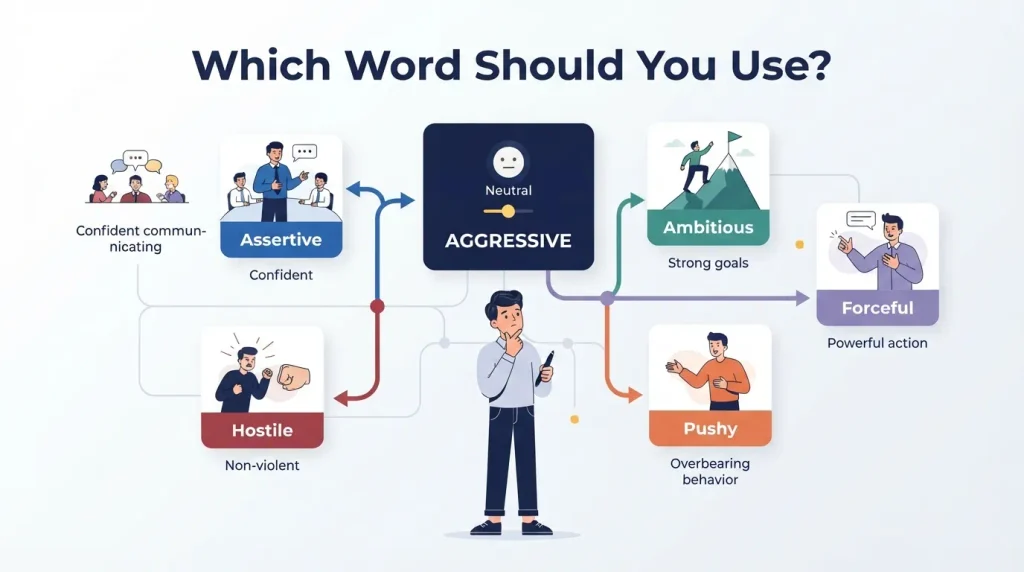
Choose the synonym based on what you actually want to communicate.
For angry or threatening behavior
Use:
hostile, belligerent, combative, confrontational
His aggressive behavior worried everyone.
→ His hostile behavior worried everyone.
For confident communication
Use:
assertive
She was aggressive during the meeting.
If you mean she expressed her opinions confidently but respectfully:
→ She was assertive during the meeting.
For strong leadership or action
Use:
forceful, decisive, driven
The manager took an aggressive approach.
→ The manager took a forceful approach.
For business goals
Use:
ambitious, competitive, bold, driven
The company has an aggressive growth plan.
→ The company has an ambitious growth plan.
For excessive pressure
Use:
pushy, overbearing, domineering
The salesperson was aggressive.
→ The salesperson was pushy.
Aggressive vs. Assertive
Aggressive and assertive are often confused, but they are not the same.
| Aggressive | Assertive |
|---|---|
| May involve hostility | Usually respectful |
| Can intimidate others | Respects other people’s boundaries |
| May involve anger | Usually calm and confident |
| Focuses strongly on getting one’s way | Expresses needs clearly |
| Often has a negative tone | Usually positive or neutral |
Example:
She was aggressive and interrupted everyone.
versus
She was assertive and clearly explained her position.
A person can be assertive without being aggressive.
Grammar and Word Forms
| Word | Part of Speech | Meaning |
|---|---|---|
| aggressive | Adjective | Showing aggression or strong force |
| aggressively | Adverb | In an aggressive manner |
| aggression | Noun | Hostile or forceful behavior |
| aggressiveness | Noun | The quality or tendency of being aggressive |
| aggressor | Noun | A person or group that attacks first |
Examples:
- He has an aggressive personality.
- The company marketed the product aggressively.
- The argument escalated into aggression.
- Her aggressiveness made negotiations difficult.
- The aggressor was identified by witnesses.
Word Formation
The word aggressive is related to Latin aggredi, meaning “to go toward,” “approach,” or “attack.”
The word family includes:
- aggressive
- aggressively
- aggression
- aggressiveness
- aggressor
The original idea of moving toward something developed into the modern meanings associated with attacking, confronting, or acting forcefully.
Read more 👉: Aware Synonyms in English: Meanings, Alternatives, and Examples
Pronunciation and Syllables
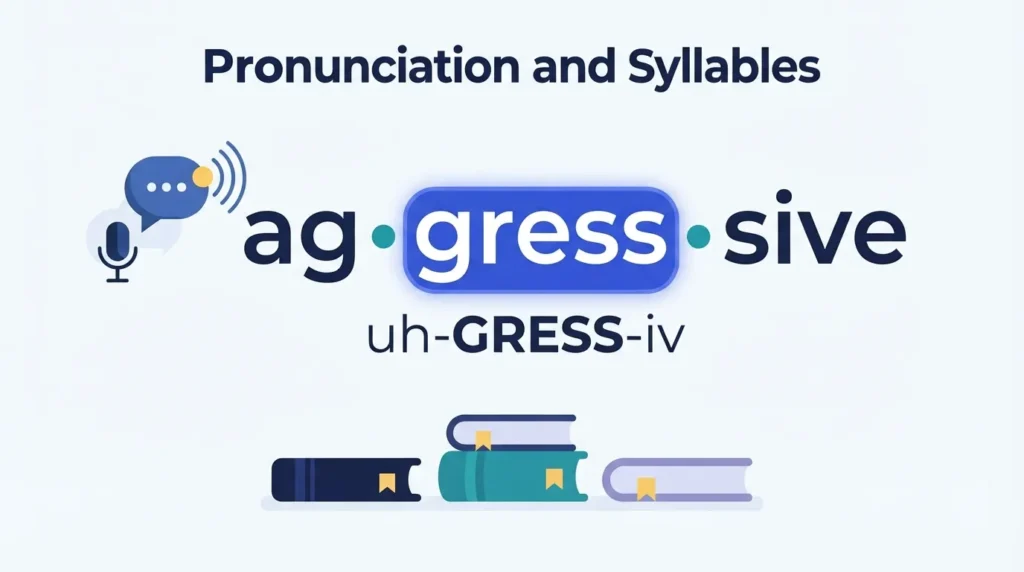
| Word | Syllables | Pronunciation (IPA) | Simple Guide |
|---|---|---|---|
| aggressive | 3 | /əˈɡrɛsɪv/ | uh‑GRES‑iv |
| aggression | 3 | /əˈɡrɛʃən/ | uh‑GRESH‑uhn |
| aggressor | 3 | /əˈɡrɛsər/ | uh‑GRES‑er |
Stress falls on the second syllable: uh‑GRES‑ive.
Etymology and Word History
Aggressive comes through French from Latin roots associated with aggredi, meaning “to go toward,” “approach,” or “attack.”
Over time, the word developed from the idea of moving toward someone to the broader meanings of attacking, confronting, or acting with unusual force.
Today, aggressive can describe both negative behavior and strong, ambitious action, depending on context.
Contextual Usage
The best synonym changes according to the situation.
Everyday conversation
Common choices include:
aggressive, hostile, pushy, assertive
Academic or formal writing
More precise choices include:
hostile, antagonistic, belligerent, confrontational, forceful
Workplace communication
Consider:
assertive, proactive, driven, forceful, competitive
Business and marketing
Common terms include:
aggressive, ambitious, competitive, bold, hard-hitting
Sports
Useful alternatives include:
competitive, forceful, intense, hard-hitting
Politics and public affairs
Depending on context:
confrontational, militant, forceful, hard-hitting, hostile
Common Collocations with Aggressive
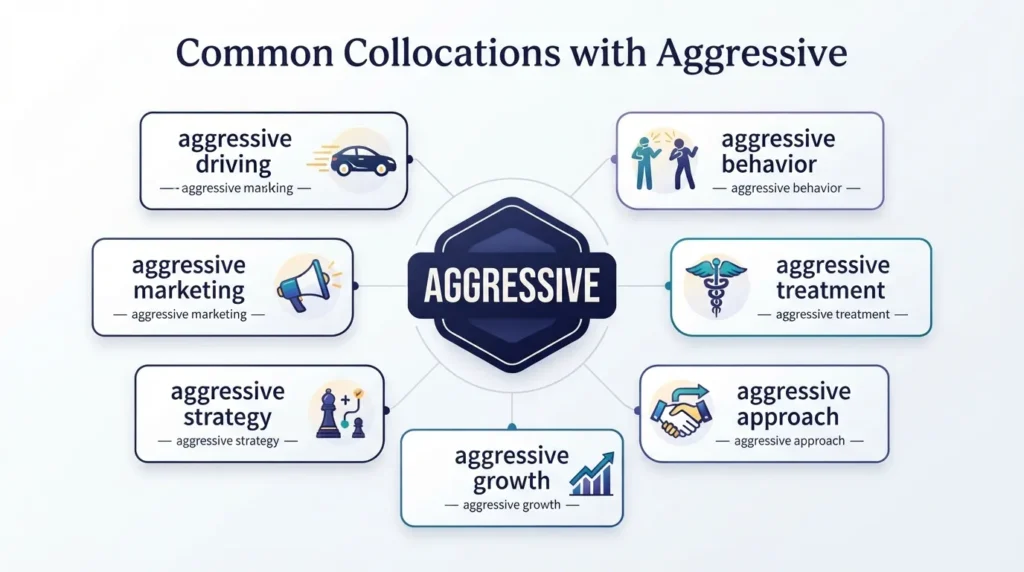
These common combinations help show how aggressive is naturally used.
- aggressive behavior
- aggressive tone
- aggressive attitude
- aggressive driving
- aggressive marketing
- aggressive pricing
- aggressive strategy
- aggressive campaign
- aggressive expansion
- aggressive growth
- aggressive approach
- aggressive stance
- aggressive treatment
- aggressive questioning
- aggressive competition
Notice that the meaning changes with the noun.
Aggressive driving usually has a negative meaning.
Aggressive marketing can mean highly forceful or ambitious marketing.
Aggressive treatment can refer to intensive medical treatment.
Real Life Examples

Hostile behavior
The driver became aggressive after the minor collision.
Better synonym:
The driver became hostile after the minor collision.
Conflict
His aggressive response ended the discussion.
Better synonym:
His confrontational response ended the discussion.
Workplace communication
She was aggressive during the meeting.
If she was confident but respectful:
She was assertive during the meeting.
Business
The company launched an aggressive expansion plan.
Possible alternative:
The company launched an ambitious expansion plan.
Sales
The salesperson used aggressive tactics.
If the meaning is excessive pressure:
The salesperson used pushy tactics.
Sports
The team played aggressively in the second half.
Possible alternatives:
The team played forcefully in the second half.
or
The team played intensely in the second half.
Sentence Transformations
Here are examples of how the best synonym changes the tone.
Original:
The company uses aggressive marketing tactics.
Alternative:
The company uses forceful marketing tactics.
Effect: Slightly less negative.
Original:
He was aggressive while defending his position.
Alternative:
He was combative while defending his position.
Effect: Emphasizes conflict and argument.
Original:
She is aggressive about reaching her goals.
Alternative:
She is driven to reach her goals.
Effect: Creates a more positive impression.
Original:
The salesperson was aggressive with customers.
Alternative:
The salesperson was pushy with customers.
Effect: Emphasizes excessive persuasion.
Common Mistakes
1. Using “aggressive” when you mean “assertive”
❌ She was aggressive because she calmly explained what she needed.
✅ She was assertive because she calmly explained what she needed.
Assertive is better when someone communicates confidently without hostility.
2. Using “aggressive” when you mean “proactive”
❌ The company took an aggressive approach to helping customers.
If you mean the company acted early and took initiative:
✅ The company took a proactive approach to helping customers.
3. Treating every synonym as interchangeable
Words such as hostile, assertive, pushy, and driven describe different qualities.
For example:
- hostile = unfriendly or threatening
- assertive = confident and direct
- pushy = excessively persuasive
- driven = highly motivated
Choosing the wrong word can change the meaning of the sentence.
British English vs. American English
There is no major difference in the meaning or spelling of aggressive between British and American English.
Both varieties use the word for:
- hostile behavior
- forceful action
- ambitious strategies
- intense approaches
The meaning is determined mainly by context rather than regional variety.
Antonyms of Aggressive
The opposite of aggressive depends on the meaning.
When aggressive means hostile
Possible antonyms include:
- peaceful
- calm
- gentle
- nonaggressive
- passive
- conciliatory
Example:
He remained calm even when the other person became aggressive.
When aggressive means forceful or ambitious
Possible opposites include:
- passive
- timid
- unassertive
- cautious
- laid-back
- easygoing
Example:
The company took a cautious approach instead of an aggressive one.
Practice: Choose the Best Word
1.
She calmly explained her needs without insulting anyone. She was:
a) belligerent
b) assertive
c) hostile
2.
After the decision, several fans began shouting threats. They became:
a) aggressive
b) proactive
c) enterprising
3.
The company wants a highly ambitious strategy for entering new markets.
a) quarrelsome
b) aggressive
c) pugnacious
4.
His controlling style made his employees uncomfortable.
a) driven
b) domineering
c) competitive
5.
The salesperson kept pressuring customers to buy.
a) peaceful
b) pushy
c) timid
Answers
- b) assertive: confident and direct without being hostile.
- a) aggressive:the fans were behaving in an angry and threatening way.
- b) aggressive : here it means highly ambitious or forceful.
- b) domineering: focused on controlling others.
- b) pushy : describes excessive pressure or persuasion.
Frequently Asked Questions
What are the best synonyms for aggressive behavior?
The strongest choices include hostile, belligerent, combative, confrontational, and antagonistic.
What are positive synonyms for aggressive?
When aggressive means ambitious or determined, consider assertive, forceful, driven, ambitious, competitive, proactive, or enterprising.
Is assertive the same as aggressive?
No. Assertive means confidently expressing yourself while respecting others. Aggressive often suggests hostility, intimidation, or excessive force.
What is a stronger word than hostile?
Belligerent is often stronger than hostile because it suggests a more openly warlike or confrontational attitude.
Can aggressive have a positive meaning?
Yes. In business, sports, and strategy, aggressive can mean bold, ambitious, competitive, or highly determined rather than angry.
What is the noun form of aggressive?
The main noun forms are aggression and aggressiveness.
What is a polite alternative to aggressive?
It depends on the situation. Assertive, forceful, direct, or proactive can be more positive alternatives.
What is the difference between aggressive and assertive?
Aggressive can involve hostility or intimidation, while assertive means being confident and direct without being hostile.
What are aggressive synonyms for formal writing?
Depending on the context, useful choices include hostile, antagonistic, belligerent, confrontational, forceful, and assertive.
Conclusion
The best aggressive synonym depends on what you mean.
For hostile or attacking behavior, use words such as hostile, belligerent, combative, or confrontational.
For confident and determined action, choose assertive, forceful, driven, ambitious, or competitive.
For someone who is too forceful with others, words such as pushy, domineering, or overbearing are more precise.
The key is not simply to find a word that looks similar to aggressive. Choose the word that communicates the exact meaning and tone you want.