

The most common synonyms for hobby are pastime, interest, pursuit, leisure activity, and recreation. Each one fits a slightly different situation, so the best choice depends on how serious, casual, or formal you want to sound.
A hobby is something you do for enjoyment in your free time, and that idea is flexible enough to be described in many ways. This guide groups hobby synonyms by meaning, explains their tone, and shows which word works best in everyday speech, formal writing, and résumés.
Meaning of Hobby
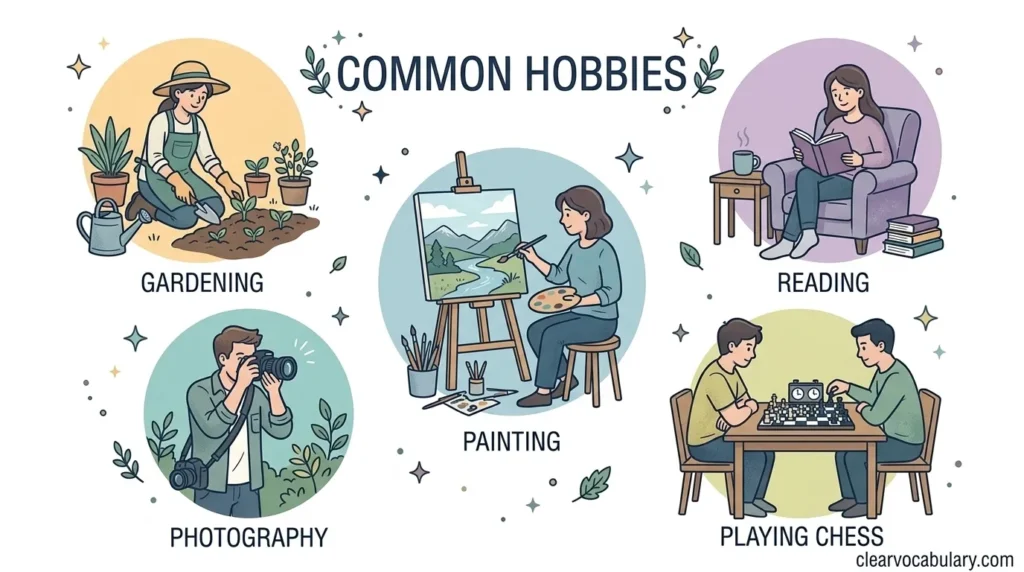
A hobby (noun) is an activity a person does regularly for pleasure rather than as a main job. Typical examples include gardening, painting, chess, hiking, and collecting coins.
She took up pottery as a hobby after retiring.
Prototype Meaning
The central idea of hobby is a voluntary, enjoyable activity in spare time. Most people picture something personal and ongoing, such as knitting, photography, or playing guitar, that they choose because they like it.
Connotative Meaning
Hobby usually sounds light, friendly, and neutral. It suggests enjoyment without pressure. It can sound slightly casual or even dismissive when used about something a person takes seriously (“It’s not just a hobby to me”). That is why words like passion, pursuit, or craft are sometimes better choices.
Hobby Synonyms Grouped by Meaning
Everyday alternatives
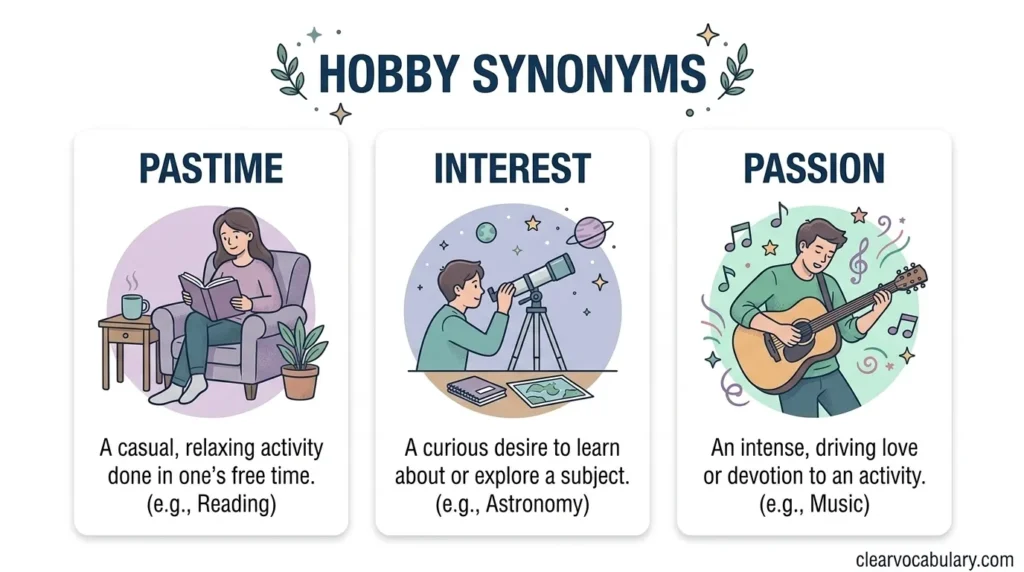
Pastime. An activity you do to pass free time pleasantly. It is the closest everyday synonym and often sounds relaxed. Reading is her favorite pastime.
Interest. A subject or activity you enjoy and pay attention to. It is broader than hobby and does not always involve regular practice. His interests include astronomy and cycling.
Leisure activity. A neutral, descriptive phrase for anything done in free time. It is common on forms, surveys, and in reports. Walking is the most popular leisure activity in the survey.
Recreation. Activity done for enjoyment, often active or social. It appears in phrases like outdoor recreation and recreation center. The park offers recreation for all ages.
More formal or literary alternatives
Pursuit. An activity followed with some effort or commitment. It sounds more serious than hobby, as in intellectual pursuits or outdoor pursuits.
Diversion. Something that takes your mind off work or worry. It is slightly formal. Crossword puzzles were a pleasant diversion on long trips. Note that diversion can also mean a detour or a distraction, so context matters.
Amusement. Something that entertains, usually lighter and more playful. Card games were their main amusement in the evenings. It can also mean the feeling of being amused.
Avocation. A formal, less common word for an activity pursued for enjoyment alongside a main job. It is the counterpart of vocation. He was a banker by profession and a violinist by avocation.
Words for a deeper commitment
Passion. A strong enthusiasm for an activity. It is stronger than hobby. Baking started as a hobby but became her passion.
Craft. A hobby that involves making things by hand, such as knitting, woodworking, or pottery. It is specific, so it does not replace hobby in general use. She spends weekends on her craft.
Creative outlet. A phrase for an activity that lets you express creativity. Journaling is his creative outlet.
Context-specific words
Sideline. An activity done in addition to a main job, often to earn extra money. It is not always done for fun, so it is not a general synonym. She sells handmade candles as a sideline.
Hobbyhorse. A figurative word for a favorite topic someone keeps returning to. It is informal and does not mean the activity itself. Public transport is his hobbyhorse. It is related to the word hobby, but it is not a true synonym.
Quick Comparison Table
| Word | Meaning | Tone or Context | Example |
|---|---|---|---|
| Pastime | Activity to pass free time | Casual, common | Fishing is a quiet pastime. |
| Interest | Subject or activity you enjoy | Neutral, résumés | Her main interest is history. |
| Leisure activity | Any free-time activity | Neutral, formal | Swimming is a popular leisure activity. |
| Recreation | Activity for enjoyment | Neutral, active or social | The town funds public recreation. |
| Pursuit | Activity followed with effort | Formal, serious | He enjoys scholarly pursuits. |
| Avocation | Non-work activity done for love | Very formal, uncommon | Gardening is her avocation. |
| Sideline | Extra activity beside main job | Business or practical | He repairs bikes as a sideline. |
| Passion | Strong enthusiasm | Emotional, strong | Music is his passion. |
Which Word Should You Use?
- In conversation: hobby, pastime, or interest all sound natural.
- On a résumé or application: interests or leisure activities are safe, professional choices.
- In formal or academic writing: pursuit, recreation, or, rarely, avocation suit the tone.
- For something you take seriously: passion or craft shows more commitment than hobby.
- For something that earns money: sideline is accurate, while hobby usually implies no income.
Read More 👉: Exist Synonyms: 25+ Alternatives With Meanings
Grammar and Word Forms
| Word | Part of Speech | Word Forms | Grammar or Use | Example |
|---|---|---|---|---|
| hobby | noun | hobbies (plural) | Countable | Painting is a relaxing hobby. |
| hobbyist | noun | hobbyists (plural) | A person who pursues a hobby | Many hobbyists build model trains. |
| pastime | noun | pastimes (plural) | Countable, written as one word | Chess is a popular pastime. |
Hobby can also work like an adjective before a noun, as in hobby farm or hobby shop.
Pronunciation and Syllables
Hobby has two syllables: hob-by, with stress on the first.
| Variety | IPA |
|---|---|
| British English | /ˈhɒbi/ |
| American English | /ˈhɑːbi/ |
Word History
Hobby is usually traced to the Middle English word hobyn, a name for a small horse. From this came hobby-horse, first a toy or costume horse and later a figure of speech for a favorite pastime or topic. The shortened form hobby eventually took over the pastime meaning. This also explains why hobbyhorse still means a pet subject today.
Sentence Transformations
Original: Her hobby is painting landscapes.
Alternative: Painting landscapes is her favorite pastime.
The meaning stays the same, with a slightly more relaxed tone.
Original: He has a hobby of collecting stamps.
Alternative: Stamp collecting is one of his main interests.
Interest is broader and does not imply regular activity.
Original: She sells jewelry she makes at home as a hobby.
Alternative: She sells jewelry she makes at home as a sideline.
The meaning changes: sideline suggests earning money, which hobby usually does not.
Original: Hiking is my hobby.
Alternative: Hiking is my passion.
This sounds stronger and more emotional.
Common Mistakes
❌ Incorrect: My favorite past time is reading.
✅ Correct: My favorite pastime is reading.
Pastime is one word. Past time means an earlier period.
❌ Incorrect: My hobbies are play football and swim.
✅ Correct: My hobbies are playing football and swimming.
After is or are, use the -ing form or a noun.
❌ Incorrect: Biting my nails is my hobby.
✅ Correct: Biting my nails is a habit.
A habit is something done automatically. A hobby is chosen for enjoyment.
Antonyms of Hobby
Hobby has no single exact opposite, but these words contrast with it:
- Work: activity done for payment or duty.
- Job, occupation, profession, career: paid roles.
- Chore, duty, obligation: tasks you must do rather than choose.
These are contrasts in purpose, not strict opposites. A hobby can turn into a career, and a career can become a passion.
Practice Questions
- Which word is more formal: pastime or avocation?
- Which word suits an activity that earns extra income: sideline or recreation?
- Choose the correct spelling: past time or pastime (as a hobby).
- Which word is stronger in feeling: interest or passion?
Answers: 1. Avocation, which is rarer and more formal. 2. Sideline. 3. Pastime. 4. Passion.
FAQs
What is another word for hobby?
Common alternatives are pastime, interest, pursuit, leisure activity, and recreation.
Is pastime the same as hobby?
They are very close. Pastime often sounds more casual and does not always suggest regular practice.
What is the difference between a hobby and an interest?
An interest is something you enjoy thinking about or learning about. A hobby usually involves actually doing something regularly.
What is a formal word for hobby?
Pursuit and leisure activity are formal and natural. Avocation is more formal still but uncommon.
What should I write instead of “hobbies” on a résumé?
Interests or leisure activities are the usual choices.
Can a hobby be a sideline?
Yes, when you start earning money from it. Until then, sideline is not the best word.
Conclusion
Use hobby when you want a simple, friendly word, and reach for pastime, interest, or leisure activity for natural variety. Choose pursuit or avocation for a formal tone, passion for deeper commitment, and sideline when money is involved. Matching the word to the situation is what makes your writing sound precise.