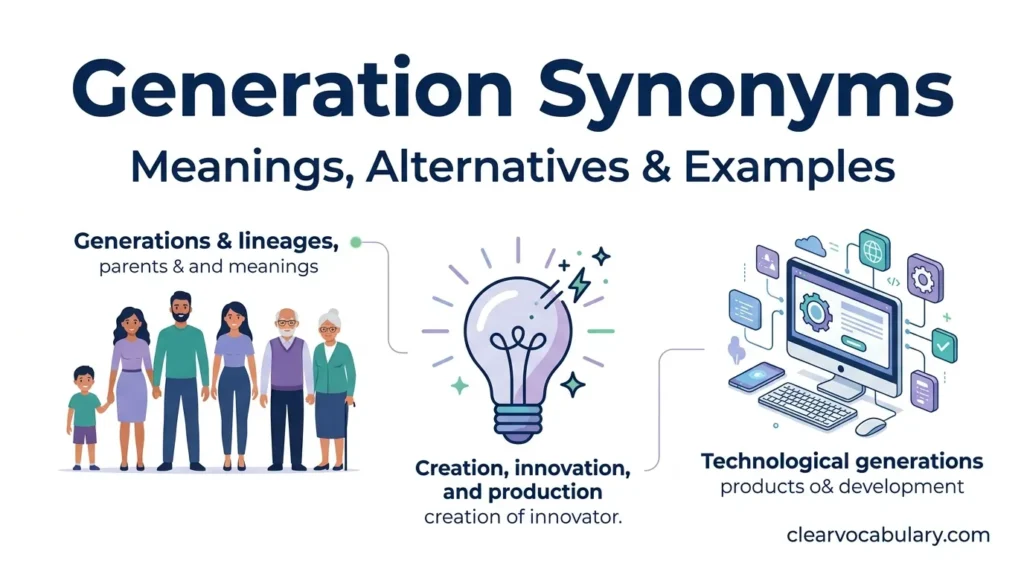

Generation refers to a group of people born around the same time or the process of producing something new.
The word generation can describe people born around the same time, the process of producing something, or a stage in the development of technology. For example, you might talk about the younger generation, the generation of electricity, or a new generation of computers. However, the best synonym depends on what you want to express.
Words such as age group, production, creation, and reproduction can replace generation in certain contexts. Other alternatives, such as offspring and lineage, are more suitable when discussing families and descendants. Understanding these differences helps you choose words that fit your meaning.
In this guide, you will learn 30 generation synonyms, their meanings, and examples of how to use them. You will also explore the word’s origin, pronunciation, related forms, antonyms, and common usage differences.
Meaning of Generation
Generation (noun): A group of people born or living around the same time, the period between successive generations, or the process of producing or bringing something into existence.
The exact meaning depends on the context. In family discussions, generation often refers to people of a similar age or family descent. In science and business, it can describe reproduction, production, or the creation of something new. It can also refer to a group of products at the same stage of technological development.
Examples of Generation
- The younger generation is learning to use new technologies.
- Solar power generation is increasing in many countries.
- This is the latest generation of smartphones.
Connotative Meaning of Generation
The word generation is generally neutral. It identifies an age group, a stage of development, or a process without automatically expressing approval or criticism.
- Positive: “The next generation of leaders” may suggest hope and progress.
- Negative: “A lost generation” can suggest hardship, disappointment, or missed opportunities.
- Neutral: “Three generations attended the family gathering” simply describes family members of different ages.
The emotional tone comes from the surrounding words and context.
Etymology of Generation
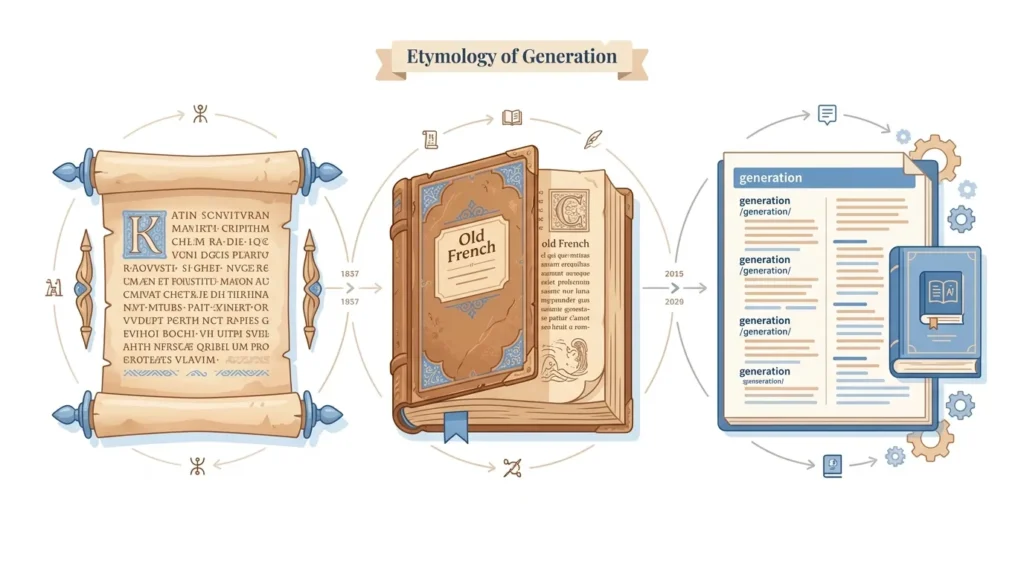
The word generation entered English through Old French generacion and Latin generatio, meaning birth, reproduction, or the act of producing. The Latin word comes from generare, meaning “to beget” or “to produce,” which is related to genus, meaning kind, race, or stock.
The word developed from its earlier associations with birth and reproduction to include broader ideas such as a group of people born around the same period, a stage in a family line, and the production of energy or other things.
Historical Development
- Old English period (c. 450–1100): English had its own vocabulary for birth, kinship, and descent. The modern word generation is not an inherited Old English form.
- Middle English period (c. 1100–1500): The word entered English through French and was used in connection with birth, origin, and reproduction.
- Modern English (c. 1500–present): Its meanings expanded to include age groups, historical periods, the creation of things, and successive stages of technological development.
Today, generation is used in everyday conversation, family history, biology, business, energy production, and technology.
Pronunciation and Syllables of Generation
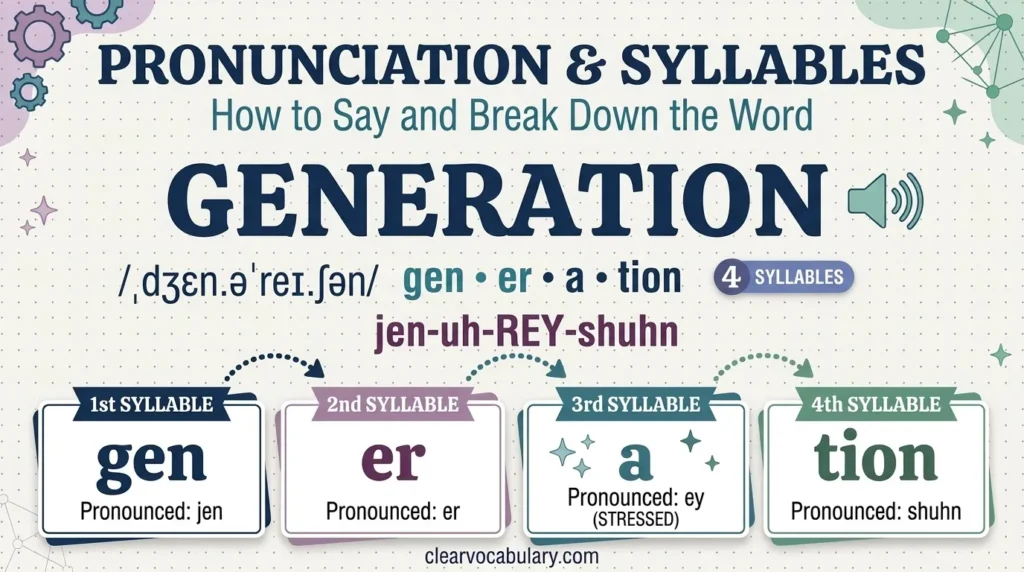
- IPA: /ˌdʒen.əˈreɪ.ʃən/
- Simple pronunciation: jen-uh-RAY-shun
- Syllables: gen-er-a-tion (four spoken syllables)
- Stress: The third syllable, “ray,” receives the main stress.
- British and American English: The standard pronunciations are broadly similar, with minor differences possible in vowel quality.
Practicing the word aloud can help you remember its stress pattern and use it naturally in conversation.
Affixation Pattern and Word Formation
The word generation belongs to a family of words related to producing, creating, and bringing something into existence.
| Word | Part of Speech | Meaning |
|---|---|---|
| Generate | Verb | To produce or create something |
| Generation | Noun | The act of producing something or a group born around the same time |
| Generated | Verb form | Produced or created |
| Generating | Verb form | Producing or creating |
| Generative | Adjective | Able to produce or create something |
| Generator | Noun | A person, device, or thing that produces something |
| Generational | Adjective | Relating to a generation or differences between generations |
| Regenerate | Verb | To renew, restore, or grow again |
Word structure: Generation is formed from the Latin word family associated with generare (“to produce or beget”), together with the suffix -ation, which forms nouns associated with actions, processes, or results.
The prefix re- in regenerate means “again.” The words generated and generating are grammatical forms of generate, while generator and generational are derived words with different functions.
Generation Synonyms: 30 Words With Meanings and Examples
The following alternatives are grouped by meaning. Some are close synonyms, while others work only in specific contexts. Choose the word that matches the intended meaning of generation.
Synonyms for Generation Meaning an Age Group
These alternatives describe people who share an approximate age range or belong to the same stage of a family or society.
1. Age Group (Noun Phrase)
Meaning: People who fall within a similar age range.
Examples:
- This age group prefers online learning.
- The survey compared different age groups.
2. Cohort (Noun)
Meaning: A group of people who share a particular characteristic or experience, such as being born during the same period.
Usage and nuance: Common in research, education, and demographics.
Examples:
- The study followed a cohort of students for five years.
- This birth cohort grew up with digital technology.
3. Peer Group (Noun Phrase)
Meaning: People of similar age, status, or experience who interact with one another.
Examples:
- Her peer group encouraged her to study.
- Teenagers are often influenced by their peer groups.
4. Age Bracket (Noun Phrase)
Meaning: A defined range of ages used to classify people.
Examples:
- Applicants must fall within the specified age bracket.
- The largest age bracket in the survey was 25 to 34.
5. Contemporaries (Noun)
Meaning: People who live or lived during the same period.
Usage and nuance: This word emphasizes sharing a historical period, not necessarily belonging to the same family or having the same age.
Examples:
- The writer was admired by her contemporaries.
- Many of his contemporaries shared similar ideas.
6. Peer Generation (Noun Phrase)
Meaning: People from approximately the same generation, especially those sharing similar experiences.
Examples:
- Her peer generation witnessed rapid technological change.
- Members of the same peer generation often share cultural references.
Synonyms for Generation Meaning Family Descent
These words relate to descendants, family connections, or the passing of life and characteristics from one generation to another.
7. Offspring (Noun)
Meaning: A person’s children or the young of an animal.
Usage and nuance: This word refers to descendants, not an entire age group.
Examples:
- The birds protect their offspring.
- The family passed its traditions to its offspring.
8. Descendants (Noun)
Meaning: People who come from a particular ancestor.
Examples:
- The descendants preserved their family’s history.
- She researched the descendants of an early settler.
9. Progeny (Noun)
Meaning: Children or descendants of a person, animal, or plant.
Usage and nuance: More formal than children or offspring.
Examples:
- The family recorded its progeny in a historical document.
- The animal’s progeny showed similar traits.
10. Lineage (Noun)
Meaning: A line of descent from an ancestor.
Examples:
- The family traced its lineage back several centuries.
- The horse came from a distinguished lineage.
11. Ancestry (Noun)
Meaning: A person’s family origins or ancestors.
Examples:
- She researched her ancestry using old records.
- His ancestry includes several generations of farmers.
12. Posterity (Noun)
Meaning: Future generations of people.
Usage and nuance: Often used when discussing what people leave for the future.
Examples:
- We must protect natural resources for posterity.
- The historian hoped the records would survive for posterity.
Synonyms for Generation Meaning Production or Creation
When generation means the act of producing something, these alternatives may fit better.
13. Production (Noun)
Meaning: The process of making or producing something.
Examples:
- Electricity production increased last year.
- The factory improved its production methods.
14. Creation (Noun)
Meaning: The act of bringing something new into existence.
Examples:
- The creation of new jobs supported the local economy.
- The artist explained the creation of her latest work.
15. Formation (Noun)
Meaning: The process of developing or bringing something into a particular shape or structure.
Examples:
- Cloud formation depends on atmospheric conditions.
- The formation of the committee took several weeks.
16. Origination (Noun)
Meaning: The beginning or source of something; the process of originating it.
Examples:
- The report examined the origination of the idea.
- The company tracks the origination of new business proposals.
17. Development (Noun)
Meaning: The process of growing, changing, or becoming more advanced.
Examples:
- The development of the vaccine took years.
- The project supports the development of new skills.
18. Production Process (Noun Phrase)
Meaning: The series of steps used to make something.
Examples:
- The production process uses less water now.
- Workers reviewed each stage of the production process.
19. Creation Process (Noun Phrase)
Meaning: The steps involved in making or developing something new.
Examples:
- The team explained its creation process.
- The creation process involved several design changes.
20. Origination Process (Noun Phrase)
Meaning: The process through which something begins or is first developed.
Examples:
- The bank reviewed its loan origination process.
- Researchers examined the origination process of the idea.
Read More👉: Aware Synonyms in English: Meanings, Alternatives, and Examples
Synonyms for Generation Meaning Reproduction
In biology, generation may refer to the process of producing offspring or new living organisms. These alternatives have more specific meanings.
21. Reproduction (Noun)
Meaning: The biological process through which living things produce offspring.
Examples:
- Reproduction allows species to continue.
- The lesson explained reproduction in flowering plants.
22. Propagation (Noun)
Meaning: The process of producing new plants or spreading organisms.
Usage and nuance: Particularly common in gardening and plant science.
Examples:
- Propagation from cuttings is common among gardeners.
- The nursery uses propagation to grow new plants.
23. Procreation (Noun)
Meaning: The biological process of producing offspring.
Examples:
- The documentary discussed procreation in mammals.
- Scientists studied the factors that affect procreation.
24. Breeding (Noun)
Meaning: The reproduction of animals or plants, often under controlled conditions.
Examples:
- Selective breeding can improve crop qualities.
- The farm specializes in horse breeding.
Synonyms for Generation Meaning a Stage of Development
In technology and product descriptions, generation often refers to a group of products developed at a similar stage.
25. Version (Noun)
Meaning: A particular form or release of a product, system, or document.
Examples:
- The latest version includes improved security.
- She installed a newer version of the software.
26. Model (Noun)
Meaning: A particular design or type of a product.
Examples:
- The new model uses less electricity.
- This model has a faster processor than the previous one.
27. Iteration (Noun)
Meaning: A new version or stage produced through repeated development and improvement.
Examples:
- The latest iteration of the app is easier to use.
- Each iteration improved the design.
28. Series (Noun)
Meaning: A group of related products, events, or items that form a sequence.
Examples:
- The company launched a new series of laptops.
- The latest series offers several improvements.
29. Successive Stage (Noun Phrase)
Meaning: One step or phase that follows another.
Examples:
- Each successive stage introduced new features.
- The technology improved at every successive stage.
30. Successor (Noun)
Meaning: A person or thing that follows another and often takes its place.
Usage and nuance: A successor may replace an earlier product or system, but the word does not mean generation in every context.
Examples:
- The new device is the successor to the earlier model.
- Engineers are developing a successor to the current system.
Quick Comparison of Generation Synonyms
| Intended Meaning | Best Alternatives | Example Context |
|---|---|---|
| People of similar ages | Age group, cohort, contemporaries | A generation of students |
| Family descent | Descendants, offspring, lineage | Several generations of a family |
| Producing something | Production, creation, formation | Generation of electricity |
| Biological reproduction | Reproduction, breeding, propagation | Generation of new organisms |
| Technological development | Version, model, iteration | A new generation of computers |
Remember that a related word is not always a direct substitute. For example, descendants refers to people who come after an ancestor, while cohort refers to people who share a characteristic or experience. Likewise, production can replace generation in “electricity generation,” but it cannot replace it naturally in “the younger generation.”
Prototype Meaning of Generation
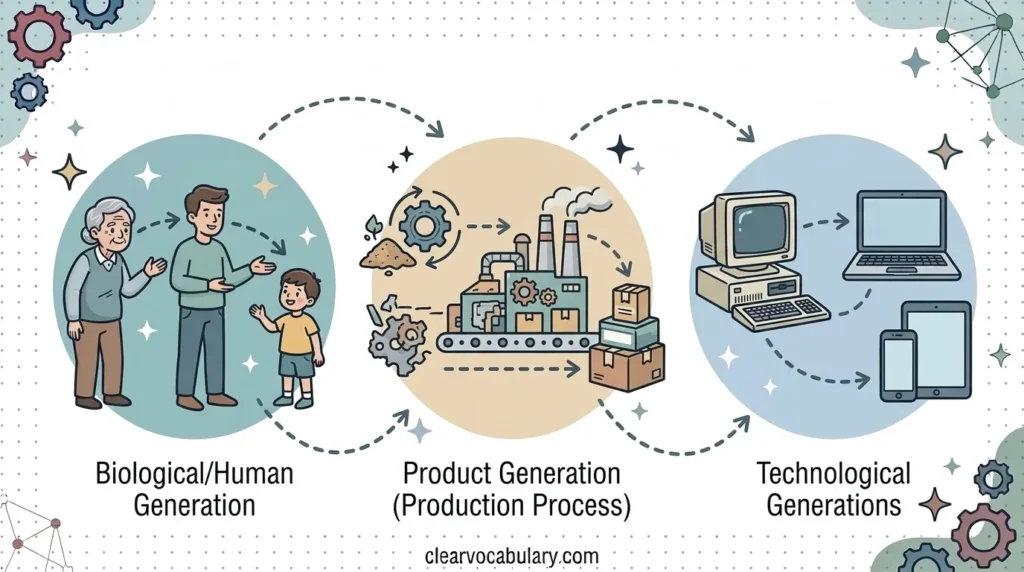
The central idea behind generation is something that is produced, comes into existence, or belongs to a particular stage in a continuing sequence. When referring to people, it often connects parents, children, and future descendants. When referring to products or processes, it emphasizes creation or development. This shared idea of succession helps explain why the word appears in such different contexts.
Prototype Categorization and Semantic Groups
The synonyms above fall into four main semantic groups.
1. People and Age Groups
Words: Age group, cohort, peer group, age bracket, contemporaries.
These terms classify people by age, shared experiences, or historical period. Cohort is particularly useful in research, while contemporaries emphasizes people living at the same time.
Example: Researchers compared two age cohorts.
2. Family and Descent
Words: Offspring, descendants, progeny, lineage, ancestry, posterity.
These terms focus on family connections and the relationship between past, present, and future generations. Lineage emphasizes a line of descent, whereas posterity refers to future generations.
Example: The family preserved its traditions for posterity.
3. Creation and Biological Processes
Words: Production, creation, formation, origination, development, reproduction, propagation, procreation, breeding.
These words describe producing something, bringing something into existence, or creating new living organisms. Their precise meanings vary by subject.
Example: The research examined the reproduction of plants.
4. Technology and Successive Development
Words: Version, model, iteration, series, successive stage, successor.
These alternatives help describe products or systems that change over time. Version identifies a particular release, while successor describes something that follows or replaces an earlier item.
Example: The latest version offers better performance.
Semantic grouping makes it easier to choose an alternative based on meaning instead of replacing a word mechanically. This is especially helpful when writing academic assignments, business reports, and everyday English sentences.
Antonyms of Generation
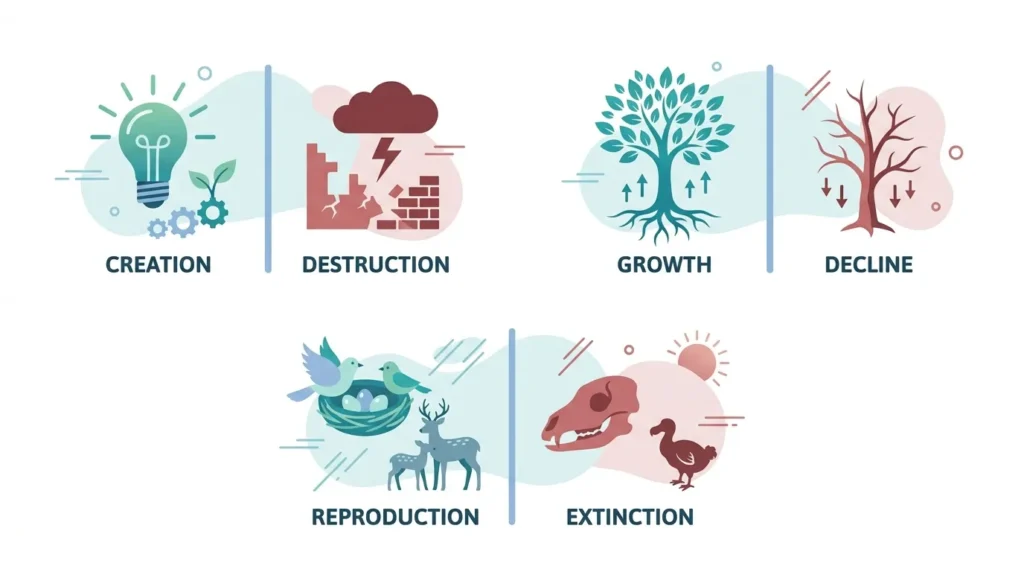
Generation does not have one universal antonym because its meaning changes with context. However, some words express contrasting ideas in particular situations.
1. Destruction (Noun)
Meaning: The act of damaging or ending something.
Example: The destruction of the old building began last week.
Contrast: Destruction is the opposite of creation or production in many contexts.
2. Elimination (Noun)
Meaning: The act of removing or getting rid of something.
Example: The elimination of unnecessary steps improved the process.
Contrast: It can oppose generation when generation means producing or creating something.
3. Decline (Noun)
Meaning: A reduction in amount, quality, strength, or activity.
Example: The region experienced a decline in electricity production.
Contrast: Decline can contrast with growth or increasing generation, depending on the sentence.
4. Extinction (Noun)
Meaning: The complete disappearance of a species or other living group.
Example: Conservation programs aim to prevent the extinction of endangered animals.
Contrast: Extinction can oppose reproduction or the continuation of generations in biological contexts.
5. Stagnation (Noun)
Meaning: A lack of growth, progress, or development.
Example: The company struggled with stagnation after years of innovation.
Contrast: Stagnation contrasts with development or progress, not with every meaning of generation.
These are contextual opposites rather than direct antonyms of generation. The correct choice depends on whether the word refers to creation, growth, reproduction, or a group of people.
Short Questions and Answers
What does generation mean?
Generation can mean a group of people born around the same time, the period between successive generations, or the act of producing something.
When should generation be used?
Use generation when discussing age groups, family descent, biological reproduction, energy production, or successive stages of technology. The surrounding words help establish the intended meaning.
Is generation positive or negative?
Generation is generally neutral. Expressions such as “a promising generation” sound positive, while “a lost generation” may sound negative.
How is generation different from production?
Generation can refer to an age group or a process of producing something. Production specifically emphasizes the act or process of making or supplying something.
Conclusion
Learning generation synonyms can help you express ideas more clearly in everyday conversation, academic writing, and professional communication. Words such as cohort and age group are useful when discussing people of similar ages. Lineage and descendants are more appropriate for family history, while production and creation suit discussions about making or developing something. In technology, words such as version, iteration, and successor describe different stages of progress.
The most important lesson is that synonyms are not always interchangeable. A word that works in a discussion about family history may sound unnatural in a report about electricity production. When learning a new synonym, check its meaning and read it in a complete sentence. This simple habit will help you build a stronger vocabulary, reduce repetition, and choose more precise words in both writing and speech.