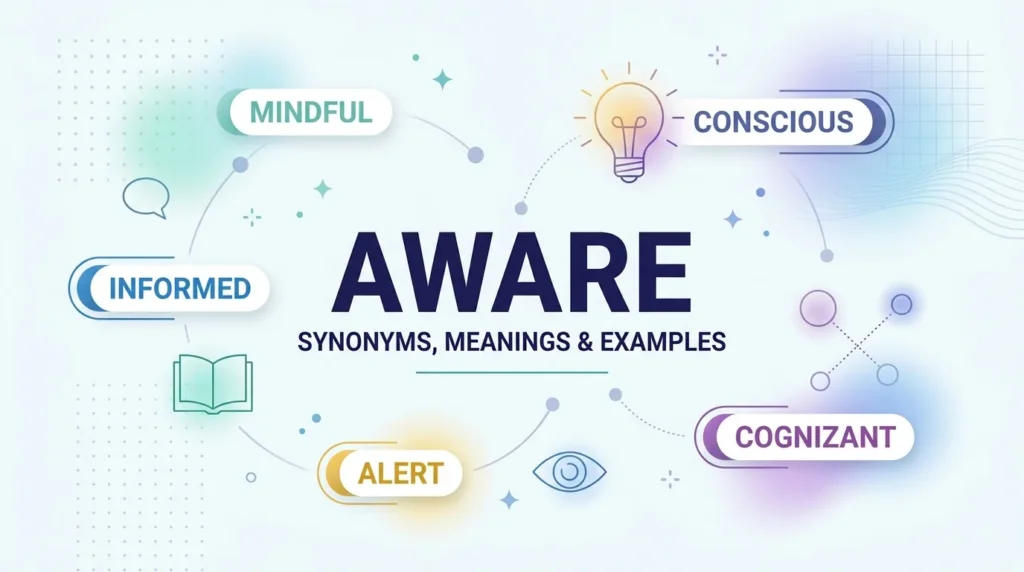

The best synonyms for “aware” are conscious, mindful, informed, alert, and cognizant. The right choice depends on whether you mean knowing a fact, noticing something, or paying careful attention.
“Aware” is a common adjective, and it appears in everyday speech, emails, essays, and reports. Used too often, it makes writing feel repetitive. This guide gives you aware synonyms in English, grouped by meaning, so you can pick the word that fits your sentence.
Quick Answer
| If you mean… | Best synonyms |
|---|---|
| Knowing a fact | informed, cognizant, conversant, apprised |
| Noticing something right now | conscious, sensible, alive to |
| Paying careful attention | mindful, alert, watchful, vigilant |
| Understanding social or emotional issues | sensitive, attuned, perceptive |
| Up to date on current events | up to date, in the know, well informed |
What Does “Aware” Mean?
Aware is an adjective. Its main meaning is having knowledge of something, or noticing that something exists or is happening.
- She was aware of the deadline. (She knew about it.)
- I became aware of a strange noise. (I noticed it.)
- He is very aware of his own mistakes. (He recognizes them.)
Notice that “aware” is usually followed by of or that.
Prototype Meaning
The central idea of “aware” is having something in your mind. When people hear the word, they usually imagine someone who knows about a fact, a danger, or a situation, whether or not they are doing anything about it.
Connotative Meaning
“Aware” is mostly neutral. It simply says that someone knows or notices something.
It can lean positive in compounds like socially aware, health-conscious, or self-aware, where it suggests thoughtfulness. It can lean negative or pointed in sentences such as “You were fully aware of the risks,” where it suggests responsibility or blame.
Synonyms for Aware, Grouped by Meaning
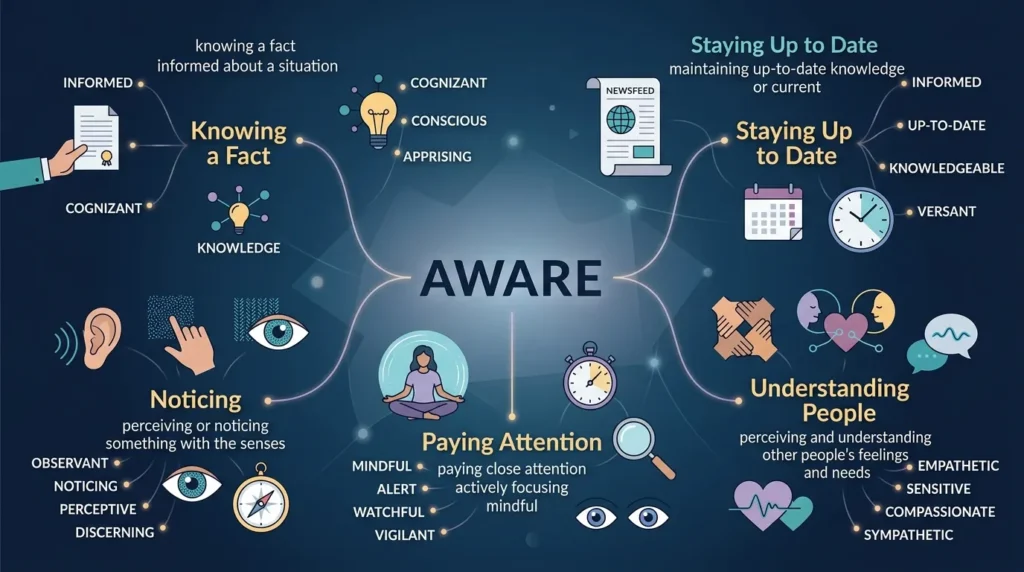
Because “aware” covers several ideas, a single list of synonyms would not help much. These groups show which word fits which sense.
1. Aware Meaning “Knowing a Fact”
- Informed: Having received the relevant information. The staff were informed of the new policy.
- Cognizant: Formal. Fully aware, often used in business and legal writing. The company was cognizant of the safety issues.
- Apprised: Formal. Told about something, almost always used as apprised of. Please keep me apprised of any changes.
- Conversant: Familiar with a subject through study or experience. She is conversant with modern tax law.
- Familiar: Acquainted with something. Are you familiar with this software?
2. Aware Meaning “Noticing or Conscious”
- Conscious: Aware of something in your own mind or surroundings. He was conscious of people staring at him.
- Sensible (of): Formal or literary. Aware of something, especially a feeling. She was sensible of the honor shown to her. This sense is now uncommon in everyday speech.
- Alive to: Fully aware of something, often a danger or opportunity. The manager was alive to the risk of delays.
- Awake to: Newly aware of something. The public is awake to the problem.
3. Aware Meaning “Paying Close Attention”
- Mindful: Keeping something in mind and acting with care. Be mindful of your tone in emails.
- Alert: Quick to notice and ready to respond. Drivers should stay alert at night.
- Watchful: Carefully observing. The nurse remained watchful throughout the night.
- Vigilant: Formal. Keeping careful watch for danger. Residents were asked to stay vigilant.
- Heedful: Formal or literary. Paying careful attention. Heedful of the warning, he turned back.
4. Aware Meaning “Understanding People or Social Issues”
- Sensitive: Alert to the feelings or needs of others. She is sensitive to cultural differences.
- Attuned: Closely in harmony with something. Good teachers are attuned to their students’ moods.
- Perceptive: Quick to notice and understand things. It was a perceptive observation.
- Enlightened: Having a broad, informed understanding. An enlightened approach to education.
5. Aware Meaning “Current and Up to Date”
- Up to date: Having the latest information. Stay up to date with industry news.
- Well informed: Having good knowledge of a subject. He is well informed about local politics.
- In the know: Informal. Possessing inside or current information. Ask Maya; she’s always in the know.
- Au fait: Formal or slightly literary, from French. Familiar with something. She is au fait with the latest regulations.
Aware Synonyms Comparison Table
| Word | Meaning | Tone / Context | Example |
|---|---|---|---|
| Conscious | Noticing or realizing | Neutral, common | I was conscious of the silence. |
| Mindful | Keeping in mind with care | Neutral to positive | Be mindful of the time. |
| Informed | Having been given facts | Neutral, professional | Customers were informed by email. |
| Cognizant | Fully aware | Formal | Cognizant of the risks, they proceeded. |
| Alert | Quick to notice and react | Neutral, practical | Stay alert near the road. |
| Vigilant | Watching carefully for danger | Formal, serious | Officials remain vigilant. |
| Sensitive | Alert to feelings | Positive, social | Be sensitive to others’ needs. |
| Apprised | Told about something | Formal, business | Keep me apprised. |
Which Word Should You Use?
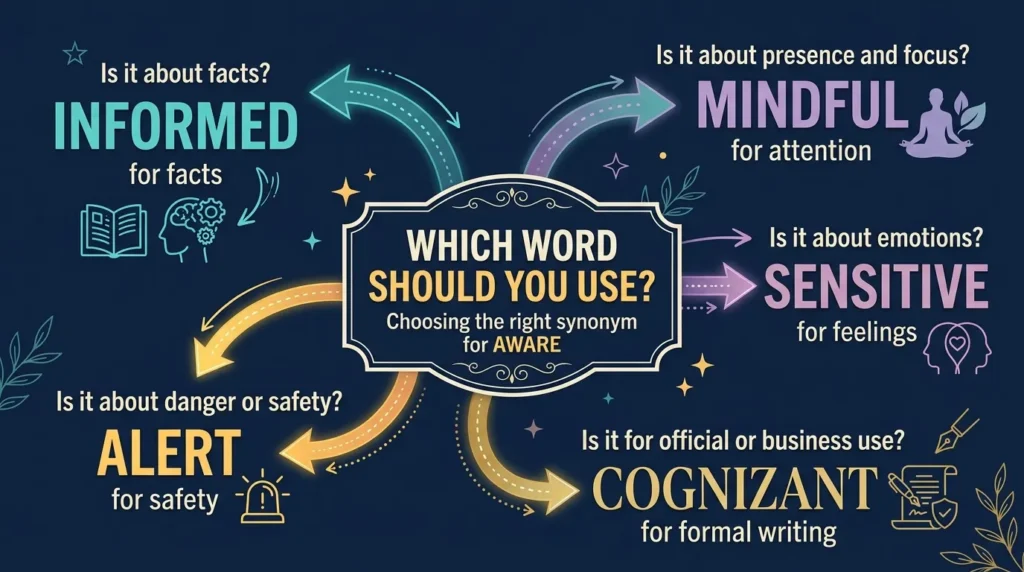
- Everyday conversation: Aware, conscious, alert, and in the know all sound natural.
- Workplace emails: Informed, apprised, and mindful work well. Cognizant sounds more formal and can seem stiff in casual messages.
- Academic and formal writing: Cognizant, conversant, and vigilant fit well.
- Warnings and safety: Alert, watchful, and vigilant carry a sense of readiness.
- Social and emotional awareness: Sensitive, attuned, and perceptive are the strongest choices.
A useful rule: if your sentence is about facts, choose informed or cognizant. If it is about attention, choose mindful or alert. If it is about feelings, choose sensitive or attuned.
Words That Are Related but Not True Synonyms
Some words come up in searches for “aware” but are not interchangeable with it:
- Awake means not sleeping, though it can mean “newly aware” in phrases like awake to the dangers.
- Knowledgeable describes someone with a lot of knowledge, not someone who simply knows one fact.
- Smart and clever describe intelligence, not awareness.
- Observant describes a habit of noticing things, while aware describes knowing something at a given moment.
Grammar and Word Forms
| Word | Part of Speech | Word Forms | Grammar / Use | Example |
|---|---|---|---|---|
| aware | adjective | more aware, most aware | Usually followed by of or that; not used before a noun in the pattern “aware of” | I am aware of the problem. |
| awareness | noun | uncountable (no usual plural) | Names the state of knowing or noticing | Awareness of the issue is growing. |
| unaware | adjective | more unaware, most unaware | Opposite of aware; also followed by of | He was unaware of the change. |
| self-aware | adjective | more self-aware | Conscious of your own character and behavior | She is a self-aware leader. |
“Aware” can also appear before a noun in compounds such as a safety-aware team or a budget-aware shopper.
Word Formation
The family of words around “aware” is small and standard:
aware → awareness (noun)
aware → unaware (negative adjective)
aware → unawareness (noun, less common than ignorance or lack of awareness)
aware + self- → self-aware → self-awareness
Common compounds: health-aware, price-aware, security-aware.
Pronunciation
| Word | Syllables | Pronunciation (US) |
|---|---|---|
| aware | 2 | /əˈwɛr/ |
| awareness | 3 | /əˈwɛrnəs/ |
The stress falls on the second syllable: a-WARE. The first syllable is a weak “uh” sound.
Etymology / Word History
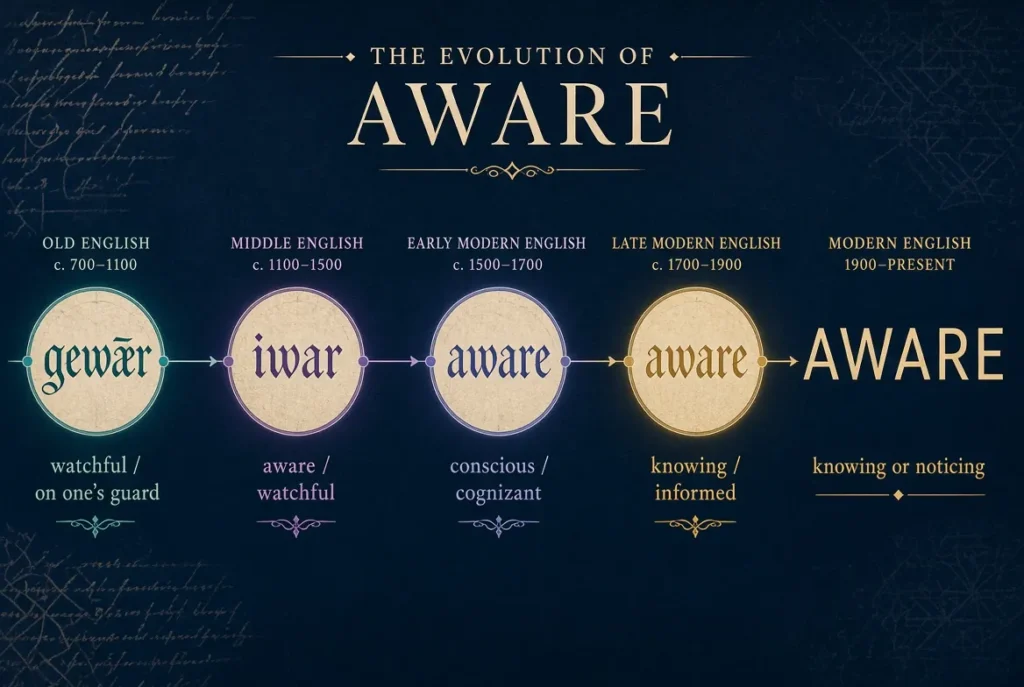
“Aware” comes from Old English gewær, meaning “watchful” or “on one’s guard.” The older sense of being watchful or wary is still visible in related words such as wary and beware. Over time, the meaning shifted from “watchful” toward the broader modern sense of “knowing” or “noticing.”
Read more 👉: Aggressive Synonyms: Better Words by Meaning & Examples
Real-Life Examples
- Are you aware that the meeting has been moved to Friday?
- Voters are increasingly aware of how their data is used.
- Be mindful of noise levels after 10 p.m.
- I wasn’t conscious of how loudly I was speaking.
- Staff must remain vigilant when handling customer payments.
- She is a perceptive manager who notices when a team member is struggling.
- Please keep me apprised of any delays.
Common Collocations and Expressions
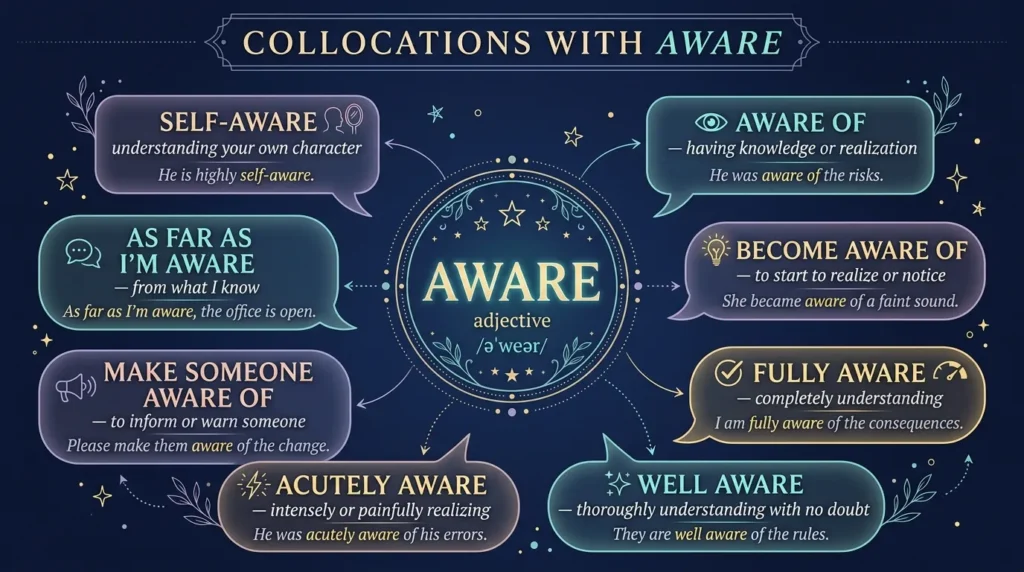
- be aware of the risks / the problem / the fact
- become aware of a change
- fully aware
- well aware (emphasizes strong knowledge): I’m well aware of the cost.
- painfully aware (aware in an uncomfortable way)
- acutely aware (sharply aware)
- make someone aware of something
- as far as I’m aware (a common hedge): As far as I’m aware, the shop is closed on Sundays.
- environmentally aware, socially aware, self-aware
Common Mistakes
❌ Incorrect: I am aware about the problem.
✅ Correct: I am aware of the problem.
“Aware” takes of, not about.
❌ Incorrect: He was conscious about the deadline.
✅ Correct: He was conscious of the deadline.
Use of with conscious when it means “aware.”
❌ Incorrect: Please keep me apprised about the situation.
✅ Correct: Please keep me apprised of the situation.
Apprised is normally followed by of.
Antonyms of Aware
- Unaware: not knowing or noticing. She was unaware of the rule change.
- Ignorant (of): lacking knowledge; can sound critical. He was ignorant of the law.
- Oblivious: completely failing to notice. He was oblivious to the noise.
- Unconscious (of): not noticing something in the mind. She was unconscious of her habit of tapping the desk.
- Heedless: paying no attention. Heedless of the warnings, they continued.
Sentence Transformations
Original: We are aware of the issue.
Alternative: We are cognizant of the issue.
The alternative is more formal and suits official statements.
Original: Be aware of your surroundings.
Alternative: Stay alert to your surroundings.
The alternative stresses readiness, not just knowledge.
Original: She is aware of other people’s feelings.
Alternative: She is sensitive to other people’s feelings.
The alternative focuses on emotional understanding.
Original: I’ll let you know if I hear anything.
Alternative: I’ll keep you apprised.
The alternative sounds more professional.
Practice: Choose the Correct Word
1. The nurse stayed ______ throughout the night shift, watching for any change in the patient.
a) apprised b) watchful c) conversant d) au fait
2. Please keep the board ______ of any changes to the schedule.
a) apprised b) vigilant c) sensitive d) heedful
3. A good listener is ______ to the feelings of others.
a) cognizant b) attuned c) conversant d) informed
4. She is ______ with several programming languages.
a) conversant b) alert c) mindful d) watchful
Answers
- b) watchful. The sentence is about careful observation.
- a) apprised. “Apprised of” means informed about something.
- b) attuned. It fits emotional sensitivity to others.
- a) conversant. It means familiar with a subject through experience.
FAQs
What is the best synonym for aware?
Conscious is the closest general-purpose synonym. For knowing facts, informed works well. For careful attention, mindful is a strong choice.
Is “cognizant” the same as “aware”?
They are very close in meaning. Cognizant is more formal and is common in business, legal, and academic writing.
What is the difference between aware and conscious?
“Aware” means knowing or noticing something. “Conscious” also describes being awake and able to think, as in the patient is conscious. In the sense of noticing, the two often overlap, as in aware of and conscious of.
Can I use “mindful” instead of “aware”?
Yes, when you mean keeping something in mind with care. Be mindful of the deadline works. It does not fit every sentence, though: I’m mindful that the shop is closed is possible but less natural than I’m aware that the shop is closed.
What is the opposite of aware?
Unaware is the standard opposite. Oblivious and ignorant are stronger alternatives.
Which preposition follows “aware”?
Use of with a noun (aware of the risk) or that with a clause (aware that it is late).
What does “self-aware” mean?
It means conscious of your own thoughts, feelings, character, and behavior.
Conclusion
“Aware” is a flexible, neutral word, but it does not always give the exact shade you need. Choose informed, cognizant, or apprised for facts, conscious for noticing, mindful, alert, or vigilant for attention, and sensitive or attuned for understanding people. Matching the synonym to the meaning of your sentence will make your writing clearer and less repetitive.