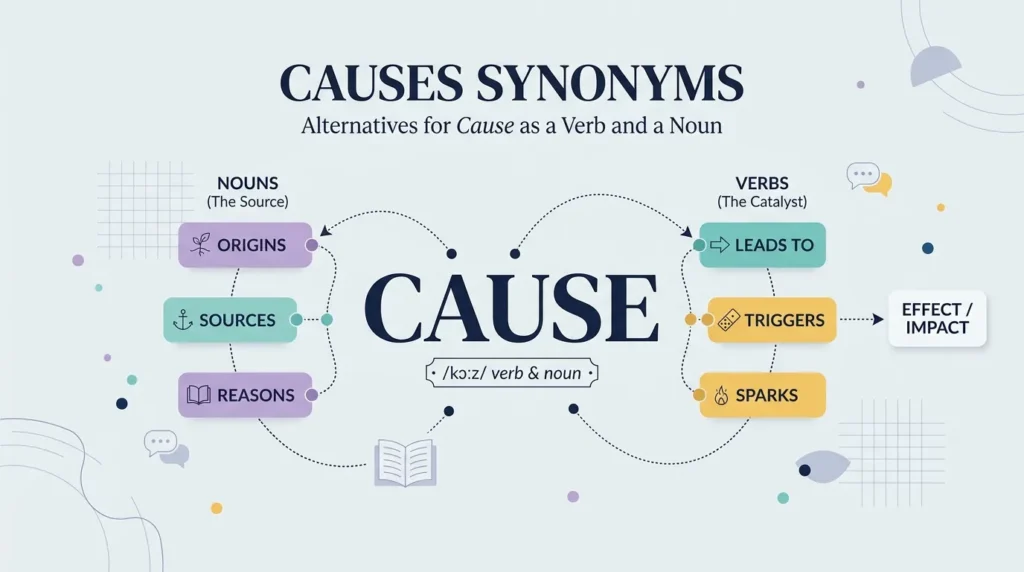

The best synonyms for “causes” depend on its job in the sentence. As a verb, it can become “leads to,” “triggers,” or “brings about.” As a noun, it can become “reasons,” “sources,” or “origins.”
People search for “causes synonyms” because causes does two different jobs. In “Stress causes headaches,” it is a verb. In “The causes of the war,” it is a plural noun. Each use has its own set of alternatives, and a word that works for one often fails in the other. This guide separates the two so you can choose accurately.
Quick Answer
When “causes” is a verb (makes something happen):
leads to, results in, brings about, triggers, sparks, provokes, prompts, produces, generates, gives rise to
When “causes” is a noun (the reasons or origins behind something):
reasons, sources, origins, roots, factors, grounds, drivers, triggers
When “causes” means a movement or principle people support:
movements, campaigns, crusades, missions
No synonym fits every sentence. Triggers suggests a sudden start, leads to suggests a gradual path, and reasons usually explains rather than produces.
Meaning of Causes
Cause is both a verb and a noun. Causes is the third-person singular verb form and the plural noun.
- Verb: to make something happen. Heavy rain causes flooding.
- Noun (reason or source): the person, thing, or event that makes something happen. Investigators are still looking for the causes of the fire.
- Noun (principle or movement): an idea or goal people support. She gave her time to several good causes.
Prototype Meaning
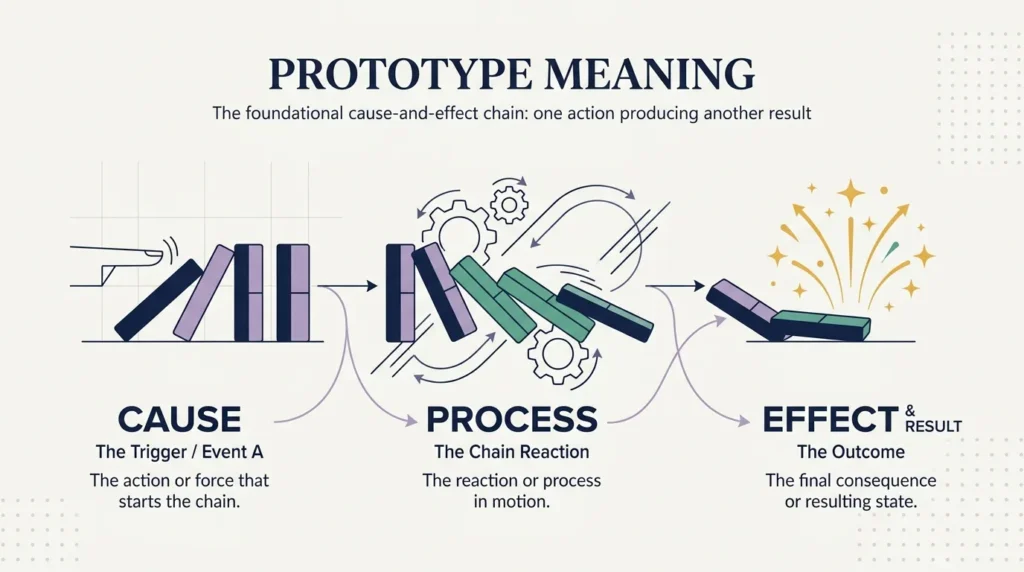
The central idea is one thing producing another: an action, event, or condition that makes something else happen. Most people picture a chain, with the cause first and the effect after it. The other senses, such as a charitable cause, grew out of this core idea.
Connotative Meaning
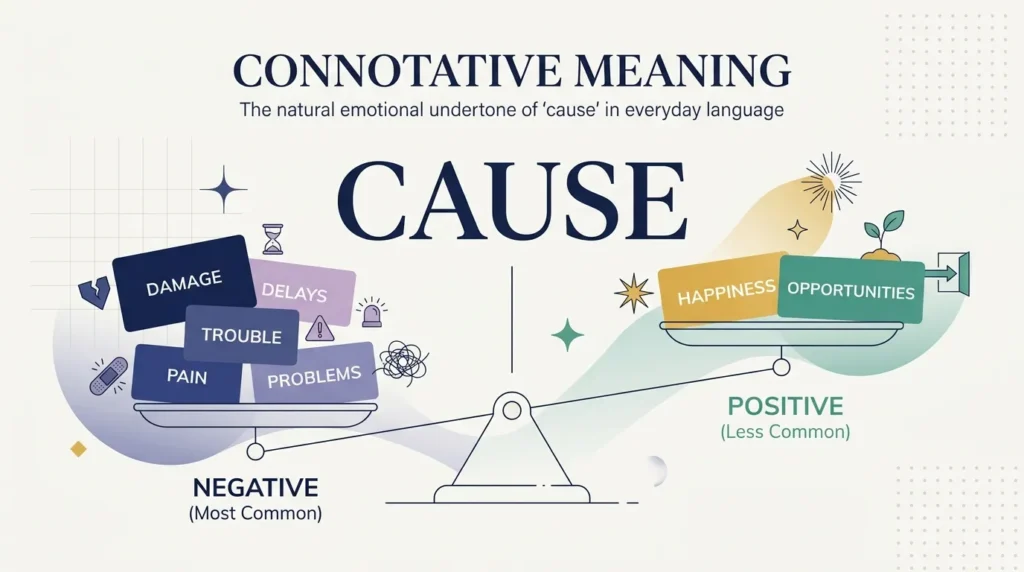
Cause is neutral in meaning, but it is used mostly with unwelcome results: cause damage, cause delays, cause trouble, cause pain. Because of that, it often sounds negative or blame-focused, and it is less natural with good outcomes. We usually say a plan brought happiness or created opportunities rather than caused them, though “cause joy” is possible in a literary tone.
Several alternatives carry their own tone:
- Provoke is usually negative and suggests a reaction, often anger.
- Spark is lively and can be positive or negative.
- Culprit (noun) is informal and places blame.
- Engender is formal and often used with positive or abstract results, such as trust.
Synonyms for Causes as a Verb
Everyday alternatives
| Word | Meaning and nuance | Tone / Context | Example |
|---|---|---|---|
| leads to | produces a result, often gradually or indirectly | Neutral, everyday | Poor sleep leads to mistakes at work. |
| results in | has a particular final outcome | Neutral, slightly formal | The storm results in power cuts every year. |
| brings about | makes a situation or change happen | Neutral to formal | New technology brings about rapid change. |
| produces | creates or yields an outcome | Neutral | Drought produces poor harvests. |
| makes | forces or leads something to happen (followed by a verb or adjective) | Very informal and common | The smoke makes my eyes water. |
Words for a sudden start or reaction
| Word | Meaning and nuance | Tone / Context | Example |
|---|---|---|---|
| triggers | sets off a reaction or event, often quickly | Common in science, health, and news | Pollen triggers allergies in many people. |
| sparks | starts something suddenly, often debate, anger, or interest | Vivid, journalistic | The decision sparks protests. |
| provokes | causes a reaction, usually strong or negative | Negative, emotional | His remark provokes an angry reply. |
| prompts | causes someone to act or something to be done | Neutral | Complaints prompt a review. |
| precipitates | causes something, usually bad, to happen suddenly or sooner than expected | Formal | The scandal precipitates his resignation. |
Formal and technical alternatives
- Gives rise to is formal: The policy gave rise to confusion.
- Induces is formal or medical, and usually refers to a state or condition: The medication induces drowsiness.
- Engenders is formal or literary, and usually refers to feelings or conditions: Honest leadership engenders trust.
- Generates is neutral to technical: The campaign generated a lot of interest.
Synonyms for Causes as a Noun
When causes means the reasons or sources behind an event, these are the best alternatives.
| Word | Meaning and nuance | Example |
|---|---|---|
| reasons | explanations, often for why someone did something or why something is so | The reasons for the delay are unclear. |
| sources | places or things where a problem or thing begins | Old wiring is a common source of fires. |
| origins | where or how something began | Historians study the origins of the conflict. |
| roots | deeper, underlying causes | The roots of the problem lie in poor planning. |
| factors | elements that contribute, often one of several | Several factors affect crop yields. |
| grounds | formal or legal basis for an action or belief | There are no grounds for a lawsuit. |
| drivers | forces that push something forward | Cost is one of the main drivers of the change. |
| triggers | specific events that set something off | Stress is a common trigger for migraines. |
Two more notes:
- Culprit is informal and means the thing to blame: Sugar is often the culprit.
- Etiology is a formal medical and scientific term for the causes of a disease.
Synonyms for Cause Meaning a Movement or Principle
When cause means something people believe in and work for, use movement, campaign, crusade, mission, or ideal. Choose by tone: campaign is organized and practical, crusade is passionate and moral, and ideal is more abstract.
She devoted her life to the cause of education. → She devoted her life to the campaign for education.
Related Words That Are Not True Synonyms
- Contribute to means to be one part of the cause, not the whole cause. Stress may contribute to illness without causing it.
- Influence and affect change something without necessarily producing it.
- Allow and enable make something possible rather than make it happen.
- Effect as a verb (to effect change) means to bring about, but it is formal and often confused with affect. It is rarely a good everyday substitute.
Read More 👉: Aggressive Synonyms: Better Words by Meaning & Examples
Which Word Should You Use?
- Everyday writing: leads to, results in, or makes are clear and natural.
- News and headlines: triggers, sparks, and prompts are short and energetic.
- Academic or formal writing: gives rise to, brings about, results in, and induces fit well. For noun uses, choose factors, origins, or underlying causes.
- Blame or conflict: provokes suggests an emotional reaction, and culprit is informal.
- Gradual outcomes: leads to works better than triggers.
- Sudden events: triggers, sparks, and precipitates work better than leads to.
- Reasons for human actions: use reasons or motives, not causes.
Sentence Transformations
Original: Using too much salt causes high blood pressure.
Alternative: Using too much salt can lead to high blood pressure.
The alternative sounds more careful, because “can lead to” does not claim a direct, certain link.
Original: The announcement caused a lot of excitement.
Alternative: The announcement generated a lot of excitement.
“Generated” sounds more positive and more business-like.
Original: The causes of the strike are complicated.
Alternative: The origins of the strike are complicated.
“Origins” points to how the strike began, while “causes” can also include later factors.
Grammar and Word Forms
| Word | Part of Speech | Word Forms | Grammar / Use | Example |
|---|---|---|---|---|
| cause | Verb | cause, causes, caused, caused, causing | Takes a direct object. Can be followed by someone to + verb. | The noise caused the baby to wake up. |
| cause | Noun | cause, causes | Countable. Usually followed by of (or for in “cause for concern”). | The causes of the fire are unknown. |
| causal | Adjective | causal | Describes a cause-and-effect link. | There is a causal link between the two events. |
| causation | Noun | causation | Formal, uncountable. Often used in law and science. | The study could not prove causation. |
Word Formation
cause → causal → causation
These forms are related, and because also comes from cause, as explained below. They are all standard, but causal and causation are formal and used mainly in academic, legal, and scientific writing.
Pronunciation
| Word | Syllables | Pronunciation |
|---|---|---|
| cause | 1 | /kɔːz/ (British); /kɔːz/ or /kɑːz/ (American) |
| causes | 2 | /ˈkɔːzɪz/ |
The final s in causes is pronounced as an extra syllable, “-iz,” because the base word already ends in a z sound. American speakers vary in the vowel, depending on region.
Etymology / Word History
Cause entered English in the Middle English period from Old French cause, which came from Latin causa, meaning “reason,” “motive,” or “lawsuit.” The word because was formed in Middle English from by cause, meaning “by reason of.” The informal short form ’cause is a clipping of because.
Common Collocations and Expressions
- cause damage, cause problems, cause delays, cause confusion
- root cause, main cause, likely cause, underlying cause
- cause and effect
- cause for concern, cause for celebration
- good cause (a charity or worthy movement)
- lost cause (something with no chance of success)
Common Mistakes
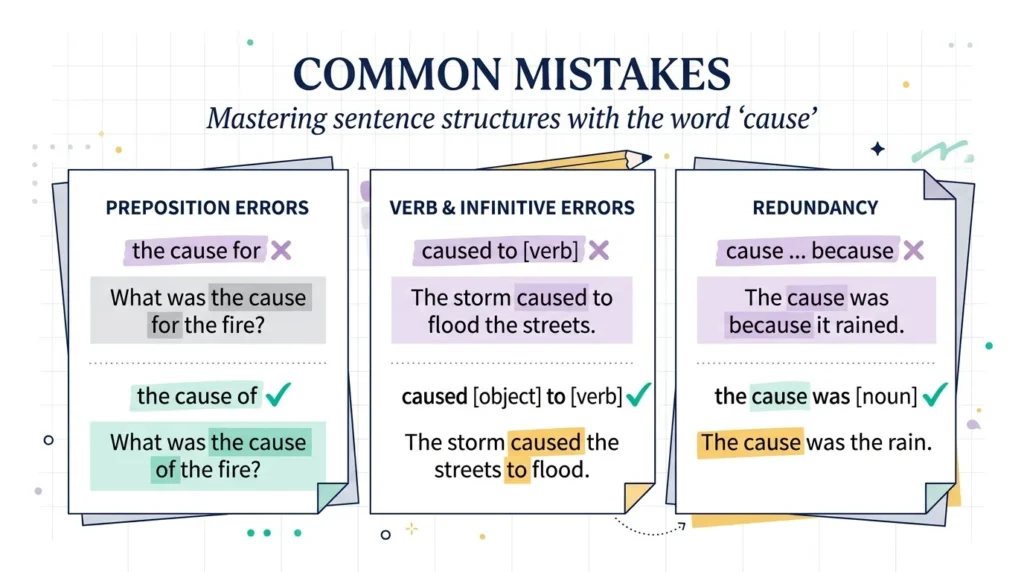
❌ Incorrect: The heavy rain caused to the flood.
✅ Correct: The heavy rain caused the flood.
Cause is followed directly by its object, without “to.”
❌ Incorrect: Smoking is a major cause for lung cancer.
✅ Correct: Smoking is a major cause of lung cancer.
Use “of” for the thing that results. “Cause for” is mainly used for a reaction, as in “cause for concern.”
❌ Wordy: The main cause of the delay was because of a strike.
✅ Better: The main cause of the delay was a strike.
“Cause” and “because” repeat the same idea.
Antonyms
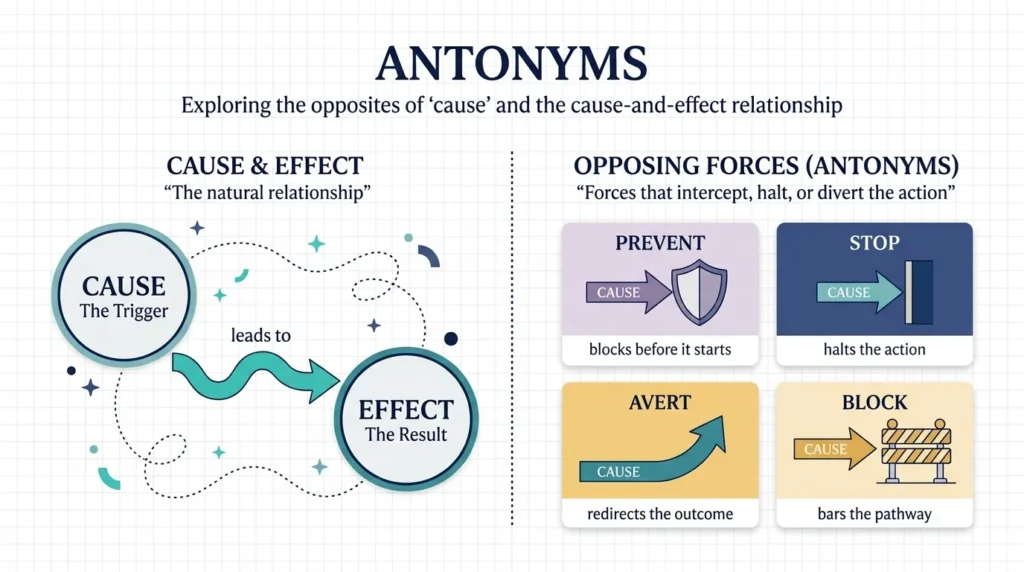
- Effect, result, outcome, consequence (nouns): the opposite end of the cause-and-effect chain. The consequence of the delay was a missed flight.
- Prevent, stop, avert, block (verbs): to keep something from happening. Regular maintenance helps prevent breakdowns.
Practice: Choose the Correct Word
- The new policy ______ widespread confusion among staff. (caused / reasons)
- Researchers are still investigating the ______ of the disease. (causes / causing)
- Dust and cold air can ______ asthma attacks in some people. (trigger / origin)
- Her speech ______ a national debate about education. (sparked / source)
Answers
- caused. A verb is needed here, and “reasons” is a noun.
- causes. A plural noun is needed after “the.”
- trigger. It is the verb that means to set off a reaction.
- sparked. It is a verb that fits a sudden debate, while “source” is a noun.
FAQs
What is a good synonym for “causes”?
As a verb, leads to and results in are safe everyday choices. As a noun, reasons and sources are the most common.
What is a more formal word for “causes”?
Gives rise to, brings about, and engenders are formal verbs. For nouns, origins and underlying factors sound more formal.
Is “reason” the same as “cause”?
Not exactly. A cause produces an effect, while a reason explains or justifies it. We say the cause of a fire, but the reason someone left early.
What is the difference between “trigger” and “cause”?
A trigger sets something off, often quickly, while a cause can be broader or deeper. Stress may trigger a migraine without being its underlying cause.
What is the difference between “causes” and “cases”?
They look similar but are unrelated. Causes relates to making something happen, and cases means instances or legal matters.
What is the opposite of “causes”?
For the noun, the opposite is usually effects or results. For the verb, it is prevents or stops.
Can “cause” be used for good outcomes?
Yes, but it leans negative in everyday use. For positive results, bring, create, or lead to often sounds more natural.
Conclusion
The right synonym for causes depends on whether you mean making something happen, the source behind it, or a movement people support. Use leads to for gradual results, triggers or sparks for sudden ones, and reasons, origins, or factors when you mean the noun. Check the sentence first, then choose the word that matches its meaning and tone.