
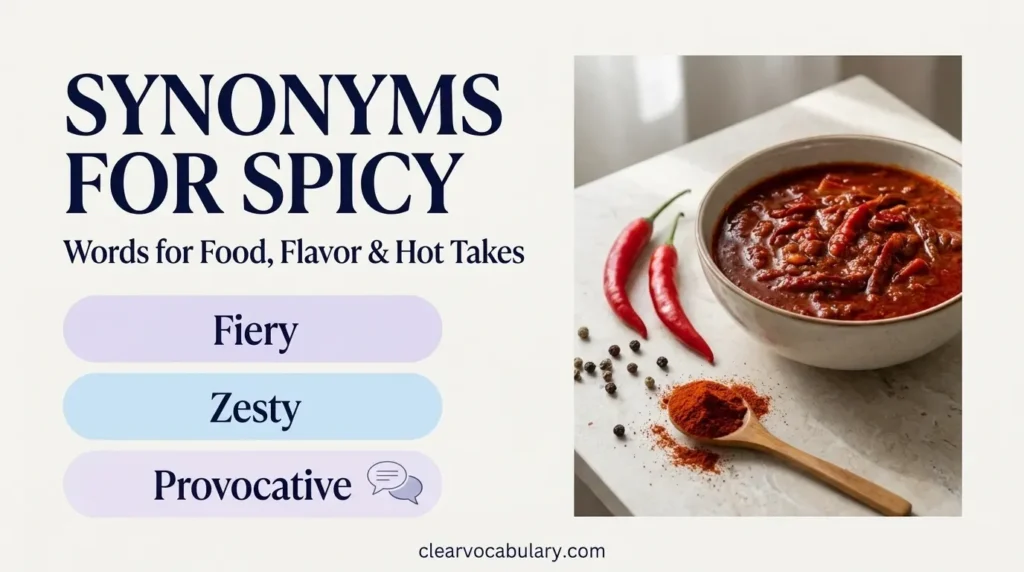
Common synonyms for spicy include hot, fiery, peppery, zesty, and racy, depending on whether you mean food with heat, flavorful food, risqué content, or a bold take.
The best synonyms for spicy depend on what you are describing. Use hot, fiery, or peppery for food with heat, flavorful or zesty for food rich in taste but not necessarily hot, racy or steamy for risqué content, and provocative or edgy for bold ideas.
Spicy is a small word with several meanings. A “spicy curry,” a “spicy novel,” and a “spicy debate” all need different replacements. This guide groups 19 alternatives by meaning, so you can pick the word that says exactly what you intend.
Meaning of Spicy
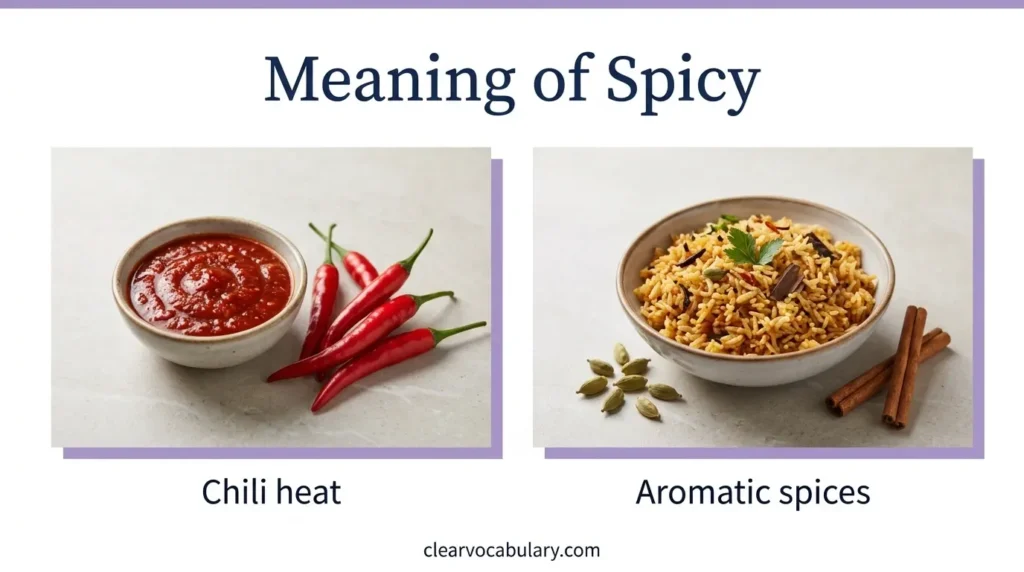
Spicy is an adjective. Its main meaning is flavored with spices, especially in a way that makes food hot or sharp. It also has figurative meanings: slightly improper, scandalous, or lively and provocative.
Prototype Meaning
The most typical meaning is food that has a hot, sharp, or strongly seasoned taste, such as chili, pepper, or curry. Importantly, spicy does not always mean hot. A cinnamon-and-clove dessert can be spicy without any burning heat.
Connotative Meaning
For food, spicy is usually positive and exciting, though it can be a warning for people who dislike heat. In other contexts, it adds a playful or slightly daring tone, as in “a spicy rumor” or “a spicy take.”
Synonyms for Spicy by Meaning
1. Hot and Sharp in Taste
| Word | Meaning | Tone or Context | Example |
|---|---|---|---|
| Hot | Having a burning sensation from chili or pepper | Everyday, menus | The salsa is too hot for me. |
| Fiery | Very hot and intense | Descriptive, strong | She loves fiery curries. |
| Peppery | Tasting of pepper, with a sharp bite | Neutral, food writing | The arugula has a peppery flavor. |
| Piquant | Pleasantly sharp or spicy | Formal, food writing | The sauce is piquant but not overwhelming. |
| Pungent | Strong and sharp in taste or smell | Strong, can be negative | The pickles were sharp and pungent. |
Hot and fiery are the closest everyday matches for heat. Piquant is more refined and suggests a pleasant sharpness. Pungent is only a related word, because it focuses on strength of smell or taste and can sound unpleasant.
2. Flavorful Without Much Heat
| Word | Meaning | Tone or Context | Example |
|---|---|---|---|
| Flavorful | Full of taste | Neutral, common | The stew is rich and flavorful. |
| Zesty | Lively and fresh in flavor | Informal, food writing | A zesty lemon dressing brightened the salad. |
| Aromatic | Having a noticeable, pleasant smell from herbs or spices | Descriptive | The rice was aromatic with cardamom. |
| Well-seasoned | Properly flavored with salt, herbs, or spices | Neutral | The chicken was well-seasoned and tender. |
| Tangy | Sharp and slightly sour | Everyday | The tangy sauce went well with the fries. |
These words suit food that is rich in taste but not necessarily hot. Tangy is a related word, not a true synonym, because it describes sharpness and sourness rather than spice.
3. Risqué or Slightly Improper
| Word | Meaning | Tone or Context | Example |
|---|---|---|---|
| Racy | Lively and slightly improper | Informal, mild | The magazine published a racy story. |
| Risqué | Close to being indecent, but not extreme | Slightly formal | He told a risqué joke at dinner. |
| Steamy | Sexually charged | Informal, stronger | She enjoys steamy romance novels. |
| Saucy | Cheeky and slightly suggestive | Playful, mild | The postcard had a saucy caption. |
| Suggestive | Hinting at something improper | Neutral to formal | The advertisement was criticized as suggestive. |
Racy and saucy are mild and playful. Steamy is stronger. Suggestive is the most neutral and works well in formal writing.
4. Bold, Controversial, or Lively
| Word | Meaning | Tone or Context | Example |
|---|---|---|---|
| Provocative | Meant to cause a strong reaction | Neutral to formal | The article raised a provocative question. |
| Edgy | Bold and slightly shocking | Informal | The brand is known for its edgy humor. |
| Heated | Angry or intense | Neutral | They had a heated debate about the budget. |
| Juicy | Full of interesting or scandalous details | Informal, gossip | She shared some juicy details about the show. |
Use these when “spicy” refers to a take, debate, or story rather than taste.
Which Word Should You Use?
- Restaurant menus and recipes: hot, fiery, and peppery describe heat clearly, while flavorful and aromatic describe taste without heat.
- Food reviews and blogs: piquant, zesty, and well-seasoned add variety.
- Books, films, and advertising: racy, steamy, or suggestive, depending on how strong the content is.
- Opinions, headlines, and social media: bold, provocative, or edgy fits a “spicy take.”
- Everyday conversation: hot or really spicy usually sounds the most natural.
READ MORE 👉: Synonyms for Property: Pick the Right Word by Meaning
Sentence Transformations
Original: The curry was too spicy for me.
Alternative: The curry was too hot for me.
“Hot” is clear on a menu, but in other contexts it may suggest temperature instead of spice.
Original: She added spicy details to the story.
Alternative: She added juicy details to the story.
“Juicy” focuses on interesting or scandalous gossip, not on a daring tone.
Original: It is a spicy romance novel.
Alternative: It is a steamy romance novel.
“Steamy” is stronger, so the alternative suggests more explicit content.
Grammar and Word Forms
| Word | Part of Speech | Word Forms | Grammar or Use | Example |
|---|---|---|---|---|
| spicy | Adjective | spicy, spicier, spiciest | Can come before a noun or after a linking verb | The soup is spicier than I expected. |
| spiciness | Noun | spiciness | Names the quality of being spicy | The spiciness of the dish surprised her. |
| spice | Noun, verb | spice, spices, spiced, spicing | The root word; spice up means to make more interesting | She spiced the stew with cumin. |
Word Formation
The adjective is formed from the noun with a suffix: spice → spicy → spiciness. The related verb phrase spice up is used figuratively, as in “spice up your presentation.”
Pronunciation and Syllables
Spicy is pronounced /ˈspaɪsi/ and has two syllables (spi-cy). The stress falls on the first syllable.
Etymology and Word History
Spice came into English from Old French espice, which came from Latin species. In late Latin, the word came to mean goods or wares, and later specifically spices. The adjective spicy was then formed from spice plus the suffix -y.
Antonyms of Spicy
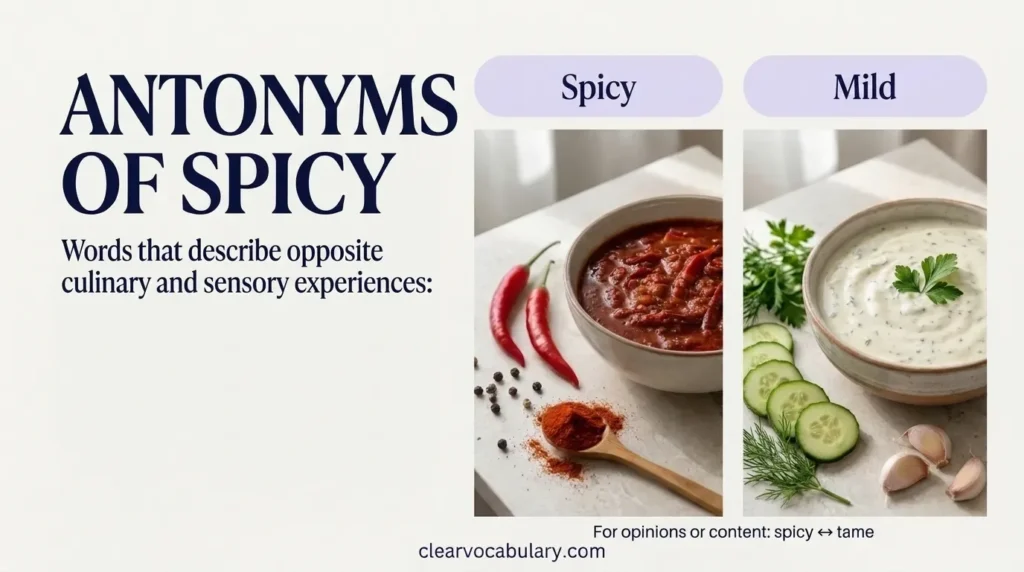
Common opposites include mild, bland, tame, and plain. Mild and bland apply to food, while tame suits content or opinions.
Common Mistakes
❌ Incorrect: The tea is too spicy to drink. (meaning too hot in temperature)
✅ Correct: The tea is too hot to drink.
Spicy refers to flavor, not temperature.
❌ Incorrect: The sauce is spicey.
✅ Correct: The sauce is spicy.
The standard spelling is spicy, without an e.
Quick Practice
Choose the best word for each sentence.
- The ______ pepper sauce made her eyes water. (fiery / saucy)
- The magazine ran a ______ story that some readers found improper. (racy / peppery)
- They had a ______ argument about the new policy. (heated / zesty)
Answers: 1. fiery (very hot in taste). 2. racy (slightly improper). 3. heated (angry or intense).
FAQs
What is a good synonym for spicy?
Hot, fiery, and peppery work for food with heat, while racy or provocative suit non-food meanings.
What is another word for spicy food?
Hot, fiery, peppery, piquant, and well-seasoned are common alternatives, depending on whether the food is hot or just flavorful.
What is the difference between spicy and hot?
Hot usually means the burning heat of chili, while spicy can also mean food flavored with spices that are not hot, such as cinnamon or cumin.
What is the difference between piquant and pungent?
Piquant describes a pleasantly sharp taste, while pungent describes a strong, sharp smell or taste that is sometimes unpleasant.
What does spicy mean in slang or social media?
It often means bold, controversial, or slightly provocative, as in a “spicy take.”
What is the opposite of spicy?
Mild and bland are the most common opposites for food, and tame is common for content or opinions.
Conclusion
The right synonym for spicy depends on what you are describing. Use hot, fiery, or piquant for heat, flavorful or zesty for taste without burn, racy or steamy for risqué content, and provocative or edgy for bold ideas. Choosing the closest word keeps your writing precise and avoids confusion.

Hi, I’m Sehrish Iqbal, the creator and writer behind clearvocabulary.com. I’m passionate about making English vocabulary easier to understand and use in everyday communication. Through clearvocabulary.com, I share clear explanations, useful synonyms, word meanings, spelling guidance, and practical examples to help readers choose the right words with confidence. My goal is to make learning vocabulary simple, accurate, and genuinely useful for students, professionals, and everyday English learners.


Pingback: Synonyms for Unwanted: 19 Words for Emails, Items & People