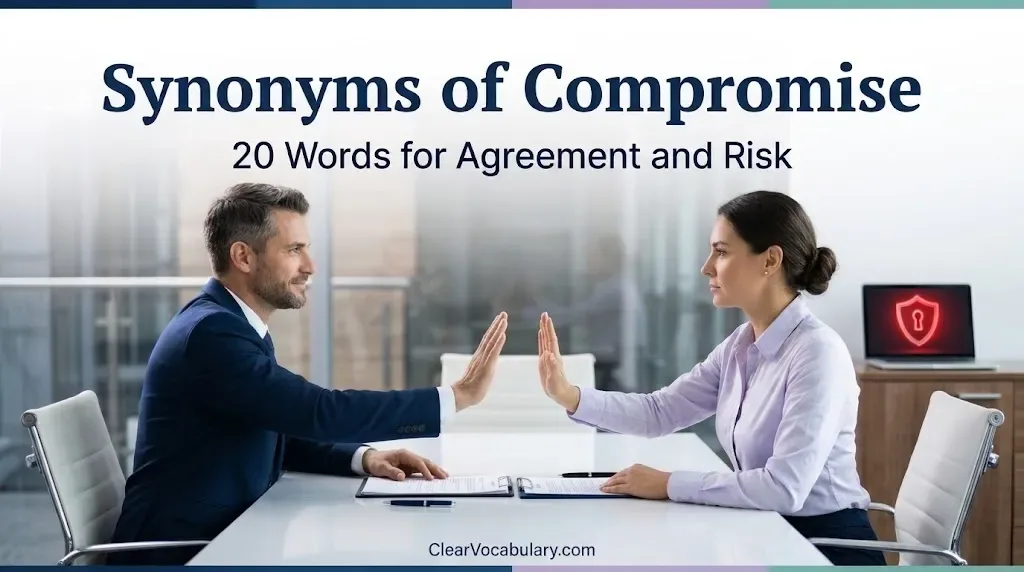
Common synonyms of compromise include settlement, agreement, middle ground, and meet halfway for agreement, and jeopardize, undermine, or endanger when it means putting something at risk.
The best synonyms of compromise depend on the meaning. Use settlement, middle ground, or give-and-take when two sides agree by each giving something up, settle or meet halfway for the action, and jeopardize, undermine, or endanger when compromise means putting something at risk.
Compromise has two very different meanings. “They reached a compromise” is positive, while “the leak compromised security” is negative. This guide groups 20 alternatives by meaning, so you can choose the word that matches your sentence.
Meaning of Compromise
Compromise can be a noun or a verb. It has two main meanings:
- Agreement by mutual concession: each side gives up something to reach a deal.
- Weakening or endangering: to damage or put something at risk, as in “compromise your safety.”
Prototype Meaning
The central meaning is an agreement in which both sides accept less than they originally wanted. This is the sense in “the two parties reached a compromise.”
Connotative Meaning
In the agreement sense, compromise is positive or neutral. It suggests fairness and cooperation. In the sense of weakening, it is negative. “Compromise your principles” suggests giving up your values, and “a compromised account” suggests that security has been damaged. A related adjective, compromising, describes something that could embarrass or incriminate someone, as in “a compromising photo.”
Synonyms of Compromise by Meaning
1. Agreement Reached by Both Sides (Noun)
| Word | Meaning | Tone or Context | Example |
|---|---|---|---|
| Settlement | A formal agreement that ends a dispute | Formal, legal, financial | The two companies reached a settlement. |
| Agreement | A shared decision or understanding | Neutral, general | After a long meeting, they came to an agreement. |
| Deal | An arrangement that both sides accept | Informal, business | The union and management struck a deal. |
| Middle ground | A position between two opposing views | Neutral | The council looked for middle ground on the budget. |
| Give-and-take | Willingness of both sides to concede | Neutral, everyday | A good marriage needs give-and-take. |
| Accommodation | An adjustment that reconciles differences | Formal | The two groups reached an accommodation. |
Agreement is the most general word, but it does not always mean that both sides gave something up. Settlement usually ends a dispute and is common in legal or financial writing. Give-and-take describes the attitude, not the result.
2. A Middle Option Between Two Things
| Word | Meaning | Tone or Context | Example |
|---|---|---|---|
| Happy medium | A satisfactory option between extremes | Everyday | They found a happy medium between spending and saving. |
| Middle course | A path between two extremes | Formal | The government chose a middle course. |
| Balance | An even mix of competing needs | Neutral | The design strikes a balance between style and comfort. |
| Trade-off | Giving up one thing to gain another | Neutral | Speed and cost are a common trade-off. |
Trade-off is a related word, not an exact synonym. It describes giving up one benefit for another, and it does not need two people to reach an agreement.
3. Reaching an Agreement (Verb)
| Word | Meaning | Tone or Context | Example |
|---|---|---|---|
| Settle | Resolve a dispute by agreement | Neutral | The neighbors settled the dispute. |
| Meet halfway | Each side concedes about equally | Informal, common | We agreed to meet halfway on the price. |
| Strike a deal | Reach a business or personal agreement | Informal | They struck a deal after two days of talks. |
| Make concessions | Give up part of a demand | Formal | Both sides had to make concessions. |
| Split the difference | Divide the gap between two positions equally | Informal, price-related | We split the difference at fifty dollars. |
Make concessions can describe one side or both sides giving something up, while meet halfway and split the difference suggest an equal split.
4. Weakening or Putting at Risk (Verb)
| Word | Meaning | Tone or Context | Example |
|---|---|---|---|
| Jeopardize | Put something at risk | Formal | Missing the deadline could jeopardize the project. |
| Undermine | Weaken gradually | Formal, neutral | Constant delays undermined confidence in the team. |
| Endanger | Put in danger | Neutral, strong | Poor wiring endangers the building. |
| Weaken | Make less strong | Everyday | Skipping tests weakens the final result. |
| Expose | Leave open to risk or harm | Neutral, technical | The error exposed customer data. |
Choose these when compromise means damage. Jeopardize suggests risk, while expose and endanger emphasize danger or vulnerability.
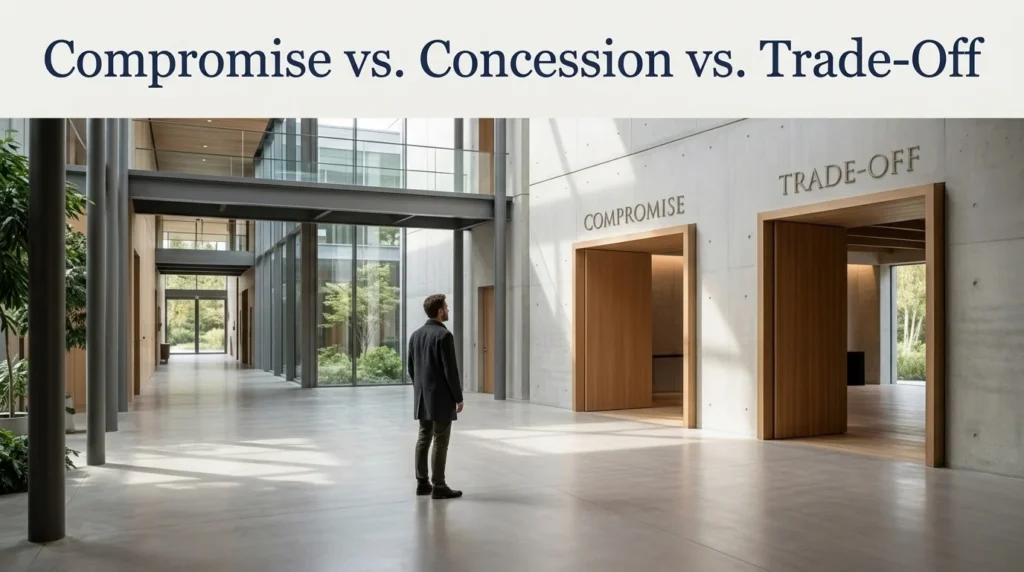
Compromise vs. Concession vs. Trade-Off
| Word | Main Idea | Who Gives Something Up |
|---|---|---|
| Compromise | An agreement or action where both sides give something up | Both sides |
| Concession | Something given up or granted | Usually one side |
| Trade-off | One benefit sacrificed for another | One person or one decision |
Which Word Should You Use?
- Negotiations and business: settlement, deal, or make concessions.
- Politics and public discussion: middle ground or give-and-take.
- Everyday situations: meet halfway, happy medium, or split the difference.
- Legal or financial writing: settlement is the most precise.
- Risk and security writing: jeopardize, undermine, endanger, or expose.
- Relationships: give-and-take sounds natural and warm.
READ MORE 👉: Synonyms for Unwanted: 19 Words for Emails, Items & People
Sentence Transformations
Original: After hours of talks, they reached a compromise.
Alternative: After hours of talks, they reached a settlement.
“Settlement” suggests a formal end to a dispute, often legal or financial.
Original: We compromised on the price.
Alternative: We split the difference on the price.
“Split the difference” is more specific. It means the gap between the two prices was divided equally.
Original: The leak compromised the company’s security.
Alternative: The leak jeopardized the company’s security.
“Jeopardized” means put at risk, while “compromised” in a security context can mean that a breach actually happened.
Grammar and Word Forms
| Word | Part of Speech | Word Forms | Grammar or Use | Example |
|---|---|---|---|---|
| compromise | Noun | compromise, compromises | Countable; often used with reach, make, or find | They reached a compromise. |
| compromise | Verb | compromise, compromises, compromised, compromising | Often followed by on or with | We compromised on the date. |
| compromised | Adjective | compromised | Weakened, damaged, or put at risk | The system was compromised. |
| compromising | Adjective | compromising | Embarrassing or incriminating | She found a compromising letter. |
Pronunciation and Syllables
Compromise is pronounced /ˈkɑːmprəmaɪz/ in US English and /ˈkɒmprəmaɪz/ in UK English. It has three syllables (com-pro-mise), with the stress on the first syllable.
British English vs. American English
The word compromise is spelled the same in both varieties. The related verb jeopardize is spelled jeopardize in American English and usually jeopardise in British English.
Etymology and Word History
Compromise came into English from Old French compromis, which came from Latin compromissum. The Latin word meant a mutual promise to accept the decision of an arbiter, and it was formed from com- (together) and promittere (to promise). This origin helps explain the central idea of a shared agreement.
Antonyms of Compromise
For the agreement sense, opposites include deadlock, standoff, and stalemate. For the verb, stand firm and hold out show refusal to compromise. For the sense of weakening, opposites include protect, safeguard, and strengthen.
Common Mistake
❌ Incorrect: The committee is compromised of five members.
✅ Correct: The committee comprises five members. (or: is composed of five members)
Compromise and comprise are different words. Comprise means to consist of.
Quick Practice

Choose the best word for each sentence.
- The union and the company finally reached a ______ after months of talks. (settlement / endanger)
- Neither side would ______, so the talks failed. (meet halfway / jeopardize)
- Sharing the password could ______ the account’s security. (jeopardize / split the difference)
Answers: 1. settlement (a formal agreement). 2. meet halfway (each side concedes). 3. jeopardize (put at risk).
FAQs
What is a good synonym of compromise?
Settlement, agreement, and middle ground are the most common alternatives for the agreement sense.
What is another word for “reach a compromise”?
Settle, meet halfway, strike a deal, and make concessions are common alternatives.
What is the difference between compromise and concession?
A compromise involves both sides giving something up, while a concession is something one side gives up or grants.
What does a compromised account mean?
It usually means that the account’s security has been damaged and that someone without permission may have access.
What is the difference between compromise and comprise?
Compromise is about agreement or risk, while comprise means to consist of.
What is the opposite of compromise?
Deadlock, standoff, and stand firm are common opposites for the agreement sense, and protect or safeguard for the sense of weakening.
Conclusion
The right synonym of compromise depends on whether you mean agreement or risk. Use settlement, middle ground, or meet halfway when both sides give something up, and jeopardize, undermine, or endanger when something is put at risk. Choosing the closest word makes your meaning clear and keeps your writing precise.

Hi, I’m Sehrish Iqbal, the creator and writer behind clearvocabulary.com. I’m passionate about making English vocabulary easier to understand and use in everyday communication. Through clearvocabulary.com, I share clear explanations, useful synonyms, word meanings, spelling guidance, and practical examples to help readers choose the right words with confidence. My goal is to make learning vocabulary simple, accurate, and genuinely useful for students, professionals, and everyday English learners.