
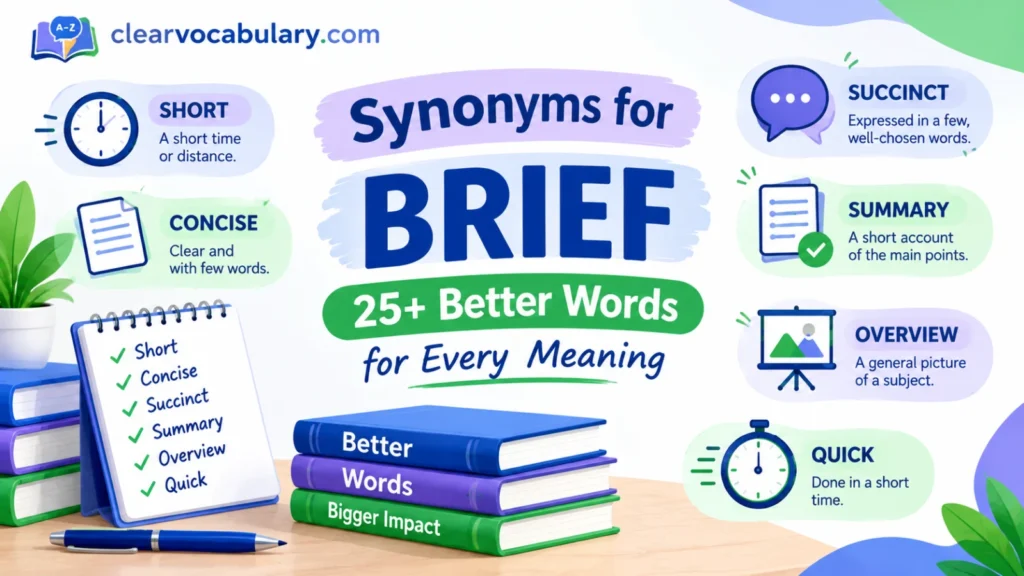

The best synonyms for brief are short, quick, and concise, with overview or synopsis for the noun and inform or update for the verb.
The best synonyms for brief depend on how you use it. For something short in time, use short, quick, fleeting, or momentary. For writing or speech, use concise, succinct, or to the point. For a summary, use overview or synopsis. For giving someone information, use update, inform, or fill in.
Brief is a small word with several jobs. It can be an adjective (“a brief meeting”), a noun (“the design brief”), or a verb (“brief the team”). A synonym that fits one meaning can sound wrong in another, so this guide groups the alternatives by meaning.
Quick Answer
| If brief means… | Best synonyms |
|---|---|
| Lasting a short time | short, quick, momentary, fleeting, passing |
| Using few words | concise, succinct, pithy, compact |
| Too short or abrupt | curt, terse, cursory |
| A summary | overview, synopsis, summary, outline, digest |
| A set of instructions | instructions, directions, guidelines, remit |
| To give information | inform, update, fill in, apprise |
Meaning of Brief
Brief most often means lasting a short time or using few words: a brief pause, a brief reply. It also names a short summary or set of instructions (a client brief), a legal document (a legal brief), and the act of giving someone key information (to brief a manager).
Prototype Meaning
When most people hear “brief,” they picture something short and to the point, such as a quick meeting, a short email, or a few seconds of silence. Everything else grows out of that idea of shortness.
Connotative Meaning
As an adjective, brief is usually neutral to positive. A brief explanation sounds efficient and respectful of the reader’s time. It can turn slightly negative when it suggests too little: “His reply was brief” may hint that he was cold or unhelpful.
Synonyms for Brief by Meaning
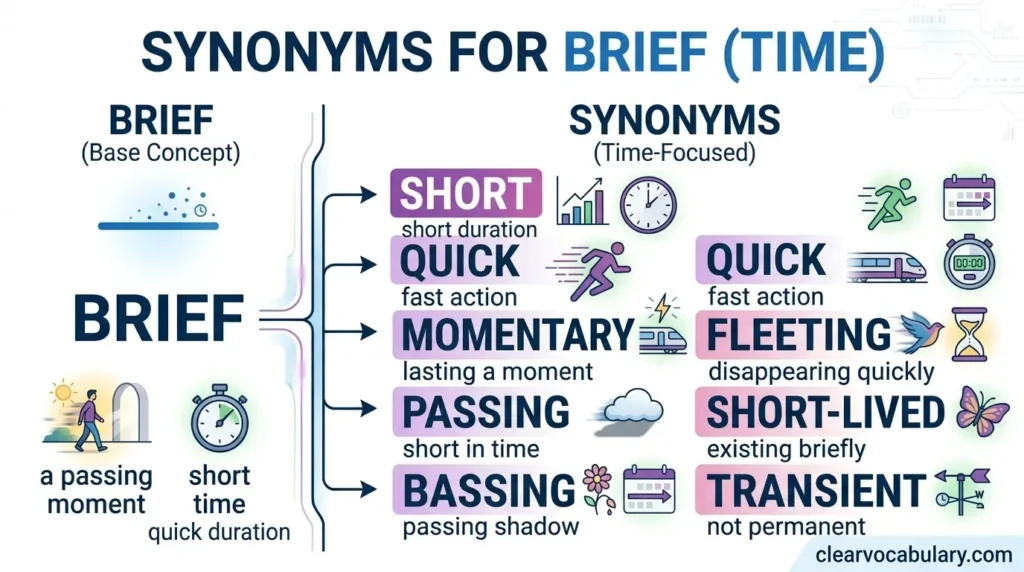
Brief meaning “short in time”
- Short: the most common everyday alternative. We had a short break.
- Quick: stresses speed. Let’s take a quick look.
- Momentary: lasting only a moment. A momentary lapse in concentration.
- Fleeting: passing almost before you notice, often with a feeling of loss. A fleeting smile.
- Passing: slight and not lasting. She made only a passing reference to it.
- Short-lived: ended sooner than expected. Their success was short-lived.
- Transient: formal; staying only briefly. Transient weather conditions.
Brief meaning “using few words”
- Concise: clear and compact, with no wasted words. A concise summary.
- Succinct: similar to concise, slightly more formal. A succinct answer.
- Pithy: short and full of meaning, often memorable. A pithy remark.
- Compact: tightly organized. A compact report.
- To the point: informal and natural in speech and workplace writing.
Brief meaning “too short or abrupt”
- Curt: short in a rude or unfriendly way. A curt reply.
- Terse: very short and sometimes cold. A terse email.
- Cursory: done quickly without care or detail. A cursory glance.
These three can sound critical, so use them for tone problems, not as polite alternatives.
Brief as a noun (summary or instructions)
- Summary: a short account of the main points.
- Overview: a general picture of a subject.
- Synopsis: a short outline of a story, film, or plan.
- Outline: the main points in a basic structure.
- Digest: a condensed version of longer material.
- Précis: a formal, concise summary of a text.
- Instructions / guidelines: for a design or project brief, these are often the closest everyday match.
Brief as a verb (to give information)
- Inform: the general, neutral choice.
- Update: adds the idea of giving the latest information.
- Fill in: informal. I’ll fill you in after the call.
- Apprise: formal. Please apprise the board of the changes.
- Prepare / instruct: fits when the person is being readied for a task.
Synonym Comparison Table
| Word | Meaning | Tone / Context | Example |
|---|---|---|---|
| short | not long in time or length | neutral, everyday | She gave a short speech. |
| concise | brief and clear | positive, professional | Keep your report concise. |
| succinct | expressed in few, well-chosen words | formal, positive | He gave a succinct answer. |
| fleeting | passing quickly | literary, slightly wistful | I caught a fleeting glimpse of her. |
| curt | brief to the point of rudeness | negative | His curt reply surprised everyone. |
| cursory | quick and not thorough | critical | The inspector made a cursory check. |
| overview | general summary | neutral, professional | Here is a brief overview of the plan. |
Which Word Should You Use?
- In emails and work writing: concise or succinct sound polished. “Please keep your update concise.”
- In casual speech: short or quick sound most natural.
- For feelings or moments: fleeting or momentary add emotional weight.
- When criticizing: curt and terse describe tone, while cursory describes effort.
- For summaries: overview suits broad pictures, synopsis suits stories and plans, and summary works almost anywhere.
READ MORE 👉: Synonyms for Antique: 15+ Better Words (With Examples)
Grammar and Word Forms
| Word | Part of Speech | Word Forms | Grammar / Use | Example |
|---|---|---|---|---|
| brief | adjective | brief, briefer, briefest | Describes nouns; comparative and superlative are regular | A briefer version is available. |
| brief | noun | brief, briefs | Countable; often “a brief” or “the brief” | The client sent a brief. |
| brief | verb | brief, briefs, briefed, briefed, briefing | Regular verb; usually takes a person as object | She briefed the team. |
| briefly | adverb | briefly | Means “for a short time” or “in few words” | He briefly explained the rules. |
| briefing | noun | briefing, briefings | A meeting or document that gives key information | The press briefing starts at noon. |
Note that briefs can also mean a style of underwear, which is a separate sense.
Word Formation
brief → briefly, briefness, briefer, briefing
The related noun brevity (shortness, especially in speech or writing) comes from the same Latin root as brief, as do abbreviate and abridge. Using brevity is a common way to sound more formal: “Brevity is important in business writing.”
Pronunciation
| Word | Syllables | Pronunciation |
|---|---|---|
| brief | 1 | /briːf/ |
It rhymes with leaf and chief. The ie makes a long “ee” sound.
Etymology / Word History
Brief came into English from Old French bref, which traces back to Latin brevis, meaning “short.” The noun sense of a short document or summary developed from related Medieval Latin usage, which is why brief names both a quality (short) and a type of document.
Common Collocations and Expressions
- a brief moment / pause / glance
- a brief history of…
- brief and to the point
- in brief (in summary)
- to be brief (a phrase used to shorten what you are about to say)
- hold no brief for (formal; not to support or argue for something)
- a design / creative / legal brief
Sentence Transformations
Original: The meeting was brief.
Alternative: The meeting was short. (Neutral; the most natural swap.)
Original: Please send me a brief summary.
Alternative: Please send me a concise summary. (Sounds more professional and focuses on clarity.)
Original: I need to brief you on the new schedule.
Alternative: I need to update you on the new schedule. (Stresses that the information is new.)
Original: Her answer was brief.
Alternative: Her answer was curt. (Now suggests she was unfriendly, so the meaning has changed.)
Common Mistakes
❌ Incorrect: Please be brevity in your answer.
✅ Correct: Please be brief in your answer.
Brevity is a noun; brief is the adjective needed here.
❌ Incorrect: He briefed me about the project yesterday’s changes.
✅ Correct: He briefed me on yesterday’s project changes.
The verb brief is usually followed by the person, then “on” or “about” the topic.
❌ Incorrect: The writer was very curt, so the essay was easy to read.
✅ Correct: The writer was very concise, so the essay was easy to read.
Curt carries a negative tone and does not praise clear writing.
Antonyms of Brief
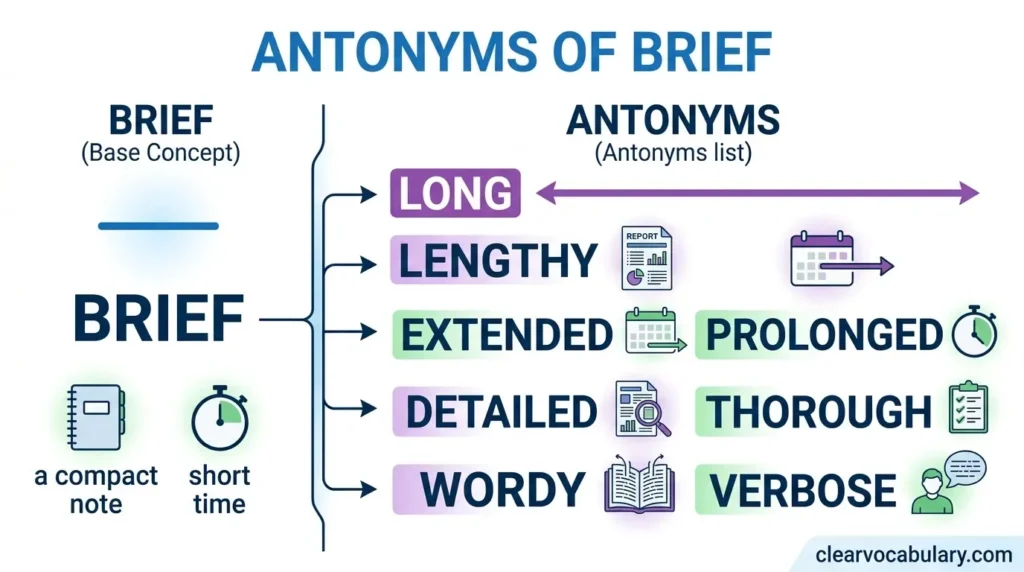
- Long: the simplest opposite. A long meeting.
- Lengthy: often suggests too long. A lengthy report.
- Extended / prolonged: stretched over time. A prolonged silence.
- Detailed / thorough: the opposite of a short summary. A detailed account.
- Wordy / verbose / long-winded: using too many words, usually critical.
Practice: Choose the Correct Word
- The manager asked for a ______ summary she could read in two minutes. (concise / prolonged)
- His ______ reply made the customer feel unwelcome. (succinct / curt)
- We had only a ______ glimpse of the singer before she left. (fleeting / lengthy)
- Please ______ the new staff on safety procedures. (apprise / abridge)
Answers
- concise. A two-minute summary needs to be short and clear.
- curt. Making someone feel unwelcome points to a rude, abrupt tone.
- fleeting. A glimpse that passes quickly is fleeting.
- apprise. It means to inform. Abridge means to shorten a text.
FAQs
What is the best synonym for brief?
For most uses, short is the safest. For writing, concise is usually better.
Is “concise” the same as “brief”?
Not exactly. Something can be brief but unclear, while concise means short and clearly expressed.
What is a synonym for brief as a noun?
Depending on context: summary, overview, synopsis, or instructions.
What is a synonym for “brief someone”?
Inform, update, fill in, or apprise.
Is “curt” a polite synonym for brief?
No. Curt suggests rudeness, so avoid it when you want to compliment someone’s writing.
What is the opposite of brief?
Long, lengthy, or extended for time and length, and detailed for explanations.
How do you pronounce brief?
/briːf/, one syllable, rhyming with “leaf.”
Conclusion
The right synonym for brief depends on the job the word is doing. Use short or quick for time, concise or succinct for clear writing, overview or synopsis for summaries, and inform or update when you are giving someone information. Be careful with curt and terse, which describe brevity that feels cold. Choosing by meaning and tone, rather than just swapping in any short word, keeps your writing natural.



Pingback: Synonyms for Metaphor: 12 Alternatives (With Examples)