

The best synonyms for unwanted are unwelcome, uninvited, and unsolicited for things nobody asked for, unnecessary, surplus, or superfluous for things that are not needed, and unloved, rejected, or abandoned for people, animals, or objects that have been left aside.
Unwanted covers several different situations. “Unwanted emails,” “unwanted furniture,” and “an unwanted guest” all use the same word, but each one is better described with a different alternative. This guide groups 19 synonyms by meaning, so you can choose the one that fits your sentence.
Meaning of Unwanted
Unwanted is an adjective that means not desired, not needed, or not welcome.
Prototype Meaning
The central meaning is something that a person does not want to have, receive, or deal with. Typical examples are unwanted calls, unwanted advice, and unwanted items cleared out of a house.
Connotative Meaning
Unwanted sounds negative, and it can feel emotional when it describes a person or an animal. For objects, it is usually neutral and practical, as in “donate your unwanted clothes.”
Synonyms for Unwanted by Meaning
1. Not Asked For or Not Welcome
| Word | Meaning | Tone or Context | Example |
|---|---|---|---|
| Unwelcome | Not gladly received | Neutral, common | The news was unwelcome. |
| Uninvited | Not asked to come or take part | Neutral | An uninvited guest arrived at the party. |
| Unsolicited | Not asked for, especially advice, emails, or offers | Formal, business | She received unsolicited offers by email. |
| Unrequested | Not asked for | Formal, neutral | The hotel added an unrequested upgrade to the booking. |
| Undesired | Not wished for | Formal | The treatment had undesired effects. |
Unwelcome is the closest everyday match. Unsolicited is very common for emails, calls, and advice, but it is not identical to unwanted. Something unsolicited was not requested, but it might still be welcome.
2. Not Needed or More Than Needed
| Word | Meaning | Tone or Context | Example |
|---|---|---|---|
| Unnecessary | Not needed | Neutral, common | The extra step was unnecessary. |
| Unneeded | Not needed | Plain, neutral | They sold their unneeded equipment. |
| Superfluous | More than is needed | Formal | Delete any superfluous words from the draft. |
| Surplus | Left over beyond what is needed | Business, neutral | The shop sold its surplus stock at a discount. |
| Redundant | No longer needed, or repeating something | Neutral, technical | The old files were redundant after the update. |
| Excess | More than is allowed or needed | Neutral | They cut excess weight from the design. |
Choose these for objects, text, and resources. Surplus and excess are about quantity, while superfluous and unnecessary are about whether something is needed. In British English, redundant also describes a job that is no longer needed.
3. Rejected or Neglected
| Word | Meaning | Tone or Context | Example |
|---|---|---|---|
| Unloved | Not loved or cared about | Emotional | The shelter cares for unloved animals. |
| Rejected | Refused or turned away | Neutral | The rejected applicants were told to reapply. |
| Neglected | Not given proper care | Neutral, descriptive | The neglected garden was full of weeds. |
| Abandoned | Left behind or given up | Strong | Volunteers rescued abandoned pets. |
| Discarded | Thrown away | Neutral, descriptive | Discarded clothing was collected for recycling. |
These words fit people, animals, and objects that have been put aside. Abandoned and unloved carry strong emotion, while discarded is more neutral and mostly describes objects.
4. Disliked or Objectionable
| Word | Meaning | Tone or Context | Example |
|---|---|---|---|
| Undesirable | Not wanted because it is harmful or unpleasant | Formal | The change had undesirable side effects. |
| Objectionable | Likely to cause disapproval | Formal | The company removed objectionable content. |
| Intrusive | Entering without invitation, often into privacy | Descriptive | She disliked the intrusive questions. |
Intrusive is a related word, not an exact synonym. It describes how something enters or interrupts, not simply that it is unwanted.
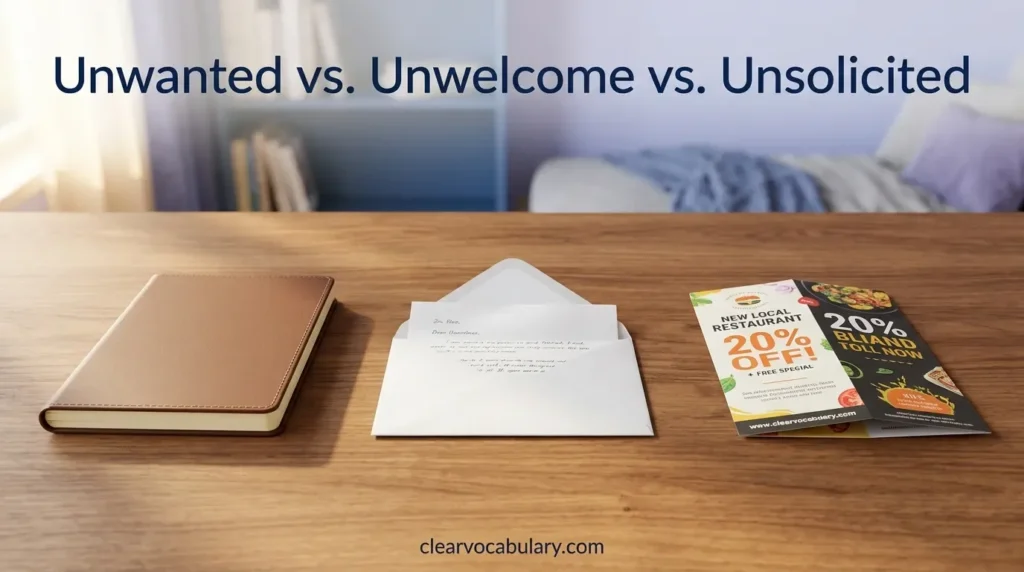
Unwanted vs. Unwelcome vs. Unsolicited
| Word | Main Idea | Typical Use |
|---|---|---|
| Unwanted | Not desired | Items, attention, calls |
| Unwelcome | Not gladly received | News, guests, attention |
| Unsolicited | Not asked for | Emails, advice, offers |
Which Word Should You Use?
- Emails, calls, and marketing: unsolicited is the most accurate and professional choice.
- Items, stock, and resources: surplus, excess, or unneeded.
- Writing and editing: unnecessary or superfluous for extra words.
- Social or emotional situations: unwelcome, rejected, or unloved.
- Animals and objects: abandoned, neglected, or discarded.
- Formal or legal writing: undesirable or objectionable.
READ MORE 👉: Synonyms for Spicy: Words for Food, Flavor & Hot Takes
Sentence Transformations
Original: She kept receiving unwanted emails.
Alternative: She kept receiving unsolicited emails.
“Unsolicited” means not requested. In the context of email, it suggests spam, but the word does not say the emails were disliked.
Original: They donated their unwanted furniture.
Alternative: They donated their surplus furniture.
“Surplus” means more than needed, not necessarily disliked.
Original: He felt unwanted at the party.
Alternative: He felt unwelcome at the party.
“Unwelcome” suggests that others made him feel he should not be there, while “unwanted” can also mean feeling unneeded or unloved.
Grammar and Word Forms
| Word | Part of Speech | Word Forms | Grammar or Use | Example |
|---|---|---|---|---|
| unwanted | Adjective | unwanted | Usually has no comparative form; also used as a noun in the unwanted | Please remove unwanted files. |
| want | Verb, noun | want, wants, wanted, wanting | The base verb | They want a quiet place. |
Word Formation
Unwanted is formed with the prefix un- (meaning “not”) and the past participle wanted: want → wanted → unwanted.
Pronunciation and Syllables
Unwanted has three syllables (un-want-ed), with the stress on the second syllable.
- US English: /ʌnˈwɑːntɪd/
- UK English: /ʌnˈwɒntɪd/
Etymology and Word History
The word want came into English from Old Norse vanta, meaning “to lack.” That older meaning survives in expressions such as “for want of,” meaning “because of a lack of.” The modern sense of desire developed from the idea of lacking something and needing it. Unwanted was formed later by adding the prefix un-.
Antonyms of Unwanted
Common opposites include wanted, desired, welcome, needed, and invited.
Common Mistake
❌ Incorrect: She deleted the unwonted emails.
✅ Correct: She deleted the unwanted emails.
Unwonted is a different, rare word that means unusual or unaccustomed. For something you do not want, use unwanted.
Quick Practice
Choose the best word for each sentence.
- The store sold its ______ stock at half price. (surplus / unloved)
- She reported the ______ messages from a stranger. (unsolicited / abandoned)
- Delete any ______ words to make the sentence shorter. (superfluous / neglected)
Answers: 1. surplus (extra stock). 2. unsolicited (not asked for). 3. superfluous (more than needed).
FAQs
What is a good synonym for unwanted?
Unwelcome, unsolicited, and unnecessary are the most common alternatives, depending on the situation.
What is the difference between unwanted and unwelcome?
Unwanted means not desired, while unwelcome means not gladly received. Unwelcome is more common for news, guests, and attention.
Is unsolicited the same as unwanted?
Not always. Unsolicited means not asked for, and something unsolicited can still be pleasant, such as a gift.
What is another word for unwanted items?
Surplus, excess, unneeded, and discarded are common choices.
What is the difference between unwanted and unwonted?
Unwonted is a rare word meaning unusual. It is not a synonym of unwanted.
What is the opposite of unwanted?
Wanted, desired, and welcome are the most common opposites.
Conclusion
The right synonym for unwanted depends on what is being rejected. Use unsolicited or unwelcome for things nobody asked for, surplus or superfluous for things that are not needed, and abandoned or rejected for people, animals, or objects that have been put aside. Choosing the more specific word makes your meaning clear and your writing more precise.

Hi, I’m Sehrish Iqbal, the creator and writer behind clearvocabulary.com. I’m passionate about making English vocabulary easier to understand and use in everyday communication. Through clearvocabulary.com, I share clear explanations, useful synonyms, word meanings, spelling guidance, and practical examples to help readers choose the right words with confidence. My goal is to make learning vocabulary simple, accurate, and genuinely useful for students, professionals, and everyday English learners.


Pingback: Synonyms of Allow: 19 Ways to Say Permit, Enable & Admit
Pingback: Synonyms of Compromise: 20 Words for Agreement and Risk