

The best synonyms for differently are otherwise, in another way, in a new way, unconventionally, and variously, depending on the meaning.
The best synonyms for differently are otherwise, in another way, in a new way, unconventionally, and variously. Which one fits depends on whether you mean “not the same way,” “in an unusual way,” or “in several different ways.”
Differently is a useful adverb, but it can feel vague when it appears several times in one piece of writing. A more precise word makes a sentence clearer. “She approached the problem unconventionally” says more than “She approached the problem differently.” Below you will find 14 synonyms for differently, grouped by meaning, so you can match the word to what you actually want to say.
Quick Answer
| If you mean… | Best alternatives |
|---|---|
| In another way | otherwise, in another way, in a different manner |
| In a new way | in a new way, innovatively, creatively |
| In an unusual way | unconventionally, unusually, distinctively, uniquely |
| In several ways | variously, diversely |
| In a contrasting way | contrastingly, dissimilarly |
No single word replaces differently in every sentence. Check the meaning first, then pick the alternative.
Meaning of Differently
Differently is an adverb. It means in a way that is not the same as another way, or not the same as before.
- We should have planned the trip differently.
- Identical twins can learn very differently.
Prototype Meaning
The central meaning of differently is “not in the same way as something else.” People usually imagine two actions, people, or situations with a clear contrast between them. Words like think, act, feel, treat, look, and do are its most typical partners.
Connotative Meaning
Differently is neutral by itself. Context gives it a tone.
- Positive: She wrote the ending differently, and it worked beautifully. (a fresh, creative choice)
- Negative: Employees felt they were treated differently. (suggesting unfairness)
- Neutral: The two machines work differently. (a plain statement of fact)
Synonyms for Differently by Meaning
1. In Another Way
These are the closest general substitutes.
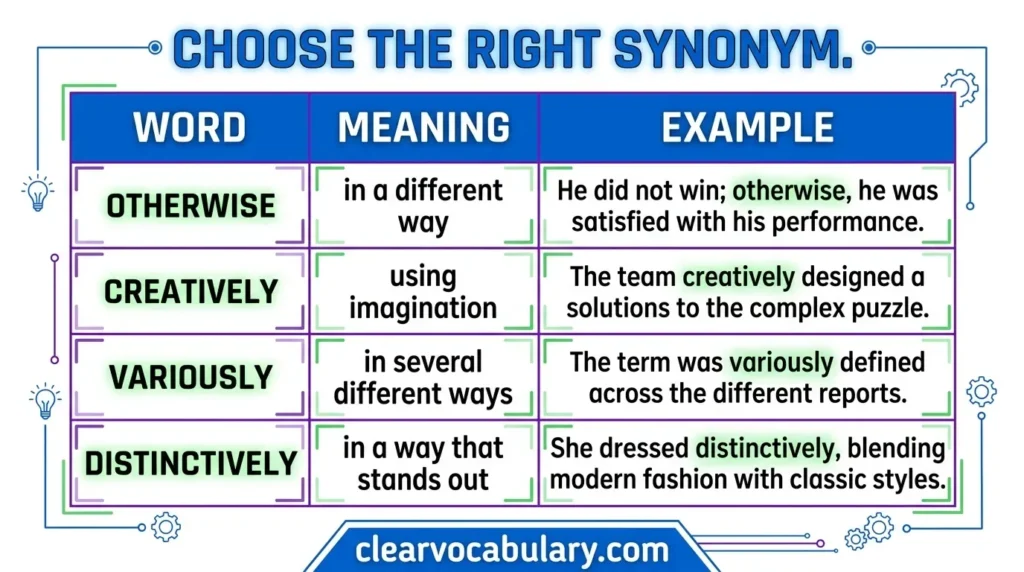
- Otherwise means in a different way or the opposite way. It is slightly formal and works best after verbs like think, believe, decide, or suggest. Unless you hear otherwise, the meeting is still on.
- In another way is plain and natural. Could you explain that in another way?
- In a different manner is more formal and wordier. The committee handled the complaint in a different manner.
2. In a New or Unusual Way
Use these when the difference is a fresh or surprising approach.
- In a new way means not as before. She now sees her job in a new way.
- Unconventionally means not following usual methods or customs. He teaches unconventionally, using music in every lesson.
- Unusually means in a way that is not typical. It can also mean “very,” so check that the meaning is clear.
- Innovatively means using new ideas or methods. The company solved the problem innovatively.
- Creatively means using imagination. She used the space creatively.
- Distinctively means in a way that sets something apart. The band plays distinctively, and you can recognize them in seconds.
- Uniquely means in a way unlike any other. It is stronger than differently, so use it only when something truly stands alone.
3. In Several Different Ways
- Variously means in different ways at different times, or by different people. The film was variously described as brilliant and boring.
- Diversely means in a range of different ways. It is formal and less common. The students responded diversely to the same text.
4. In a Contrasting Way
- Contrastingly means in a way that stands in contrast. Contrastingly, the second group recovered more slowly.
- Dissimilarly means in a way that is not alike. It is formal and mostly found in academic or technical writing.
Related Words That Are Not Exact Synonyms
These words are sometimes used instead of differently, but their meanings are not the same:
- Alternatively introduces another option (“Alternatively, we could leave early”). It does not describe how something is done.
- Conversely shows an opposite situation.
- Anew / afresh mean “again, in a new way.” She began the essay afresh.
- Separately / individually mean one at a time or on its own, which is different from “not the same way.”
Synonym Comparison Table
| Word | Meaning | Tone / Context | Example |
|---|---|---|---|
| Otherwise | In a different way | Formal; common after think, say, decide | He believes otherwise. |
| In another way | Not in the same way | Neutral, everyday | Try explaining it in another way. |
| In a new way | Not as before | Neutral, positive | She sees her job in a new way. |
| Unconventionally | Against usual methods | Neutral to positive | They celebrated unconventionally. |
| Innovatively | With new ideas | Positive; business, design | The team worked innovatively. |
| Distinctively | In a way that stands out | Neutral to positive | The dish is seasoned distinctively. |
| Variously | In several different ways | Formal; descriptions | The result was variously interpreted. |
| Contrastingly | In contrast | Formal; writing and analysis | Contrastingly, sales fell in March. |
Which Word Should You Use?
- Everyday speech: Use differently, in another way, or in a new way. They sound natural.
- Formal or academic writing: Use otherwise, variously, dissimilarly, or contrastingly.
- Praising creativity: Use innovatively, creatively, or distinctively.
- Describing mixed reactions: Use variously. It is the only synonym that clearly means “by different people in different ways.”
- Being cautious: Keep differently when a more specific word would add meaning that is not there. A simple word is better than an inaccurate one.
Grammar and Word Forms
| Word | Part of Speech | Word Forms | Grammar / Use | Example |
|---|---|---|---|---|
| differently | Adverb | more differently (rare), most differently (rare) | Modifies verbs; often followed by from or than | They think differently from us. |
| different | Adjective | more different, most different | Describes nouns | A different approach |
| differ | Verb | differs, differed, differing | Often followed by from | Opinions differ. |
| difference | Noun | differences | Countable | There is a big difference. |
Differently rarely takes a comparative form in natural English. Instead of “more differently,” people usually rephrase the sentence.
Word Formation
Differently is built from different + -ly. The adjective different comes from the verb differ, with the ending -ent, and -ly turns it into an adverb.
differ → different → differently
Related words from the same family include difference and differentiate.
READ MORE 👉: Synonyms for Brief: 25+ Better Words for Every Meaning
Pronunciation
| Word | Syllables | Pronunciation |
|---|---|---|
| differently | 4 in spelling (dif-fer-ent-ly) | /ˈdɪf(ə)rəntli/ |
The middle e is often dropped in speech, so many speakers say it as three syllables: DIF-rent-ly. Both are normal. The stress falls on the first syllable.
Etymology / Word History
Different entered English from Old French and goes back to Latin differre, “to carry apart, to differ,” formed from dis- (“apart”) and ferre (“to carry”). The adverb differently is formed in English by adding -ly to different.
Real-Life Examples
- Everyone remembers the accident differently.
- If I were doing it again, I would do it differently.
- Cats and dogs react very differently to loud noises.
- She dresses quite differently from her friends.
- My brother sees things differently, and I respect that.
Common Collocations and Expressions
- think differently / see things differently
- do things differently
- treat someone differently
- behave differently / act differently
- feel differently about something
- respond differently / perform differently
- no differently (as in She acted no differently than usual)
Common Mistakes
❌ Incorrect: She sings different from her sister.
✅ Correct: She sings differently from her sister.
A verb needs an adverb, so use differently, not the adjective different.
❌ Incorrect: I see the problem alternatively.
✅ Correct: I see the problem differently.
Alternatively introduces another option. It does not mean “in a different way.”
❌ Incorrect: This works diffrently.
✅ Correct: This works differently.
The word has a double f and a middle e: dif-fer-ent-ly.
British English vs American English
The spelling is the same in both varieties. The difference is in the word that follows:
- differently from is accepted everywhere.
- differently than is more common in American English.
- differently to is heard mainly in British English, especially in speech.
None of these is simply wrong. If you are unsure, from is the safest choice.
Antonyms of Differently
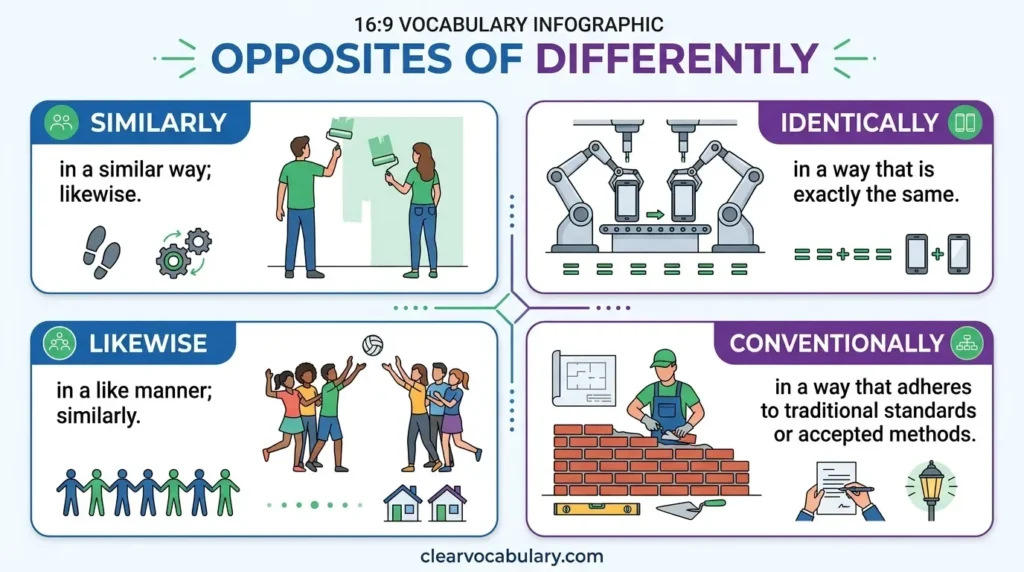
- Similarly means in a like way. Both teams played similarly.
- Identically means in exactly the same way. The twins dress identically.
- Likewise means in the same way. She voted, and he did likewise.
- Conventionally means in the usual way. It is the opposite of unconventionally.
Sentence Transformations
Original: The two groups responded differently to the survey.
Alternative: The two groups responded variously to the survey.
Variously suggests many different reactions, not just two.
Original: He solved the puzzle differently.
Alternative: He solved the puzzle unconventionally.
This adds a sense that his method was unusual.
Original: Unless you tell me differently, I’ll book the table.
Alternative: Unless you tell me otherwise, I’ll book the table.
Otherwise is the more natural, standard phrase here.
Practice: Choose the Correct Word
1. The critics reacted ______ to the film: some loved it, some hated it.
a) similarly b) variously c) identically
2. Unless the notice says ______, the office opens at nine.
a) otherwise b) alternatively c) separately
3. The architect designed the building ______, ignoring every traditional rule.
a) conventionally b) unconventionally c) likewise
4. The teacher explained the idea ______, hoping the class would finally understand.
a) in another way b) uniquely c) contrastingly
Answers
- b) variously. Mixed reactions from different people fit variously.
- a) otherwise. Unless otherwise stated is a standard phrase.
- b) unconventionally. Ignoring traditional rules means breaking convention.
- a) in another way. The meaning is simply “not the same way as before.”
FAQs
What is the best synonym for differently?
It depends on the meaning. Otherwise and in another way are the closest general substitutes. Unconventionally fits unusual methods, and variously fits several different ways.
Is “otherwise” a synonym of differently?
Yes, in the sense of “in a different way,” as in He thinks otherwise. It does not always replace differently. You would not say “She sings otherwise from her sister.”
What is the difference between different and differently?
Different is an adjective that describes a noun (a different plan). Differently is an adverb that describes how something is done (They planned differently).
Is it “differently than” or “differently from”?
Both are used. From is accepted in all varieties of English, while than is more common in American English.
How many syllables does differently have?
It has four in careful speech (dif-fer-ent-ly), though many speakers say three (DIF-rent-ly).
What is the opposite of differently?
Common opposites are similarly, identically, and likewise. For the unusual sense, conventionally is the opposite.
Can I use “alternatively” instead of differently?
Usually not. Alternatively introduces another option, such as “We could, alternatively, take the train.” It does not describe the manner of an action.
Conclusion
Differently is a neutral, flexible adverb, but it is rarely the most precise choice. Use otherwise or in another way for a simple change of method, unconventionally or innovatively for something unusual or new, variously for mixed results, and contrastingly to highlight a contrast. When none of these adds meaning, plain differently is still correct.