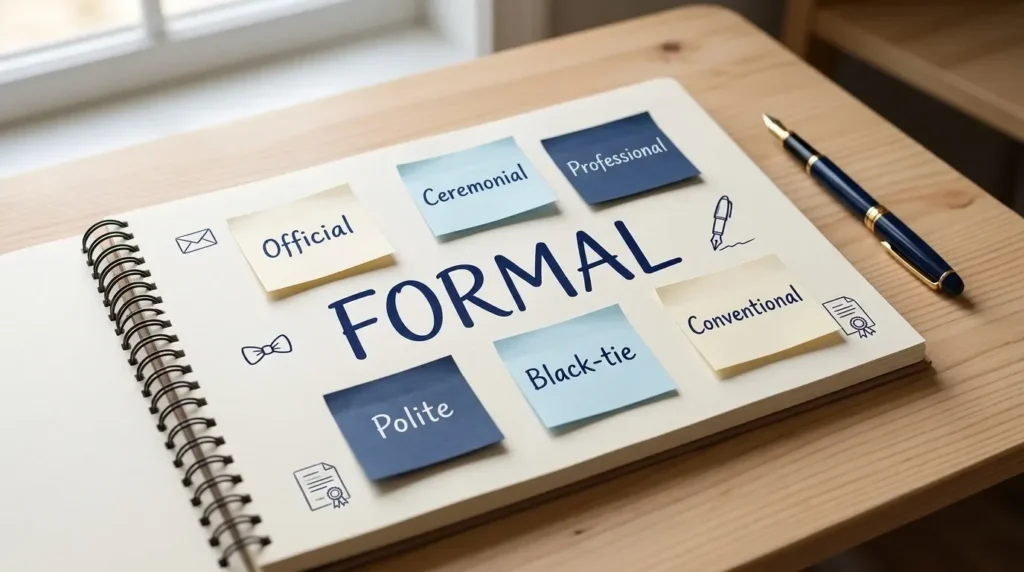

Common synonyms for formal include official, ceremonial, polite, professional, black-tie, and conventional, depending on whether you mean an event, language, dress, manner, or procedure.
The best synonym for formal depends on what you mean. Use official or ceremonial for events, polite or professional for language, black-tie for dress codes, reserved or stiff for manner, and conventional for rules and methods.
Formal is a flexible word, and that is the problem. “A formal dinner,” “a formal tone,” and “a formal agreement” use one word for three different ideas. This guide sorts synonyms for formal by meaning, so you can pick the word that fits your sentence.
Quick Answer: Which Word Fits Your Meaning?
- Event or ceremony: official, ceremonial, solemn
- Writing or speech: professional, polite, courteous, scholarly
- Clothing: black-tie, elegant, smart, dressy
- Personality or manner: reserved, stiff, ceremonious
- Rules or procedures: conventional, prescribed, standard, structured
Meaning of Formal
As an adjective, formal describes something that follows established rules, customs, or procedures. It usually suggests seriousness, correct behavior, or official standing. Common examples are formal language, formal dress, a formal request, and formal education.
Prototype Meaning
The most typical sense of formal is “following accepted rules of etiquette or procedure, especially in serious or public situations.” A formal letter, a formal ceremony, and a formal complaint all fit this core idea.
Connotative Meaning
Formal is usually neutral or positive, suggesting respect, care, and professionalism. In personal settings it can imply distance. A formal greeting between close friends, for example, may sound cold.
Synonyms for Formal by Meaning
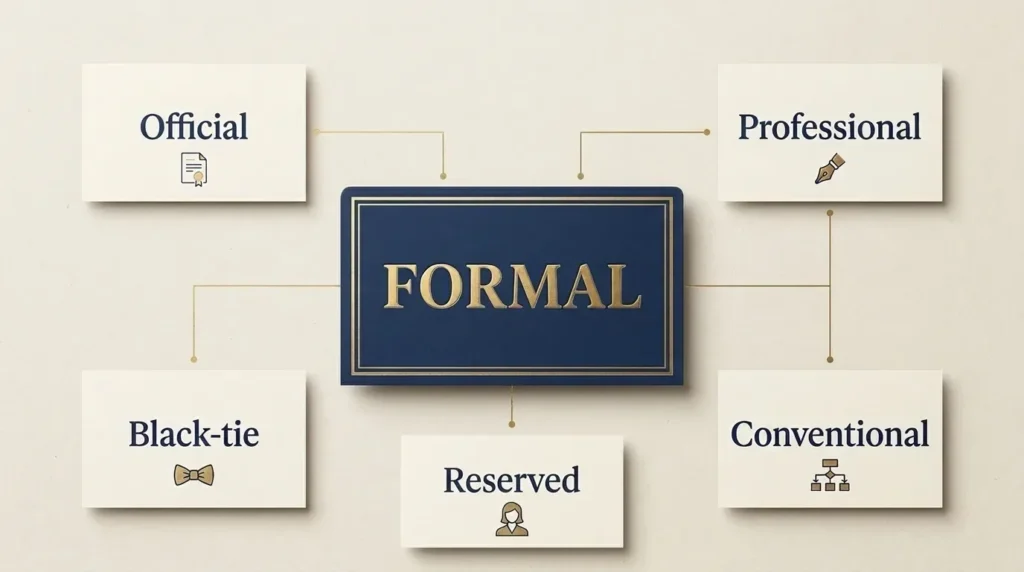
Official or Ceremonial
Use these for events, announcements, and public occasions.
- Official: approved by or coming from an authority
- Ceremonial: relating to a ceremony or ritual
- Solemn: serious and dignified, often for important or sad occasions
- Stately: impressive and slow-moving, with a sense of grandeur
- Dignified: showing calm seriousness and self-respect
Formal Language and Writing
Use these for tone, vocabulary, and style.
- Proper: correct according to accepted standards
- Polite: showing good manners
- Courteous: respectful and considerate, a little more formal than polite
- Professional: suitable for work or business
- Scholarly: suited to academic or learned writing
Formal Dress and Events
Use these for clothing and dress codes.
- Black-tie: a specific dress code, usually tuxedos and evening gowns
- Elegant: stylish and refined
- Smart: well dressed, especially in British English
- Dressy: more formal than everyday wear (informal word)
Stiff or Reserved Manner
These describe how a person behaves. Several carry a negative tone.
- Reserved: keeping feelings and opinions private
- Ceremonious: very careful about correct behavior and ceremony
- Stiff: lacking warmth or ease
- Starchy: stiffly formal (informal, usually critical)
- Stuffy: overly formal and old-fashioned (informal, negative)
- Buttoned-up: very controlled and conventional (informal idiom)
Rules, Methods, and Structure
Use these for procedures, systems, and education.
- Conventional: following accepted standards or customs
- Prescribed: officially set out or required
- Standard: following the usual or accepted form
- Structured: organized according to a clear system
- Orthodox: following traditional or generally accepted methods
- Authorized: officially approved
Some words are related but are not true synonyms. Serious and sober describe mood, and rigid describes inflexibility. None of them means formal.
Comparison Table: Key Alternatives
| Word | Meaning | Tone or Context | Example |
|---|---|---|---|
| Official | Approved by an authority | Neutral, procedural | The school sent an official notice. |
| Solemn | Serious and dignified | Respectful, weighty | The president gave a solemn address. |
| Polite | Showing good manners | Everyday, neutral | Her reply was brief but polite. |
| Professional | Suited to a workplace | Neutral to positive | Keep your email professional. |
| Scholarly | Academic and learned | Positive, written | The essay uses a scholarly tone. |
| Black-tie | Specific evening dress code | Event-specific | The gala is black-tie. |
| Stiff | Lacking ease or warmth | Mildly negative | His speech sounded stiff. |
| Conventional | Following accepted customs | Neutral | They used a conventional format. |
Which Synonym for Formal Should You Use?
In everyday conversation: Polite or proper works best. Formal itself is usually fine too.
In workplace writing: Professional and courteous are clearer than formal. “Keep the tone professional” tells the reader exactly what you expect.
In academic writing: Scholarly and conventional suit essays and research.
For invitations and events: Black-tie, official, and ceremonial are the most precise. In British English, smart is common for dress codes.
To describe a person: Reserved is gentle. Stiff, starchy, and stuffy are critical, so use them only when you mean criticism.
Grammar and Word Forms
| Word | Part of Speech | Word Forms | Grammar or Use | Example |
|---|---|---|---|---|
| formal | adjective | formal, more formal, most formal | Before a noun or after a linking verb | The invitation was formal. |
| formal | noun (chiefly US) | formal, formals | A formal dance or gown | She bought a dress for the winter formal. |
| formally | adverb | more formally, most formally | Describes how something is done | They were formally introduced. |
| formality | noun | formality, formalities | A rule or custom, or the state of being formal | The signing was a mere formality. |
| formalize | verb | formalize, formalized, formalizing, formalizes | Make something official (formalise in British English) | They formalized the agreement. |
Word Formation
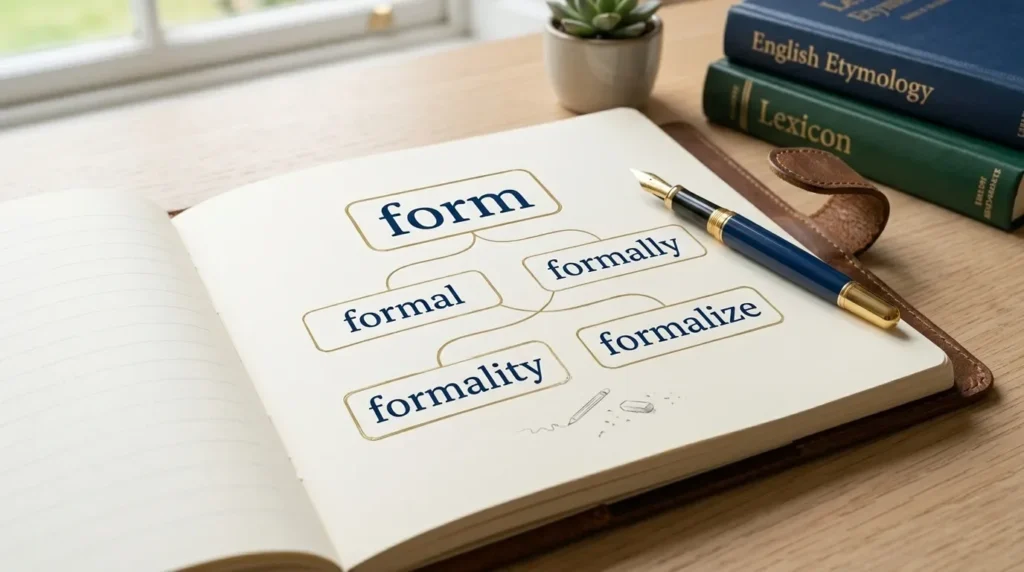
The family grows from a clear root: form → formal → formally, formality, formalize.
The prefix in- gives the opposite: informal → informally, informality.
Pronunciation and Syllables
| Word | IPA (US) | IPA (UK) | Syllables | Stress |
|---|---|---|---|---|
| formal | /ˈfɔːrməl/ | /ˈfɔːməl/ | 2 (for-mal) | First syllable |
Etymology
Formal comes from Latin formalis, which is linked to forma, meaning “shape” or “form.” It entered English in the Middle English period. The sense moved from “relating to form” to “following established forms and rules,” which is how we use it today.
Antonyms
The main antonym is informal. Other opposites depend on the sense:
- Casual: relaxed and not concerned with correctness
- Relaxed: free from stiffness or strictness
- Colloquial: typical of everyday spoken language
- Unofficial: not approved by an authority
- Conversational: natural and friendly in tone
Sentence Transformations
Original: Please use a formal tone in your email.
Alternative: Please use a professional tone in your email.
Professional is more specific to the workplace and sounds less stiff.
Original: The ceremony was very formal.
Alternative: The ceremony was very solemn.
Solemn adds a serious, respectful mood, so it is not always interchangeable with formal.
Original: He is a formal person.
Alternative: He is a reserved person.
Reserved describes personality and avoids the cold feeling that formal can carry.
READ MORE 👉: Sneaky Synonyms: 25+ Better Words for Sneaky (With Examples)
Common Mistakes
Formally vs. formerly: These look alike but mean different things. Formally means in an official or proper way. Formerly means at an earlier time.
❌ Incorrect: She was formally the company’s treasurer.
✅ Correct: She was formerly the company’s treasurer.
The sentence refers to a past role, so it needs formerly.
Also be careful with official. A formal complaint and an official complaint are close in meaning, but a formal letter is not always an official one. Formal describes style, while official describes authority.
Practice Questions
Choose the best word for each sentence: official, black-tie, scholarly, stiff, conventional.
- The invitation said the gala was ______, so he rented a tuxedo.
- The journal prefers a ______ writing style with careful citations.
- After years of working alone, her manner with new colleagues felt ______.
- The company followed a ______ hiring process with interviews and references.
- Only an ______ announcement from the ministry can confirm the change.
Answer key
- black-tie. It names the specific dress code.
- scholarly. It describes academic writing.
- stiff. It describes an awkward, cold manner.
- conventional. It describes a standard, accepted process.
- official. It refers to authority, not style.
FAQs

What is a good synonym for formal?
It depends on the meaning. Official and ceremonial suit events, professional and polite suit language, and conventional suits methods and rules.
What is a synonym for formal in writing?
Professional, scholarly, and courteous are common choices. Proper also works when you mean correct, standard English.
What is another word for formal dress?
Black-tie, elegant, dressy, and smart (in British English) all describe formal dress. Black-tie names a specific dress code.
Is stuffy a synonym for formal?
Only in a negative sense. Stuffy describes something overly formal and old-fashioned, so it is a criticism, not a neutral synonym.
What is the opposite of formal?
Informal is the main antonym. Casual, relaxed, and colloquial are common opposites depending on context.
Is formal the same as official?
Not always. Formal describes style and manner, while official describes approval by an authority. A document can be formal without being official.
Conclusion
Formal covers several ideas: ceremony, correct language, dress codes, reserved manners, and standard procedures. Ask yourself which idea you mean, then choose the synonym that matches it. Official, polite, black-tie, reserved, and conventional each say it more clearly than the general word formal.