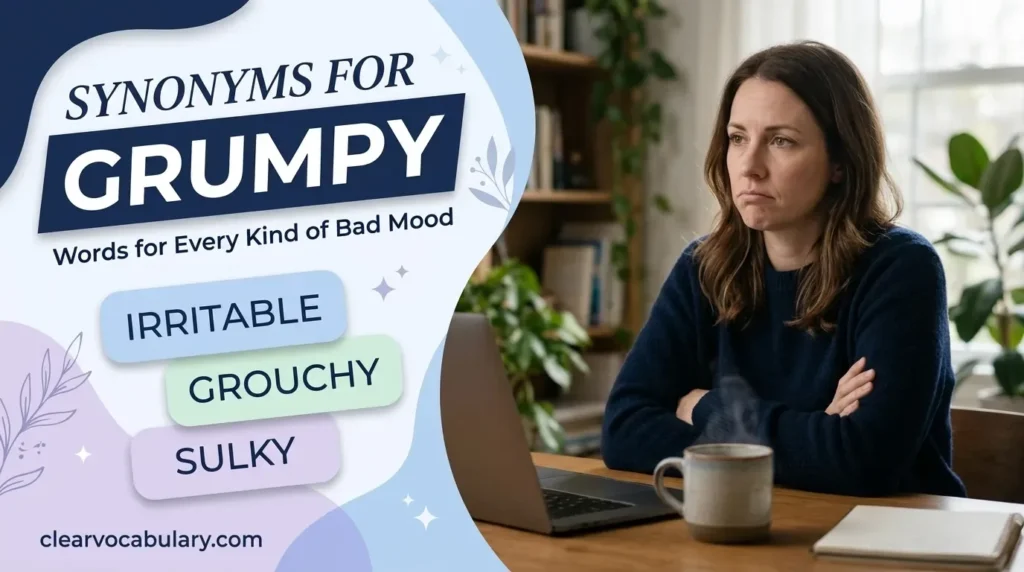

Common synonyms for grumpy include cranky, grouchy, irritable, crotchety, sulky, and irascible, depending on whether the mood is brief, habitual, silent, or formal.
The best synonym for grumpy depends on the kind of bad mood. Use cranky or crabby for a tired, short-lived mood, grouchy or crotchety for a habitually irritable person, sulky or sullen for silent resentment, and irascible for a formal, stronger alternative.
Grumpy is an informal, flexible word, and the right substitute changes with the situation. A toddler who missed a nap, an old neighbor who complains about everything, and a coworker who snaps in meetings are all “grumpy,” but each fits a different word. This guide sorts synonyms for grumpy by meaning, tone, and context, so you can choose the one that fits.
Quick Answer: Which Word Fits Your Meaning?
- Tired or short-lived bad mood: cranky, crabby, cross, out of sorts
- Easily annoyed in general: irritable, testy, short-tempered, snappish
- Habitually bad-tempered, often an older person: grouchy, crotchety, curmudgeonly, cantankerous
- Silent, resentful mood: sulky, sullen, surly
- Formal or literary: irascible, churlish, fractious
Meaning of Grumpy
Grumpy is an adjective meaning bad-tempered, easily annoyed, or in a sour mood. It is informal and usually describes mild irritation rather than real anger. The cause is often small, such as tiredness, hunger, or a bad morning.
Prototype Meaning
The most typical sense of grumpy is “in a bad mood and likely to complain or snap, especially over minor things.” The picture most people have is of someone who needs coffee, sleep, or time alone.
Connotative Meaning
Grumpy sounds mild and often a little humorous. It can be affectionate, as in “a grumpy old man who secretly loves the kids,” or mildly critical. Because it downplays the feeling, it can sound too light for serious anger or hostility.
Synonyms for Grumpy by Meaning
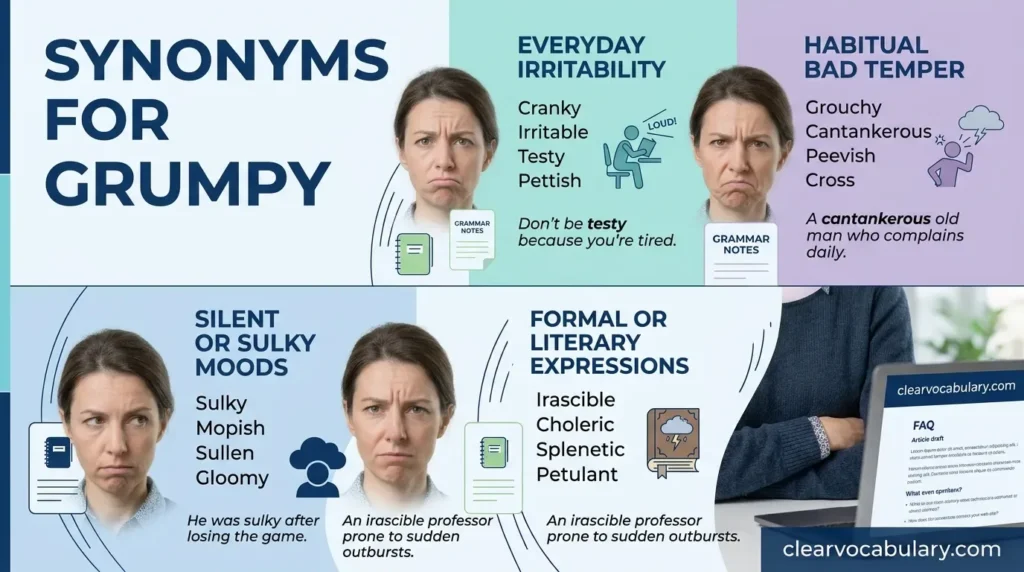
Everyday Irritability
Use these for ordinary bad moods and mild annoyance.
- Bad-tempered: easily angered or in a poor mood (the plainest, most neutral option)
- Cranky: irritable, often from tiredness or discomfort (mainly North American in this sense)
- Crabby: easily annoyed and complaining
- Cross: mildly angry, common in British English
- Irritable: easily annoyed
- Testy: impatient and quick to get annoyed
- Short-tempered: quick to lose patience
- Snappish: inclined to speak sharply
- Ratty: irritable (British informal)
- Narky: bad-tempered (British informal)
- Stroppy: bad-tempered and difficult (British informal)
Habitually Bad-Tempered
These suggest a lasting personality, and many are used for older people.
- Grouchy: complaining and bad-tempered
- Curmudgeonly: bad-tempered and stubborn, usually of an older person
- Crotchety: irritable and set in one’s ways
- Cantankerous: argumentative and hard to please
- Crusty: gruff and short-tempered, often with hidden warmth
- Ornery: stubborn and bad-tempered (US informal)
- Gruff: abrupt or rough in manner, not always angry
- Surly: rude and unfriendly in a bad-tempered way
Silent or Sulky Moods
These describe resentment shown through silence or a pouting manner.
- Sulky: silently resentful, often childishly
- Sullen: gloomy and unwilling to talk or cooperate
- Petulant: childishly bad-tempered over something small
- Peevish: complaining in an irritable, childish way
- Querulous: complaining in a whiny tone (formal)
Formal or Literary
Use these in more formal writing or fiction.
- Irascible: easily made angry
- Churlish: rude and unpleasant in a mean way
- Fractious: irritable and difficult to control
Nouns for a Grumpy Person
A grump or a grouch is a grumpy person. A curmudgeon is a bad-tempered, stubborn person, usually older.
Some related words are not true synonyms. Moody means having changeable moods, glum means sad, and angry is stronger than grumpy. They can overlap with grumpy in a sentence, but they do not mean the same thing.
Comparison Table: Key Alternatives
| Word | Meaning | Tone or Context | Example |
|---|---|---|---|
| Cranky | Irritable, often from tiredness | Informal, everyday | The baby was cranky after the flight. |
| Grouchy | Complaining and bad-tempered | Informal, mildly humorous | He’s grouchy before his first coffee. |
| Irritable | Easily annoyed | Neutral, suited to formal use | Lack of sleep made her irritable. |
| Testy | Impatient and quick to annoy | Neutral to slightly formal | He gave a testy reply. |
| Sulky | Silently resentful | Often childish | She went quiet and sulky after losing. |
| Surly | Rude and unfriendly | Negative | The surly clerk barely looked up. |
| Curmudgeonly | Stubborn and bad-tempered | Often affectionate, for older people | The curmudgeonly neighbor waved us off his lawn. |
| Irascible | Easily made angry | Formal, literary | The irascible professor shouted at the class. |
Which Synonym for Grumpy Should You Use?
Describing a tired child or a short-lived mood: Cranky, cross, or crabby fits best.
Describing a coworker or in professional writing: Irritable or short-tempered is neutral and safe. Cranky and grouchy sound too casual.
Describing an older character in fiction: Curmudgeonly, crotchety, and crusty add personality.
Describing silence and resentment: Sulky or sullen shows the mood through behavior.
Writing in a formal or literary style: Irascible and fractious sound more serious.
Adding humor or affection: Grumpy, grouchy, and crabby keep the tone light.
READ MORE 👉: Synonyms for Formal: 25+ Words for Writing, Dress, and Events
British English vs. American English
Some choices depend on region. Cranky and ornery are most familiar in American English. In British English, cross, ratty, narky, and stroppy are common. Note that cranky in British usage can also mean eccentric, so American readers may read it differently.
Grammar and Word Forms
| Word | Part of Speech | Word Forms | Grammar or Use | Example |
|---|---|---|---|---|
| grumpy | adjective | grumpy, grumpier, grumpiest | Before a noun or after a linking verb | She is always grumpy before coffee. |
| grumpily | adverb | more grumpily, most grumpily | Describes how something is done | He answered grumpily. |
| grumpiness | noun | grumpiness (uncountable) | The state of being grumpy | His grumpiness faded after lunch. |
| grump | noun (informal) | grump, grumps | A grumpy person | Don’t be such a grump. |
Word Formation
The family builds from a short root: grump → grumpy → grumpily, grumpiness.
Pronunciation and Syllables
| Word | IPA | Syllables | Stress |
|---|---|---|---|
| grumpy | /ˈɡrʌmpi/ | 2 (grump-y) | First syllable |
Etymology
Grumpy dates from the late 1700s and is formed from the noun grump plus the suffix -y. The origin of grump itself is uncertain, and it may imitate a low grumbling sound.
Common Collocations and Expressions
- grumpy old man: a stock phrase, often affectionate
- wake up grumpy: to be in a bad mood from the start of the day
- get out of bed on the wrong side: an idiom meaning to be in a bad mood for no clear reason
Antonyms
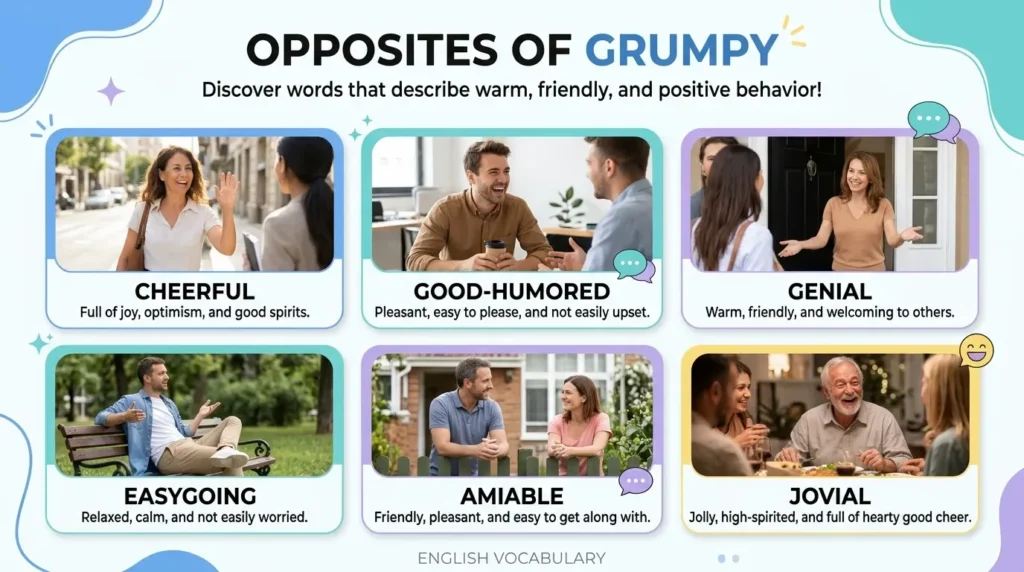
The opposite of grumpy depends on the sense.
- Cheerful: noticeably happy and positive
- Good-humored: having a pleasant, tolerant mood
- Genial: friendly and warm
- Easygoing: relaxed and not easily annoyed
- Amiable: friendly and likable
- Jovial: cheerful and sociable
Sentence Transformations
Original: My boss was grumpy this morning.
Alternative: My boss was irritable this morning.
Irritable is more neutral and suits workplace writing.
Original: The grumpy old man complained about the noise.
Alternative: The curmudgeonly old man complained about the noise.
Curmudgeonly adds a sense of stubborn, long-standing bad temper.
Original: The kids were grumpy after the long drive.
Alternative: The kids were cranky after the long drive.
Cranky fits tiredness and discomfort, and sounds natural in everyday American English.
Common Mistakes
Choosing a word that clashes with the behavior. Sulky suggests silent resentment, so it does not match a person who is shouting.
❌ Incorrect: The sulky customer shouted angrily at the staff.
✅ Correct: The irritable customer shouted at the staff.
Sulky describes quiet pouting, not open anger. Irritable fits the shouting better.
Also avoid treating moody as a direct synonym. Moody means having changeable moods, so someone can be moody without being grumpy. Finally, remember that grumpy is informal. In a formal report, choose irritable or bad-tempered instead.
Practice Questions
Choose the best word: cranky, curmudgeonly, sulky, irascible, surly.
- The toddler was ______ because she had missed her nap.
- After the argument, he sat in ______ silence and refused to talk.
- The ______ shopkeeper barely answered our questions.
- The ______ old neighbor complained about the noise every weekend.
- The ______ editor was known for losing his temper over small errors.
Answer key
- cranky. It fits tiredness and a short-lived mood.
- sulky. It describes silent resentment.
- surly. It suggests rudeness and an unfriendly manner.
- curmudgeonly. It suits an older, stubborn, bad-tempered person.
- irascible. It describes someone easily made angry, in a formal tone.
FAQs
What is a good synonym for grumpy?
Cranky, grouchy, and irritable are the most common everyday choices. Irritable is the most neutral.
What is another word for a grumpy old man?
Curmudgeon is the usual noun. As adjectives, curmudgeonly, crotchety, crusty, and cantankerous all fit.
What is the difference between grumpy and grouchy?
They are very close in meaning. Grouchy often suggests more open complaining, while grumpy can be quieter and is often used affectionately.
What is a formal synonym for grumpy?
Irritable, bad-tempered, and irascible work in formal writing. Irascible is the strongest and most literary of the three.
What word means grumpy because of tiredness?
Cranky is the most natural choice, especially for children. Out of sorts is a gentler phrase.
What is the opposite of grumpy?
Cheerful is the most direct opposite. Good-humored, genial, and easygoing are common alternatives.
Conclusion
Grumpy covers a wide range, from a tired child to a lifelong complainer. Match the synonym to the situation: cranky for a short-lived mood, irritable for neutral description, curmudgeonly or crotchety for a character, sulky for silent resentment, and irascible for formal writing. The more precisely the word fits, the clearer the picture you give your reader.