

The best synonyms for antique are vintage, old, ancient, period, heirloom, and collectible, but each one means something slightly different. Antique usually describes a valuable old object, so the right alternative depends on how old the item is and why it matters.
People often use antique, vintage, and old as if they were interchangeable. They are not. A 250-year-old oak table is an antique, a 1970s jacket is vintage, and last decade’s phone is simply old. This guide explains the real differences, so you can choose the word that fits.
Quick Answer
| If you mean… | Use |
|---|---|
| Valuable and very old (often 100+ years) | antique, period piece, heirloom |
| Old but not quite antique | vintage, retro, classic |
| Simply not new | old, aged, secondhand |
| Extremely old, from early history | ancient, archaic |
| Old-fashioned in style | old-fashioned, dated, outmoded |
| Worth collecting | collectible, curio, relic |
Meaning of Antique
Antique can be an adjective or a noun. As an adjective, it describes something very old, often valued for its age, craftsmanship, or rarity. As a noun, it means an old object, such as furniture, jewelry, or a clock, that collectors or buyers value.
She inherited an antique mirror from her grandmother. (adjective)
The shop sells antiques from the Victorian era. (noun)
Prototype Meaning
When most people hear antique, they picture a well-made, valuable old object: a carved wooden cabinet, a pocket watch, or a porcelain vase. The idea combines age, quality, and value.
Connotative Meaning
Antique usually has a positive connotation. It suggests charm, history, craftsmanship, and worth. In casual speech, however, calling a person or a device “antique” can sound negative or humorous, as in “This laptop is an antique,” meaning it is hopelessly outdated.
Synonyms for Antique
Close Synonyms (Valuable Old Objects)
- Vintage: Old and typically of high quality, from a specific past period. It is often used for items about 20–99 years old, such as clothing, wine, or cars. She wore a vintage dress from the 1960s.
- Period (as in period furniture): Made in or typical of a specific historical era. The hotel is decorated with period furniture.
- Heirloom: A valued object passed down through a family. The ring is a family heirloom. An heirloom is not necessarily an antique, but it often is.
- Collectible: Something that people collect, whether or not it is very old. Early comic books are highly collectible.
- Classic: Of lasting quality and style, often used for older cars, films, and designs. He restored a classic Mustang.
Contextual Alternatives (Simply Old)
- Old: The everyday, neutral choice with no suggestion of value.
- Aged: Old, often through long use or time. An aged oak barrel.
- Ancient: Belonging to the very distant past, usually thousands of years ago. Ancient pottery was found at the site.
- Time-worn: Showing the effects of age and use. A time-worn staircase.
- Secondhand: Previously owned, with no suggestion of historical value.
Formal or Literary Alternatives
- Archaic: Belonging to an earlier time and no longer in common use. Often used for language, customs, or technology.
- Venerable: Respected because of great age. A venerable institution. This is usually used for people, buildings, or traditions rather than objects for sale.
- Antiquated: Old-fashioned and out of date. This one tends to be negative.
- Obsolete: No longer used because something newer has replaced it.
Informal Alternatives
- Retro: Imitating or recalling the style of the recent past. A retro diner. Retro items may be new but styled to look old.
- Old-school: Traditional or from an earlier style. An old-school record player.
- Oldie: A casual word for something old, such as a song or film.
Nouns Related to Antiques
These are related words, not exact synonyms:
- Relic: An object that survives from the past, often with historical or sacred importance.
- Artifact (also artefact): An object made by people in the past, usually studied by historians or archaeologists.
- Curio: A small, unusual, and interesting object.
- Keepsake: An item kept for sentimental reasons, regardless of age.
Antique vs Vintage vs Old: What’s the Difference?
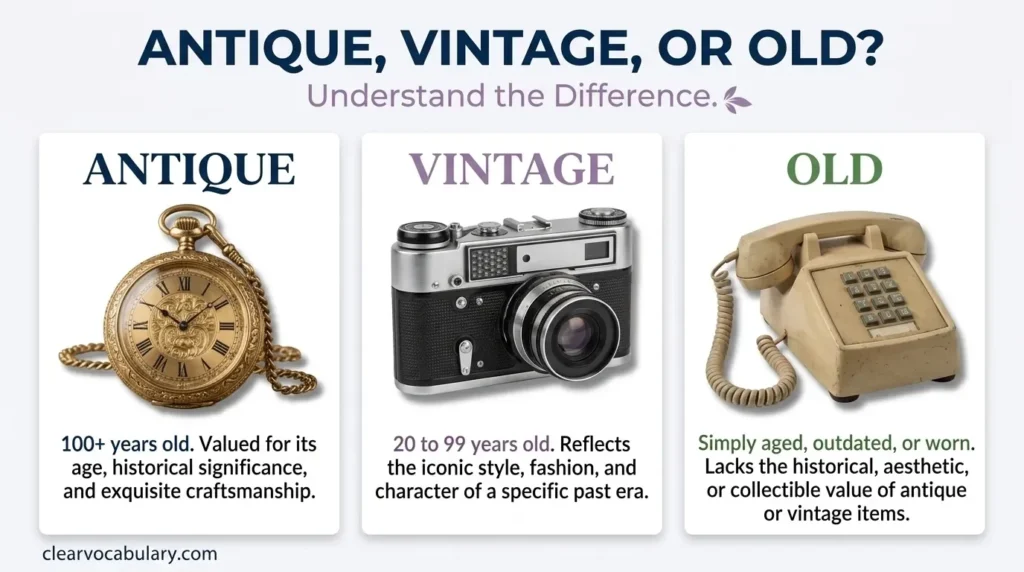
| Word | Typical Meaning | Usual Age | Tone | Example |
|---|---|---|---|---|
| Antique | Valuable, well-made old item | Often 100+ years | Positive, formal | an antique desk |
| Vintage | High-quality item from a past era | About 20–99 years | Positive, trendy | a vintage guitar |
| Old | Not new | Any age | Neutral | an old bicycle |
| Ancient | From the distant past | Thousands of years | Neutral to dramatic | an ancient coin |
| Retro | Styled like the past | May be new | Casual, fashionable | a retro lamp |
The “100 years old” rule for antiques is a common guideline in antiques trading, especially in the United States and the UK, but it is not a universal legal definition. Rules can differ by country and by customs or insurance purposes.
Which Word Should You Use?
- Selling or buying furniture, art, or jewelry: Use antique if it is very old and valuable. Use vintage for mid-century or more recent pieces.
- Fashion and cars: Vintage or classic is the usual choice, since antique sounds too old for most clothing.
- Describing a family object: Heirloom highlights sentimental value and inheritance.
- Archaeology and history: Use ancient, artifact, or relic.
- Humor or criticism: Words such as outdated or antiquated work better than antique.
- Everyday writing: Plain old is often the clearest choice.
READ MORE 👉: Synonyms Definition and Examples: Types & Easy Guide
Sentence Transformations
Original: She collects antique clocks.
Alternative: She collects vintage clocks.
The alternative suggests the clocks are younger, perhaps from the 20th century.
Original: The museum displays antique tools from the 1800s.
Alternative: The museum displays period tools from the 1800s.
“Period” focuses on the historical era rather than on value.
Original: That antique computer still works.
Alternative: That outdated computer still works.
“Outdated” removes the idea of value and adds a mildly critical tone.
Grammar and Word Forms
| Word | Part of Speech | Word Forms | Grammar / Use | Example |
|---|---|---|---|---|
| antique | Adjective | no comparative in normal use | Placed before a noun or after be | an antique vase |
| antique | Noun | antique, antiques | Countable noun | She sells antiques. |
| antique | Verb (rare) | antiques, antiqued, antiquing | Means to give an old appearance to something, or to shop for antiques | They spent the weekend antiquing. |
Related forms include antiquity (ancient times), antiquated (outdated), antiquarian (a person who collects or studies old objects), and antiquity-related terms such as antiquities.
Pronunciation
| Word | Syllables | Pronunciation |
|---|---|---|
| antique | 2 | /ænˈtiːk/ |
The stress falls on the second syllable: an-TEEK. The -que ending is pronounced /k/, not “kwe.”
Etymology / Word History
Antique entered English from French (antique), which came from Latin antiquus, meaning “old” or “ancient.” The same Latin root gave English antiquity. Early uses referred to things from ancient times, and the sense of a valued old object developed later.
Common Collocations and Expressions
- antique shop / antique store
- antique furniture
- antique dealer
- antique jewelry
- antique finish (a surface treated to look aged)
- antique white (a warm off-white color)
- Antiques Roadshow is a well-known television program name, not a general expression.
Common Mistakes
❌ Incorrect: I bought an antique phone from 2015.
✅ Correct: I bought an old phone from 2015. (or a used phone)
A 2015 phone is not usually considered an antique.
❌ Incorrect: The vintage Roman statue is on display.
✅ Correct: The ancient Roman statue is on display.
Vintage is not used for objects from the ancient world.
❌ Incorrect: She sells vintage antiques from the 1990s.
✅ Correct: She sells vintage items from the 1990s.
Using both words together is contradictory in most contexts.
British English vs American English
The spelling antique is the same in both varieties. Usage is also very similar, though both countries commonly use “100 years” as an informal threshold. In the UK, antique dealer and antiques fair are especially common phrases, and antiques is regularly used as a plural noun in both countries.
Antonyms of Antique
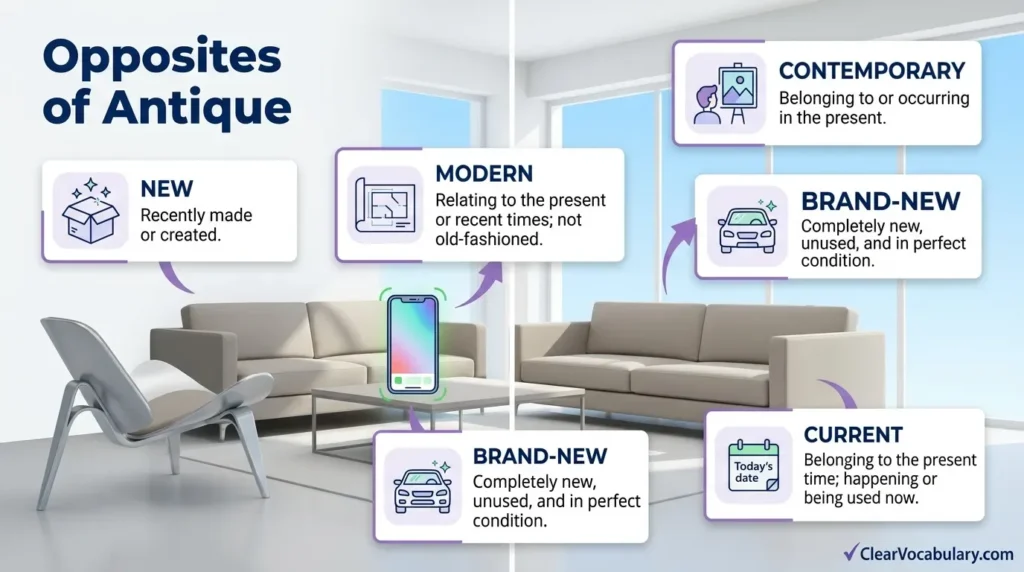
- New: a new table
- Modern: modern furniture
- Contemporary: contemporary art
- Brand-new: a brand-new phone
- Current: current technology
Practice: Choose the Correct Word
1. A 1960s leather jacket would usually be called ______.
a) ancient b) vintage c) archaic
2. The ring has been passed down in our family for generations. It is a(n) ______.
a) heirloom b) obsolete c) retro
3. Archaeologists discovered ______ tools thousands of years old.
a) retro b) ancient c) secondhand
4. The café is decorated in a ______ style, though everything in it is new.
a) retro b) venerable c) antique
Answers
- b) vintage. It is a high-quality item from a past era, but not old enough to be an antique.
- a) heirloom. The key idea is being passed down in a family.
- b) ancient. The tools are from the distant past.
- a) retro. Retro describes new items styled to look like the past.
FAQs
What is the best synonym for antique?
Vintage is the most common alternative, but it usually refers to younger items. For an object of similar age and value, period piece or heirloom may fit better.
Is vintage the same as antique?
No. Antique usually suggests an item around 100 years old or more, while vintage usually means an item from a specific past era, often 20 to 99 years old.
How old does something need to be to be an antique?
Many dealers use 100 years as a general guideline, but this is a trade convention rather than a rule that applies everywhere.
Can I call a person “antique”?
It is possible in a humorous way, but it can sound rude. Words such as elderly or senior are more polite, and venerable can sound respectful in the right setting.
What is the difference between antique and ancient?
Antique describes valuable old objects, often a few hundred years old. Ancient describes the very distant past, such as ancient Egypt or Rome.
What is the opposite of antique?
Common opposites are new, modern, and contemporary.
Is “antiquated” a synonym for antique?
Not exactly. Antiquated means old-fashioned or outdated and usually carries a negative tone, while antique is generally positive.
Conclusion
Choose antique for valuable objects that are very old, vintage for quality items from a recent past era, and ancient for things from the distant past. Use heirloom when family history matters, retro for new items with an old style, and plain old when none of the extra meaning is needed. Matching the word to the age, value, and tone of what you are describing makes your writing more precise.



Pingback: Synonyms for Brief: 25+ Better Words for Every Meaning