
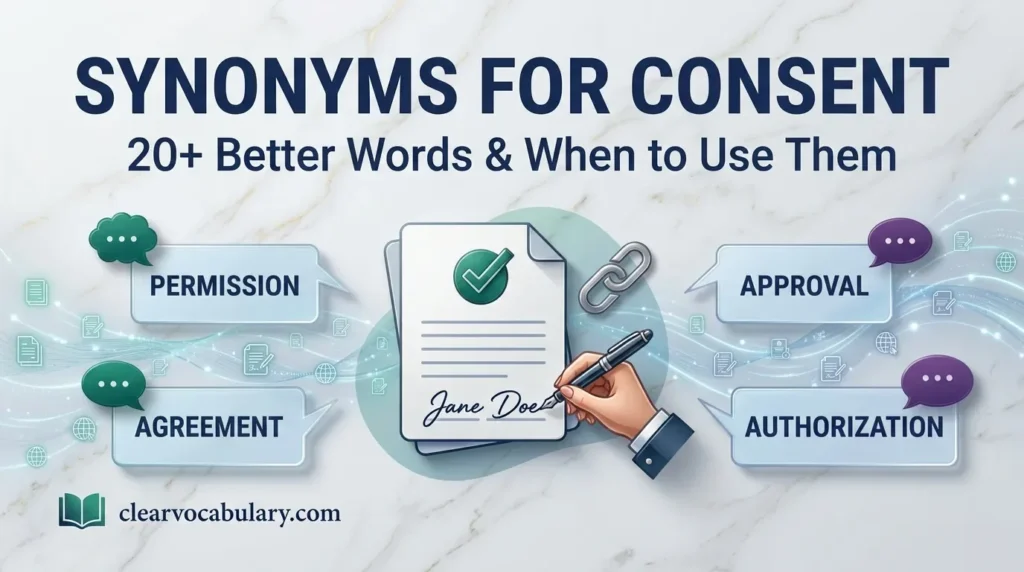

The best synonyms for consent are permission, approval, agreement, assent, and authorization. Which one fits depends on whether you mean agreeing to something, allowing something, or officially approving something.
Consent is a small word that carries a lot of weight. It appears in legal documents, medical forms, contracts, privacy notices, and everyday conversation, and the right alternative changes depending on the setting. This guide groups synonyms for consent by meaning, shows how formal or casual each one sounds, and gives natural examples.
Quick Answer
| If you mean… | Best synonyms |
|---|---|
| Agreeing to something | agreement, assent, acceptance, acquiescence |
| Allowing something | permission, leave, sanction, allowance |
| Officially approving something | approval, authorization, clearance, endorsement |
| As a verb: to agree | agree, assent, accede, concur, comply |
| As a verb: to allow | permit, allow, authorize, approve, sanction |
No single word replaces consent in every sentence. “Informed consent” can’t simply become “informed permission,” for example, because the term is fixed in law and medicine.
Meaning of Consent
Consent can be a noun or a verb. As a noun, it means agreement or permission for something to happen. As a verb, it means to agree to something or allow it.
Prototype Meaning
The central idea is a person freely agreeing to something that affects them or that someone else wants to do. Think of signing a form, saying “yes, that’s fine,” or giving the go-ahead.
Connotative Meaning
Consent is generally neutral to positive, but it carries a serious, respectful tone. It suggests the decision was made freely and knowingly. Words like acquiescence or submission can sound negative because they imply reluctant or pressured agreement, so they are not true replacements when freely given agreement is the point.
Synonyms for Consent by Meaning
Consent as agreement
- Agreement: a general, everyday word for saying yes. “We reached agreement on the schedule.”
- Assent: formal; a quiet or official yes. “The board gave its assent to the merger.”
- Acceptance: agreeing to take or go along with something. “Her acceptance of the terms was immediate.”
- Concurrence: formal; agreement with another person’s view or decision. “The judge noted the concurrence of both parties.”
- Acquiescence: agreeing without protest, often reluctantly. “His acquiescence came after weeks of pressure.”
Consent as permission
- Permission: the most common everyday synonym. “You need your parents’ permission to go on the trip.”
- Leave: formal or old-fashioned. “He asked leave to speak.”
- Allowance: informal permission or tolerance. Less common in this sense.
- Sanction: official permission, and in some contexts also approval. “The project had the sanction of the council.” Note that sanction can also mean a penalty, so check the context.
Consent as official approval
- Approval: a positive, widely used word. “The plan received approval from management.”
- Authorization: formal, official permission, often in writing. “The bank requires authorization before the transfer.”
- Clearance: official permission to proceed. “The team got clearance to begin construction.”
- Endorsement: public support or approval. “The proposal gained the endorsement of local doctors.”
- Blessing: informal, warm approval. “They got their parents’ blessing to marry.”
- Go-ahead / green light: informal. “We finally got the green light.”
Consent as a verb
- Agree: “She agreed to the interview.”
- Assent: formal. “The senator assented to the amendment.”
- Accede: formal; to yield to a request. “The company acceded to their demands.”
- Concur: to share an opinion or decision. “The second doctor concurred.”
- Permit / allow: “The school permits students to use phones at lunch.”
- Approve / authorize: “The manager approved the request.”
Comparison Table: Choosing Between Close Synonyms
| Word | Tone | Best context | Example |
|---|---|---|---|
| Permission | Neutral, everyday | Rules, requests, family | “I asked permission to leave early.” |
| Approval | Positive | Work, plans, ideas | “The design won the client’s approval.” |
| Assent | Formal | Official or legal agreement | “The king gave his royal assent.” |
| Authorization | Formal, official | Business, banking, security | “You need written authorization.” |
| Agreement | Neutral | Mutual decisions, contracts | “They signed an agreement.” |
| Acquiescence | Formal, slightly negative | Reluctant agreement | “Her silence was taken as acquiescence.” |
Which Word Should You Use?
- Everyday conversation: use permission, okay, or agreement. “Did you get permission?” sounds natural.
- Workplace writing: approval and authorization are the clearest. “Please send approval by Friday.”
- Legal and medical writing: keep consent itself when it is part of a fixed term such as informed consent, parental consent, or age of consent. Replacing it can change the legal meaning.
- Formal or political writing: assent and concurrence suit official decisions.
- Reluctant yes: acquiescence or acceptance describes agreement without enthusiasm.
- Warm, personal approval: blessing works well in family and relationship contexts.
Grammar and Word Forms
| Word | Part of speech | Forms | Grammar / use | Example |
|---|---|---|---|---|
| consent | noun | consents (rare plural) | Usually uncountable | “She gave her consent.” |
| consent | verb | consents, consented, consenting | Often followed by to | “He consented to the search.” |
| assent | noun / verb | assents, assented, assenting | Verb also uses to | “They assented to the plan.” |
| permission | noun | (uncountable) | Used with give, ask for, need | “We need permission.” |
| permit | verb | permits, permitted, permitting | Takes an object | “They permit pets.” |
| approve | verb | approves, approved, approving | Takes an object; approve of means to like | “She approved the budget.” |
A useful grammar point: consent to takes a noun or -ing form (consent to the surgery, consent to being recorded), while permit and allow take an object (permit him to enter).
Word Formation
- consent → consensual → consensually
- consent → nonconsent / nonconsensual (prefix non-)
- consent → consenting (as in consenting adults)
- Related, but a different word: consensus (general agreement among a group), which shares a Latin root with consent but should not be treated as a synonym.
READ MORE 👉: Synonyms for Brief: 25+ Better Words for Every Meaning
Etymology
Consent comes from the Latin consentire, made of com- (“together”) and sentire (“to feel”), so the original idea is “to feel together” or share a feeling. It entered English through Old French. The same root appears in consensus, sentiment, and sense.
Common Collocations
- give / grant / refuse / withdraw consent
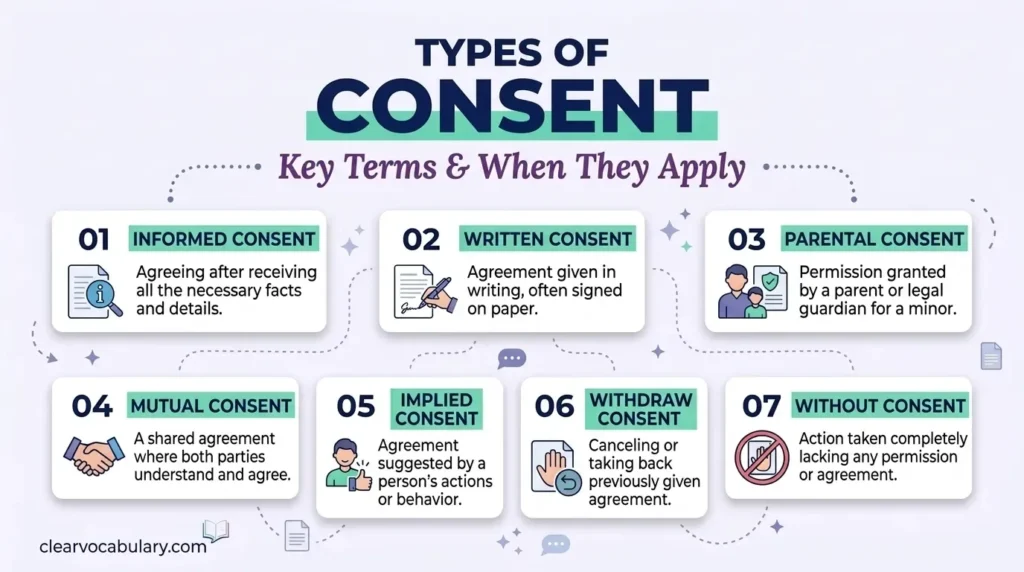
- informed consent
- written consent
- parental consent
- mutual consent
- implied consent
- without (someone’s) consent
- by common consent
- the age of consent
Antonyms of Consent
- Refusal: declining to agree. “His refusal surprised everyone.”
- Denial: rejecting a request. “The denial of permission was final.”
- Objection / dissent: open disagreement. “There was no dissent in the vote.”
- Veto: a formal power to reject. “The president threatened a veto.”
- Disapproval: a negative judgment.
Sentence Transformations
Original: The patient gave her consent to the procedure.
Alternative: The patient gave her authorization for the procedure.
(More formal, administrative; “informed consent” is usually preferred in medical contexts.)
Original: He consented to the changes.
Alternative: He agreed to the changes.
(Simpler and more conversational.)
Original: The school needs parental consent for the trip.
Alternative: The school needs the parents’ permission for the trip.
(Sounds everyday; “consent” sounds more official.)
Original: The board consented to the merger.
Alternative: The board assented to the merger.
(More formal, but may sound stiff in modern business writing.)
Common Mistakes
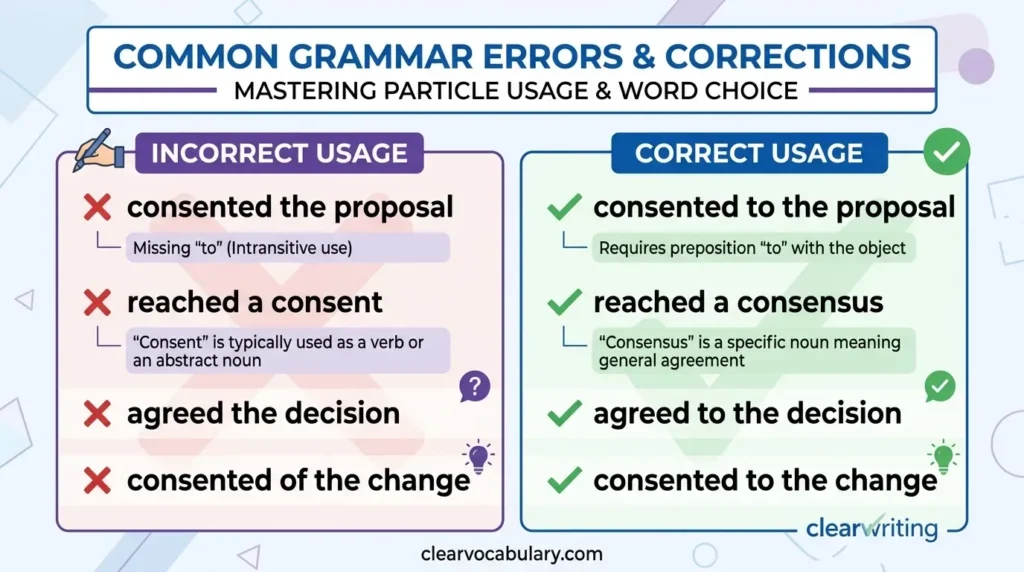
❌ Incorrect: She consented the proposal.
✅ Correct: She consented to the proposal.
As a verb, consent needs “to.”
❌ Incorrect: The team reached a consent on the new policy.
✅ Correct: The team reached a consensus on the new policy.
Consensus means general agreement within a group.
❌ Incorrect: She assented her boss’s permission.
✅ Correct: She received her boss’s permission, or she assented to the request.
Practice: Choose the Correct Word
- The company needed written ______ from the property owner before building. (authorization / acquiescence)
- After weeks of pressure, he gave a reluctant ______. (endorsement / acquiescence)
- The committee reached a general ______ after a long debate. (consensus / permission)
- She asked her parents’ ______ to stay out late. (permission / concurrence)
Answers
- authorization — formal, official permission suits a business context.
- acquiescence — it implies reluctant agreement.
- consensus — it means agreement among a group.
- permission — the natural everyday word for asking to do something.
FAQs
What is the best synonym for consent?
Permission is the most common everyday synonym, and approval works well in professional settings. For a formal yes, use assent.
Is consent the same as permission?
They overlap, but consent stresses freely agreeing, while permission stresses being allowed to do something. Consent often has legal or ethical weight.
Is “consensus” a synonym of consent?
No. Consensus means general agreement among a group. The two words share a root but are used differently.
What is a formal word for consent?
Assent, authorization, and concurrence are formal choices.
What is a more casual way to say consent?
Okay, go-ahead, green light, or blessing, depending on context.
What is the opposite of consent?
Refusal, denial, dissent, objection, or veto, depending on the sentence.
Can I replace “informed consent” with another term?
It is best to keep it. It is a fixed term in law and medicine, and a substitute may not carry the same meaning.
Conclusion
The right synonym for consent depends on the situation. Use permission for everyday requests, approval for plans and decisions, authorization for official or written clearance, and assent for formal agreement. Keep consent when it is part of a fixed legal or medical phrase, and avoid mixing it up with consensus.