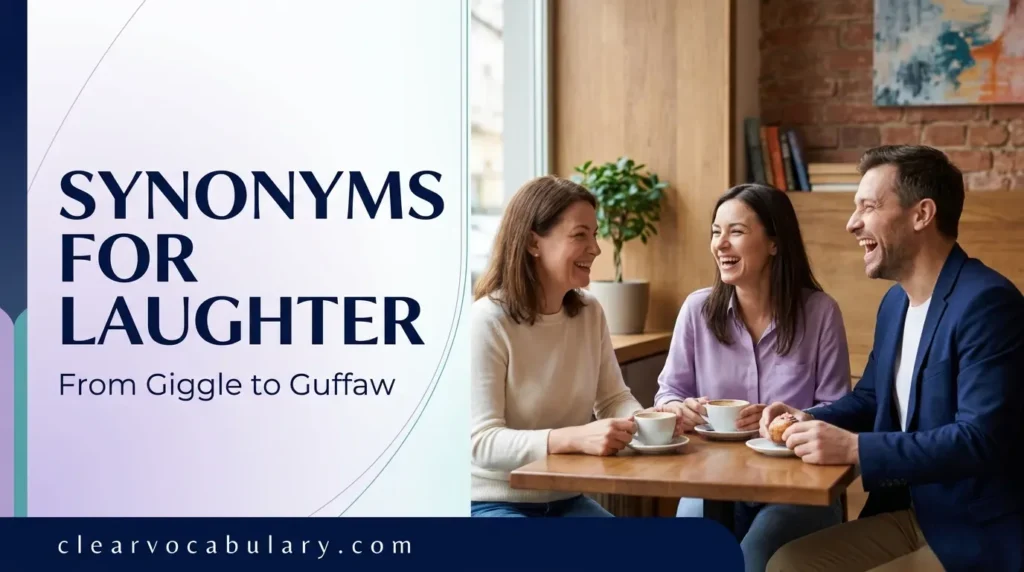
Common synonyms for laughter include chuckle, giggle, guffaw, titter, mirth, and merriment, depending on whether you mean a quiet laugh, a loud laugh, a mocking laugh, or the feeling of amusement.
The best synonym for laughter depends on how loud, how kind, and how long the laughing is. Use chuckle for a quiet laugh, giggle for a light, playful one, guffaw or belly laugh for a loud, hearty one, and mirth or merriment for the cheerful feeling behind it.
Laughter covers a wide range, from a polite smile-like sound to a cruel snicker. This guide groups synonyms for laughter by sound and mood, so you can choose the word that shows readers exactly what you mean.
Quick Answer: Which Word Fits Your Meaning?
- Quiet, gentle laughter: chuckle, giggle, chortle
- Loud, hearty laughter: guffaw, belly laugh, hoot, roar, peal
- Suppressed or mocking laughter: snicker, snigger, titter, snort
- The feeling of amusement: mirth, merriment, hilarity, glee, amusement
- Laughter used to mock: derision, mockery, ridicule
Meaning of Laughter
Laughter is a noun meaning the sound or action of laughing, usually in response to something funny, surprising, or joyful. It can also describe the cheerful mood that goes with laughing.
Prototype Meaning
The most typical sense of laughter is “the sound people make when they are amused.” Children laughing at a game or an audience laughing at a joke both fit this core idea.
Connotative Meaning
Laughter is mostly positive. It suggests joy, warmth, and social connection. But it can also be nervous, awkward, or cruel, so the tone depends on the context. That is why more specific synonyms are useful.
Synonyms for Laughter by Meaning
Light and Gentle Laughter
- Chuckle: a quiet, low laugh, often private or mild
- Giggle: a light, high-pitched laugh, often from children or nervous excitement
- Chortle: a joyful, snorting chuckle
Loud and Hearty Laughter
- Guffaw: a loud, boisterous laugh
- Belly laugh: a deep, full-bodied laugh
- Hoot: a short, loud burst of laughter
- Roar (of laughter): a loud, sustained burst, often from a crowd
- Howl (of laughter): a loud laugh, often with exaggeration
- Peal (of laughter): a ringing, cheerful outburst
- Cackle: a harsh, shrill laugh, often unpleasant
Suppressed or Mocking Laughter
- Snicker: a half-hidden laugh, often disrespectful
- Snigger: the British English form of snicker
- Titter: a short, nervous or suppressed laugh
- Snort: a laugh through the nose, often involuntary
Amusement and Merriment
These describe the feeling or mood, not the sound.
- Amusement: the state of finding something funny
- Mirth: cheerful amusement, often shown in laughter (formal or literary)
- Merriment: cheerful fun and laughter, especially in a group
- Hilarity: extreme amusement, often noisy
- Glee: great delight, sometimes at someone’s good luck or expense
- Jollity: cheerful, festive fun
Laughter That Mocks
- Derision: contemptuous laughter or ridicule
- Mockery: laughter or teasing that makes fun of someone
- Ridicule: words or laughter that make someone look foolish
Informal Expressions
- Hysterics: uncontrollable laughter (often “in hysterics,” British informal)
- In stitches: laughing so hard it hurts (idiom)
Some related words are not true synonyms. Smile and grin describe facial expressions, not sound. Humor and comedy describe what causes laughter. Levity means lightness in treating something serious, which is a related but different idea.
Comparison Table: Key Alternatives
| Word | Meaning | Tone or Loudness | Example |
|---|---|---|---|
| Chuckle | Quiet, low laugh | Soft, friendly | He gave a chuckle when he read the card. |
| Giggle | Light, high laugh | Playful, sometimes nervous | The children giggled behind their hands. |
| Titter | Short, suppressed laugh | Nervous or slightly mocking | A titter ran through the audience. |
| Snicker | Half-hidden laugh | Disrespectful | Someone snickered when he tripped. |
| Guffaw | Loud, boisterous laugh | Hearty, noisy | The joke drew a loud guffaw. |
| Cackle | Harsh, shrill laugh | Often unpleasant | The villain let out a cackle. |
| Mirth | Cheerful amusement | Formal, literary | His eyes sparkled with mirth. |
| Derision | Contemptuous laughter | Negative | The idea was met with derision. |
Which Synonym for Laughter Should You Use?
For a child or a light, playful laugh: Giggle is the natural choice.
For a quiet, friendly reaction: Chuckle suggests mild amusement without drawing attention.
For a loud, joyful reaction: Guffaw, belly laugh, and roar show strong amusement.
For a cruel or disrespectful reaction: Snicker, snigger, and derision suggest mockery.
For a villain or a harsh sound in fiction: Cackle adds a sharp, unsettling edge.
For a formal or literary description of mood: Mirth, merriment, and amusement are better than laughter alone.
When the exact sound does not matter: Plain laughter works well, especially in news or academic writing.
Grammar and Word Forms
| Word | Part of Speech | Word Forms | Grammar or Use | Example |
|---|---|---|---|---|
| laughter | noun | laughter (uncountable) | Not used with a or in the plural | Laughter filled the room. |
| laugh | noun | laugh, laughs | Countable, a single instance | She let out a short laugh. |
| laugh | verb | laugh, laughed, laughing, laughs | Often followed by at or with | They laughed at the joke. |
| laughable | adjective | more laughable, most laughable | Deserving ridicule, not simply funny | The excuse was laughable. |
| laughably | adverb | more laughably | In a ridiculous way | The offer was laughably low. |
Word Formation
The family grows from the verb: laugh → laughter, laughing, laughable → laughably.
Pronunciation and Syllables
| Word | IPA (US) | IPA (UK) | Syllables | Stress |
|---|---|---|---|---|
| laughter | /ˈlæftər/ | /ˈlɑːftə/ | 2 (laugh-ter) | First syllable |
The gh in laughter is pronounced as an /f/ sound, the same as in laugh.
Etymology
Laughter comes from Old English hleahtor, which is linked to the verb for laughing. The word is generally thought to be imitative in origin, echoing the sound it describes.
Chortle is a more recent invention. Lewis Carroll coined it in Through the Looking-Glass (1871), probably blending chuckle and snort.
Common Collocations and Expressions
- burst into laughter: to begin laughing suddenly
- roar with laughter: to laugh very loudly
- peals of laughter: repeated ringing outbursts
- gales of laughter: waves of loud laughter
- nervous laughter: laughter caused by tension
- contagious laughter: laughter that spreads to others
- laughter is the best medicine: a proverb about the value of humor
READ MORE 👉: Synonyms for In Addition in an Essay: 20+ Better Transitions
British English vs. American English
Snigger is the usual British spelling and word, while snicker is more common in American English. In hysterics is a British informal expression, while in stitches is understood in both varieties.
Antonyms

The opposite of laughter depends on the sense.
- Crying: shedding tears with sound
- Weeping: crying quietly, often from deep sadness
- Sobbing: crying with short, heavy breaths
- Gloom: a mood of sadness or low spirits (opposite of mirth)
- Seriousness: a solemn mood without humor
Sentence Transformations
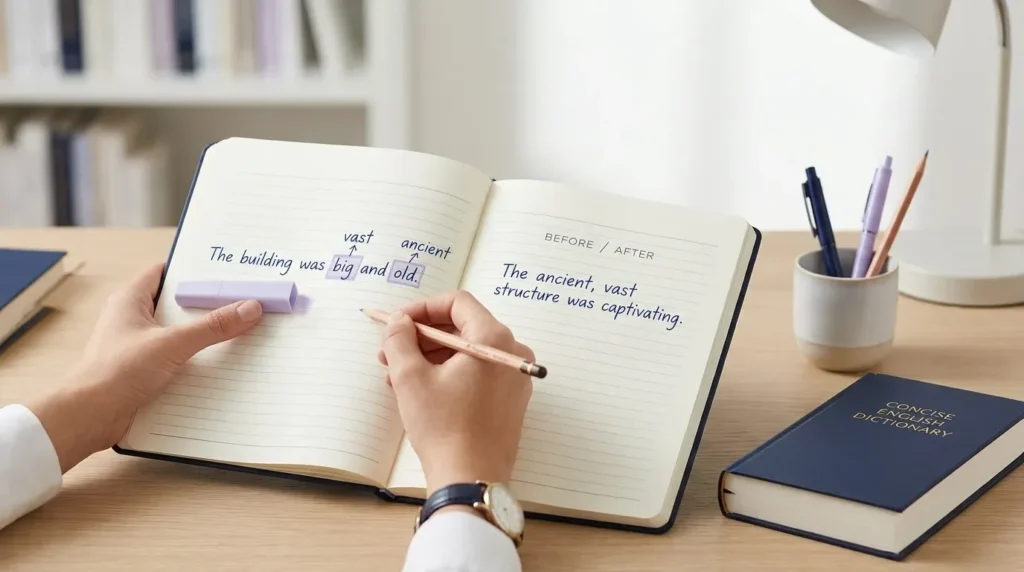
Original: There was laughter in the hall.
Alternative: Peals of laughter rang through the hall.
The alternative adds a cheerful, ringing sound.
Original: The audience laughed when he fell.
Alternative: A snicker ran through the audience when he fell.
Snicker shows a quiet, slightly mocking reaction, so the tone changes.
Original: She laughed at the story.
Alternative: She gave a chuckle at the story.
Chuckle is quieter and suggests mild amusement.
Common Mistakes
Making laughter plural. Laughter is uncountable, so it has no plural form and does not take a.
❌ Incorrect: The room was full of laughters.
✅ Correct: The room was full of laughter.
If you need a countable word, use laugh.
❌ Incorrect: She let out a laughter.
✅ Correct: She let out a laugh.
Also be careful with laughable. It does not mean “funny in a good way.” It means so poor or absurd that it deserves ridicule: “a laughable attempt.” And remember that laugh at (mocking) and laugh with (sharing the fun) differ in meaning.
Practice Questions
Choose from: chuckle, guffaw, snicker, cackle, mirth.
- The old joke earned only a small ______ from the audience.
- The comedian’s final line brought a loud ______ from the back row.
- A few students let out a mocking ______ when he mispronounced the word.
- The witch’s ______ echoed through the castle.
- His eyes sparkled with ______ at the family’s silly story.
Answer key
- chuckle. It suggests a small, quiet laugh.
- guffaw. It describes a loud, hearty laugh.
- snicker. It suggests a half-hidden, mocking laugh.
- cackle. It describes a harsh, shrill laugh.
- mirth. It describes the cheerful feeling of amusement.
FAQs
What is a formal synonym for laughter?
Mirth, merriment, and amusement are more formal, and they describe the feeling more than the sound.
What word means loud laughter?
Guffaw, belly laugh, roar, and hoot all describe loud laughter. Guffaw is the most common single word.
What is the difference between a chuckle and a giggle?
A chuckle is a low, quiet laugh, often from adults. A giggle is higher and lighter, often associated with children or nervous excitement.
What is another word for laughing at someone?
Derision, mockery, and ridicule describe laughing at someone unkindly. A snicker or snigger is a smaller, quieter version.
Is laughter countable or uncountable?
Laughter is uncountable. Use laugh when you need a countable noun, as in “a short laugh.”
What is the opposite of laughter?
Crying, weeping, and sobbing are the main opposites. Gloom is the opposite of mirth.
Conclusion
Laughter has many shades, from a quiet chuckle to a roar of mirth to a cruel snicker. Think about loudness, mood, and whether the laughing is friendly, then choose the word that shows it. When the exact sound does not matter, plain laughter is still a clear and natural choice.

Hi, I’m Sehrish Iqbal, the creator and writer behind clearvocabulary.com. I’m passionate about making English vocabulary easier to understand and use in everyday communication. Through clearvocabulary.com, I share clear explanations, useful synonyms, word meanings, spelling guidance, and practical examples to help readers choose the right words with confidence. My goal is to make learning vocabulary simple, accurate, and genuinely useful for students, professionals, and everyday English learners.