
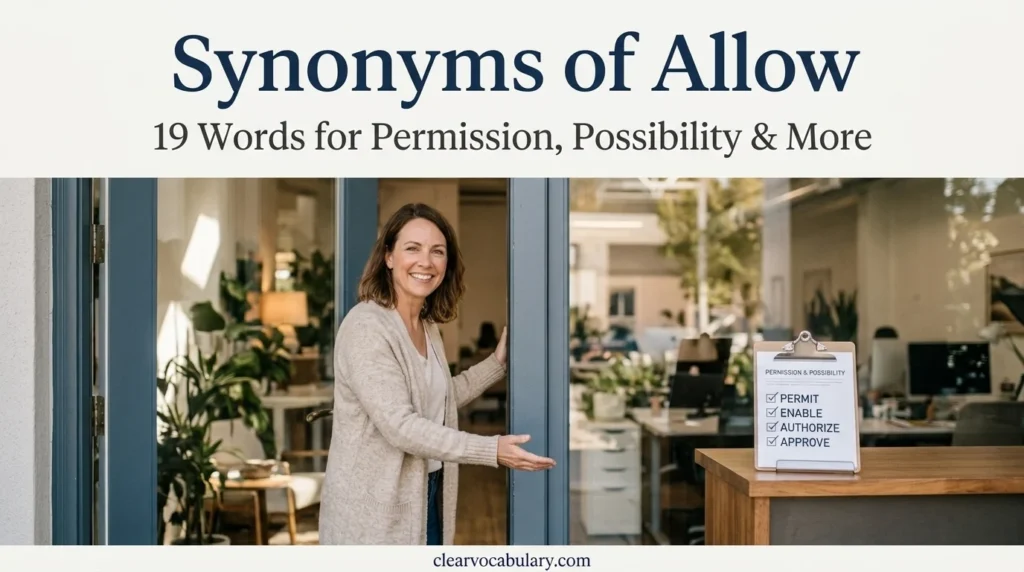
Common synonyms of allow include permit, let, authorize, enable, and set aside, depending on whether you mean giving permission, making something possible, or leaving room for it.
The best synonyms of allow are permit, let, authorize, and approve when you mean giving permission, enable or make possible when something becomes achievable, and set aside or factor in when you mean leaving room for something.
Allow is a common verb with several distinct meanings. “Allow guests to enter,” “allow two hours,” and “allow that he was right” each need a different replacement. This guide groups 19 alternatives by meaning, so you can choose the one that fits.
Meaning of Allow
Allow is a verb. Its main meaning is to give permission for something to happen or to let someone do something. It also means to make something possible, to set aside time or money for something, and, in formal writing, to admit that something is true.
Prototype Meaning
The central meaning is giving permission, as in “The school allows students to bring laptops.”
Connotative Meaning
Allow is neutral. It is less formal than permit and more official than let. It does not imply approval, because a person can allow something without liking it.
Synonyms of Allow by Meaning
1. Giving Permission
| Word | Meaning | Tone or Context | Example |
|---|---|---|---|
| Permit | Formally allow | Formal, rules | The library does not permit food in the reading room. |
| Let | Allow, without formality | Informal, common | She let him borrow her car. |
| Authorize | Give official permission or power | Formal, business | The manager authorized the payment. |
| Approve | Officially accept or agree to | Formal | The board approved the new budget. |
| Sanction | Give official permission | Formal, official | The council sanctioned the project. |
| Consent to | Agree to something, often formally | Formal, legal | He consented to the search. |
| Grant | Give permission or a right | Formal | The court granted her request. |
Let and permit are the most useful pair: let is casual, and permit sounds official. Approve goes further than allow, because it suggests that the decision is a favorable one. Sanction has two opposite meanings, to approve and to punish, so check the context before using it.
2. Making Something Possible
| Word | Meaning | Tone or Context | Example |
|---|---|---|---|
| Enable | Give the ability or means to do something | Neutral, technical | The update enables users to edit files offline. |
| Make possible | Create the conditions for something | Plain, neutral | The grant made the research possible. |
| Facilitate | Make a process easier | Formal | The software facilitates communication between teams. |
Enable is the best match when “allow” is about capability, not permission. Facilitate is only a related word, because it means to make something easier, not to make it possible.
3. Leaving Room, Time, or Money
| Word | Meaning | Tone or Context | Example |
|---|---|---|---|
| Allocate | Assign for a particular purpose | Business, formal | They allocated two hours for the meeting. |
| Set aside | Reserve for later use | Neutral, everyday | She set aside time for exercise each morning. |
| Factor in | Include in a calculation or plan | Neutral, common | Please factor in delays when you plan the trip. |
| Take into account | Consider when making a decision | Neutral, formal | The report takes inflation into account. |
These are useful replacements for the phrases allow time and allow for.
4. Admitting a Point (Formal)
| Word | Meaning | Tone or Context | Example |
|---|---|---|---|
| Admit | Accept that something is true | Neutral | He admitted that the plan had flaws. |
| Concede | Accept a point, often reluctantly | Formal | She conceded that her opponent was right. |
| Acknowledge | Recognize that something is true | Neutral, formal | They acknowledged the mistake. |
This meaning appears in formal sentences such as “I allow that he has a point.” It is now fairly rare, and admit, concede, or acknowledge sound more natural in modern writing.
5. Putting Up With Something
| Word | Meaning | Tone or Context | Example |
|---|---|---|---|
| Tolerate | Accept something you may dislike | Neutral, formal | The school will not tolerate bullying. |
| Put up with | Accept something unpleasant | Informal | They put up with the noise for months. |
Allow vs. Permit vs. Let
| Word | Register | Typical Pattern | Example |
|---|---|---|---|
| Allow | Neutral | allow + person + to + verb | They allow staff to work from home. |
| Permit | Formal | permit + person + to + verb | The rules permit staff to work from home. |
| Let | Informal | let + person + verb (no to) | They let staff work from home. |
Which Word Should You Use?
- Everyday speech: let or allow.
- Rules, policies, and official notices: permit, authorize, or approve.
- Software and technology: enable is the standard word.
- Planning and scheduling: set aside, allocate, or factor in.
- Arguments and debates: concede, admit, or acknowledge.
- Behavior you dislike: tolerate.
READ MORE 👉: Synonyms for Unwanted: 19 Words for Emails, Items & People
Sentence Transformations
Original: The school does not allow phones in class.
Alternative: The school does not permit phones in class.
The meaning is the same, but “permit” sounds more formal and fits a policy statement.
Original: The app allows users to edit photos.
Alternative: The app enables users to edit photos.
“Enables” focuses on capability, not permission.
Original: Please allow for traffic.
Alternative: Please factor in traffic.
The meaning is nearly the same, and “factor in” is easier for many readers to understand.
Grammar and Word Forms
| Word | Part of Speech | Word Forms | Grammar or Use | Example |
|---|---|---|---|---|
| allow | Verb | allow, allows, allowed, allowing | Usually followed by a person and to + verb | They allowed us to leave early. |
| allowance | Noun | allowance, allowances | An amount given or permitted | He receives a monthly travel allowance. |
| allowable | Adjective | allowable | Permitted or acceptable | The allowable limit is ten items. |
| disallow | Verb | disallow, disallows, disallowed | To refuse to allow | The referee disallowed the goal. |
Word Formation
Related forms include allow → allowable → allowance and the negative form disallow.
Pronunciation and Syllables
Allow is pronounced /əˈlaʊ/ and has two syllables (al-low). The stress falls on the second syllable.
Etymology and Word History
Allow came into English from Old French alouer. Two Latin sources contributed to it: allaudare, meaning “to praise,” and Medieval Latin allocare, meaning “to assign.” This explains why the word covers both approval (permission) and setting something aside (allowing time or money).
Antonyms of Allow
Common opposites include forbid, prohibit, ban, prevent, refuse, and disallow.
Common Mistakes
❌ Incorrect: The school doesn’t allow to use phones.
✅ Correct: The school doesn’t allow students to use phones.
Allow needs an object (the person or group) before the to-infinitive.
❌ Incorrect: She let me to go.
✅ Correct: She let me go.
Let is followed by a bare infinitive, without “to.”
Quick Practice
Choose the best word for each sentence.
- The manager had to ______ the purchase before the order could be placed. (authorize / tolerate)
- We should ______ extra time for traffic. (set aside / sanction)
- She had to ______ that her opponent made a fair point. (concede / facilitate)
Answers: 1. authorize (give official permission). 2. set aside (reserve time). 3. concede (admit a point).
FAQs
What is a good synonym of allow?
Permit, let, and authorize are the most common alternatives for giving permission.
What is the difference between allow and permit?
They mean almost the same, but permit is more formal and is often used in rules and official notices.
What is the difference between allow and let?
Let is more informal and is followed by a bare infinitive, as in “let him go.” Allow is followed by to, as in “allow him to go.”
What is another word for “allow for”?
Factor in, take into account, and make allowance for are common alternatives.
What is the opposite of allow?
Forbid, prohibit, and ban are the most common opposites.
Is “allow to” correct?
Yes, but allow needs a person or group before “to,” as in “allow students to use laptops.”
Conclusion
The right synonym of allow depends on the meaning. Use permit or authorize for formal permission, let for casual speech, enable when something becomes possible, and set aside or factor in when you leave room for something. Choosing the closest word makes your writing clearer and more natural.

Hi, I’m Sehrish Iqbal, the creator and writer behind clearvocabulary.com. I’m passionate about making English vocabulary easier to understand and use in everyday communication. Through clearvocabulary.com, I share clear explanations, useful synonyms, word meanings, spelling guidance, and practical examples to help readers choose the right words with confidence. My goal is to make learning vocabulary simple, accurate, and genuinely useful for students, professionals, and everyday English learners.