
Common synonyms of dom include dominant, assertive, and commanding for the slang meaning, lord or sir for the title, and house or home for the Slavic word.
The best synonyms of dom depend on which meaning you need. Use dominant, assertive, or commanding when dom is slang for dominant, lord or sir when it is a title, state or realm for the suffix -dom, and house or home when it is the Slavic word dom.
“Dom” is a short word with four unrelated uses. That makes it easy to misread and hard to replace without knowing the context. This guide separates each meaning, gives the closest alternatives, and keeps the explanations clear and neutral.
Meaning of Dom
| Meaning | What It Is | Example |
|---|---|---|
| 1. Short for dominant | Informal slang for a person who leads or holds control | He has a dom personality. |
| 2. A title | A respectful title meaning “lord” or “sir” | Dom Pérignon, Dom Pedro |
| 3. The suffix -dom | Forms nouns for a state, condition, or domain | kingdom, freedom, wisdom |
| 4. A word in other languages | “House” or “home” in Polish, Czech, Russian, and other Slavic languages | Polish: dom |
Prototype Meaning
In English, the most typical meaning today is the informal short form of dominant: a person who takes the lead or holds control in a situation or role dynamic.
Connotative Meaning
The slang form is informal and can sound unclear to readers who do not know it. The standard words that replace it vary in tone. Assertive and commanding are positive, while domineering and overbearing are negative.
Synonyms of Dom by Meaning
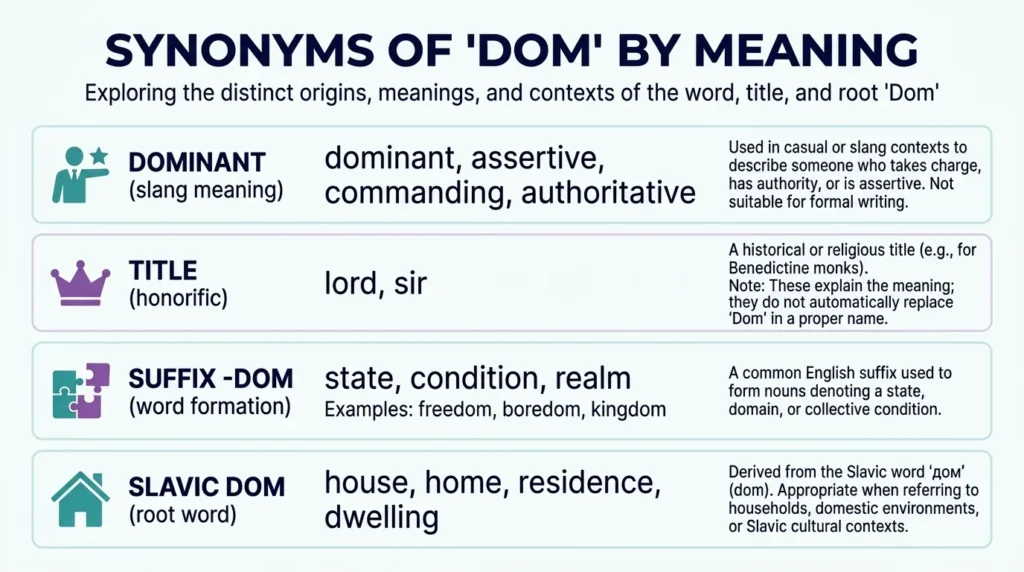
1. Dom as Short for Dominant
Confident and in charge
| Word | Meaning | Tone or Context | Example |
|---|---|---|---|
| Dominant | Having the most power or influence | Neutral, standard | He has a dominant personality in meetings. |
| Assertive | Clear and confident about what you want | Positive, professional | She is assertive without being rude. |
| Commanding | Having natural authority | Positive, strong | The captain had a commanding presence. |
| Authoritative | Trusted and having proper authority | Formal, positive | Her authoritative voice calmed the room. |
| Take-charge | Ready to lead and make decisions | Informal, positive | We need a take-charge person for this project. |
| In control | Managing a situation firmly | Neutral | He stayed in control during the crisis. |
Too forceful or controlling
| Word | Meaning | Tone or Context | Example |
|---|---|---|---|
| Domineering | Controlling others in an overbearing way | Negative, formal | His domineering manner made the team uneasy. |
| Overbearing | Unpleasantly forceful | Negative | She found her boss overbearing. |
| Controlling | Wanting to direct everything | Negative, everyday | A controlling attitude damages trust. |
| Bossy | Fond of giving orders | Informal, mild | The older cousin was a bit bossy. |
Dominant is the closest standard word. Assertive is the safest choice for professional writing, because it sounds confident without suggesting force.
2. Dom as a Title
| Word | Meaning | Tone or Context | Example |
|---|---|---|---|
| Lord | A person with authority or rank | Formal, traditional | The lord of the manor welcomed the guests. |
| Sir | A respectful form of address | Formal, polite | Sir, your table is ready. |
| Master | A person with authority or skill | Formal, older usage | The master of the house gave the order. |
| Don | Spanish and Italian honorific from the same Latin source | Formal, foreign | Don Quixote |
Dom is not simply replaced by sir in names. In “Dom Pérignon” or “Dom Pedro,” it is part of the proper name or title and stays as written. The alternatives above explain its meaning, but they do not replace it.
3. The Suffix -dom
The suffix -dom forms nouns that show a state, a condition, or a domain. Similar suffixes in English include -hood, -ship, and -ness, but they are not always interchangeable.
| Word | Meaning of -dom | Similar Suffix or Word | Example |
|---|---|---|---|
| freedom | the state of being free | liberty | They fought for their freedom. |
| boredom | the state of being bored | tedium | Boredom set in after an hour. |
| kingdom | the realm of a king | realm | The kingdom was at peace. |
| wisdom | the quality of being wise | insight | She shared her wisdom with the group. |
| stardom | the state of being a star | fame | The film brought her stardom. |
The suffix -dom forms words such as kingdom and freedom, while -hood forms childhood and -ship forms friendship. The three are not interchangeable, so freedom cannot become freehood.
4. Dom as the Slavic Word for House
| Word | Meaning | Tone or Context | Example |
|---|---|---|---|
| House | A building where people live | Neutral | Polish dom means house. |
| Home | The place where someone lives | Warm, everyday | Dom can also mean home. |
| Residence | A place where someone lives | Formal | The family’s residence is in Warsaw. |
| Dwelling | A place to live | Formal | An old dwelling stood by the river. |
This meaning appears in names such as the Russian word dom in “Dom Knigi” (House of Books) and in many place and street names.
Dominant vs. Assertive vs. Domineering
| Word | Tone | Main Idea |
|---|---|---|
| Dominant | Neutral | Having the most influence or power |
| Assertive | Positive | Expressing needs clearly and confidently |
| Domineering | Negative | Controlling others too much |
Which Word Should You Use?
- Workplace and professional writing: assertive or authoritative.
- Describing a leader: commanding or take-charge.
- Criticizing controlling behavior: domineering or overbearing.
- Formal writing: dominant is the standard word.
- General audiences: use dominant or assertive instead of the slang form.
- Names and titles: keep Dom as written.
- Words ending in -dom: use the full word, such as freedom or kingdom.
READ MORE 👉: Synonyms of Compromise: 20 Words for Agreement and Risk
Sentence Transformations
Original: He has a dom personality.
Alternative: He has a dominant personality.
“Dominant” is the standard form and works in formal writing.
Original: Her dom attitude annoyed the team.
Alternative: Her domineering attitude annoyed the team.
“Domineering” is clearly negative, which matches the idea of annoyance.
Original: The kingdom was at peace.
Alternative: The realm was at peace.
“Realm” is more literary. It works well in historical or fantasy writing.
Grammar and Word Forms
| Word | Part of Speech | Word Forms | Grammar or Use | Example |
|---|---|---|---|---|
| dom | Noun (informal) | dom, doms | Slang short form of dominant | The dom of the group took the lead. |
| Dom | Title | Dom (no plural) | Capitalized; used before a name | Dom Pedro ruled Brazil. |
| -dom | Suffix | n/a | Attached to a noun or adjective to form a noun | free + -dom = freedom |
| dominant | Adjective, noun | dominant | Standard word | A dominant color in the painting is blue. |
| dominate | Verb | dominate, dominates, dominated, dominating | To control or have the most influence | The team dominated the match. |
| dominance | Noun | dominance | The state of being dominant | The company’s dominance continued. |
| domineer | Verb | domineer, domineers, domineered, domineering | To control in an overbearing way | He domineers his staff. |
Word Formation
Related forms include dominate → dominant → dominance → domination and domineer → domineering. For the suffix, examples include free → freedom, bore → boredom, and king → kingdom.
Pronunciation and Syllables
- Dom (word or title): /dɒm/ (UK) or /dɑːm/ (US), with one syllable.
- -dom (suffix): pronounced /dəm/, a short unstressed sound, as in kingdom /ˈkɪŋdəm/ and freedom /ˈfriːdəm/.
- Dominant: /ˈdɒmɪnənt/ (UK) or /ˈdɑːmɪnənt/ (US), with three syllables (dom-i-nant).
Etymology and Word History
- Dom (title) and dominant: both come from Latin dominus, meaning “lord” or “master,” which comes from domus, meaning “house.” The same root gives English words such as dominate and domain.
- Don: the Spanish and Italian Don comes from the same Latin source.
- -dom (suffix): from Old English dōm, meaning “judgment, law, or state.” It is related to the words doom and deem.
- Dom (house) in Slavic languages: the word is related to Latin domus and comes from the same ancient root.
So the title Dom and the Slavic word dom share an ancient connection through the idea of a house.
Antonyms of Dom
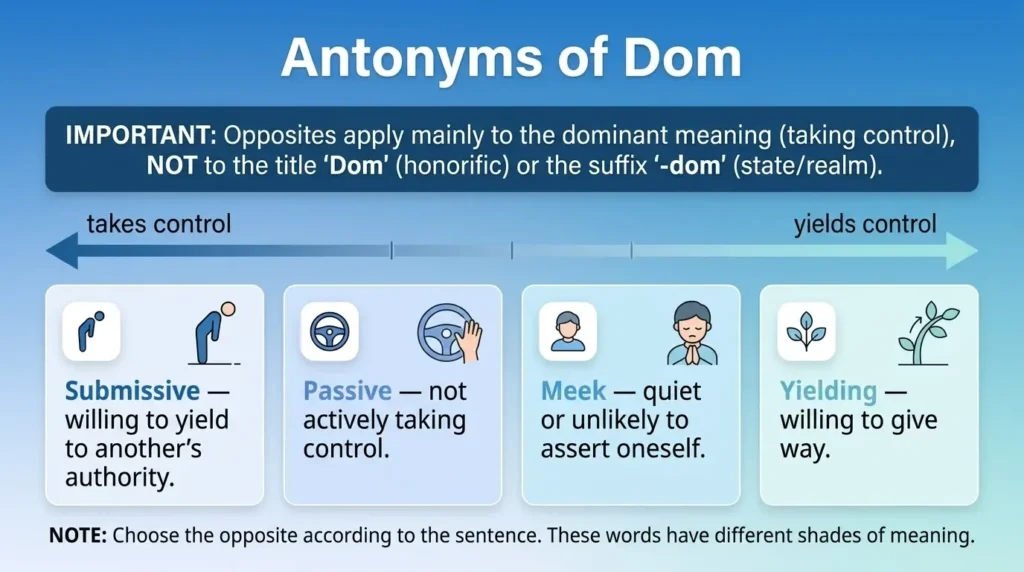
For the dominant meaning, common opposites are submissive, passive, meek, and yielding. For the suffix and title meanings, there are no true antonyms.
Common Mistakes
❌ Incorrect: She is dominate in her field.
✅ Correct: She is dominant in her field.
Dominate is a verb, and dominant is the adjective.
❌ Incorrect: The freehood of the press is important.
✅ Correct: The freedom of the press is important.
Not every noun suffix works with every word. Freedom is the only standard form.
Quick Practice
Choose the best word for each sentence.
- She speaks clearly and confidently without being rude, so she is ______. (assertive / domineering)
- The suffix in “kingdom” means ______. (a state or realm / a house)
- In Polish, “dom” means ______. (house / lord)
Answers: 1. assertive (confident but not controlling). 2. a state or realm. 3. house.
FAQs
What does dom mean?
Dom is most often a short form of dominant. It can also be a title meaning “lord,” a suffix meaning a state or domain, or a word meaning “house” in Slavic languages.
What is a good synonym of dom?
Dominant, assertive, and commanding are the most common alternatives.
What does -dom mean in a word?
It forms nouns that show a state, condition, or domain, as in freedom, boredom, and kingdom.
What does dom mean in Polish or Russian?
It means “house” or “home.”
What is the difference between dominant and domineering?
Dominant is neutral and describes having the most influence. Domineering is negative and describes controlling others too much.
What is the opposite of dom?
Submissive is the usual opposite, and passive or yielding also work.
Conclusion
The best synonym of dom depends on the meaning. Use dominant or assertive for the slang form, keep Dom as written when it is a title, understand -dom as a suffix for a state or realm, and read dom as “house” in Slavic languages. For general audiences, the standard words are clearer than the slang form.

Hi, I’m Sehrish Iqbal, the creator and writer behind clearvocabulary.com. I’m passionate about making English vocabulary easier to understand and use in everyday communication. Through clearvocabulary.com, I share clear explanations, useful synonyms, word meanings, spelling guidance, and practical examples to help readers choose the right words with confidence. My goal is to make learning vocabulary simple, accurate, and genuinely useful for students, professionals, and everyday English learners.