
Good synonyms for in addition in an essay include additionally, moreover, furthermore, besides, and as well as. The right choice depends on three things: how formal your essay is, whether your next words form a full clause or a noun phrase, and how strongly the new point supports your argument.
Many students repeat “in addition” at the start of every body paragraph, which makes an essay feel mechanical. This guide gives you alternatives grouped by function, with example sentences, punctuation advice, and the grammar rules that decide when each one works.
Quick Answer: Which Word Fits Your Sentence?
- Adding a full new point (formal): additionally, furthermore, moreover, further
- Adding a stronger or more emphatic point: moreover, what is more, besides
- Adding a noun or idea inside a sentence: as well as, along with, together with, apart from
- Informal or spoken style: plus, on top of that, not to mention, too
Meaning of In Addition
In addition is a transition phrase meaning “also” or “as a further point.” It signals that the next idea is of the same kind as the previous one, usually another reason, example, or piece of evidence.
Prototype Meaning
The core meaning of in addition is “adding one more point to what has already been said.” It adds without comparing, contrasting, or ranking.
Connotative Meaning
In addition sounds neutral and moderately formal. It carries no emotional tone, but repeated use can make writing feel list-like, because it tells the reader only that another point is coming, not how the points connect.
Synonyms for In Addition by Function
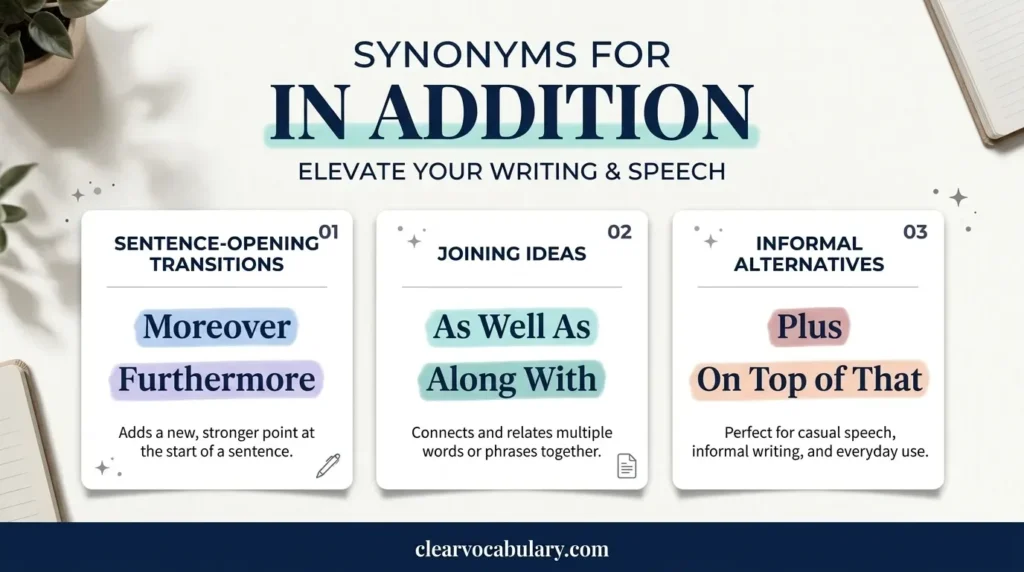
Sentence-Opening Transitions
These usually start a sentence and are followed by a comma.
- Additionally: the closest direct synonym, formal and neutral
- Further: adds a point in formal writing (some writers prefer furthermore)
- Furthermore: adds a point and moves the argument forward
- Moreover: adds a point that strengthens what came before
- What is more: adds a point with slight emphasis
- Besides: adds a final, often decisive point (more conversational)
- Also: adds a point and works best inside a sentence, before the main verb
Words That Join Nouns or Phrases
These work like in addition to: they connect nouns, noun phrases, or -ing forms inside one sentence.
- As well as: joins two items without changing the grammar
- Along with: suggests two things occurring together
- Together with: a slightly more formal version of along with
- Apart from: adds an item, often before an exception or extra detail
- Aside from: the same meaning, a little less formal
- Coupled with: joins two factors that combine to produce an effect
- Over and above: adds something beyond what has been mentioned
Structures That Add Emphasis
- Not only … but also: gives both points equal weight in one sentence
- Equally important: adds a point of the same weight
Informal Alternatives
Use these in speeches, blog posts, or personal writing, not in formal essays.
- Plus: casual, common in speech
- On top of that: informal, adds a point to an already long list
- Not to mention: informal, adds a point as if it were obvious
- Too / as well: place at the end of a clause
Some words that look similar are related but not true synonyms. Likewise and similarly show comparison, not addition. Above all and most importantly rank a point rather than add one.
Comparison Table: Key Alternatives
| Word or Phrase | Function and Tone | Typical Position | Essay Example |
|---|---|---|---|
| Additionally | Neutral, formal | Start of sentence | Additionally, the survey included rural areas. |
| Furthermore | Formal, builds the argument | Start of sentence | Furthermore, the data suggest a clear trend. |
| Moreover | Formal, strengthens the point | Start of sentence | Moreover, the policy reduced costs. |
| Besides | Conversational, decisive | Start of sentence | Besides, the plan is too expensive. |
| As well as | Neutral, joins items | Inside a sentence | The report covers health as well as education. |
| Along with | Neutral, shows combination | Inside a sentence | Along with funding, schools need trained staff. |
| Apart from | Neutral to formal | Start or middle | Apart from cost, safety was a concern. |
| Plus | Informal | Start or middle | Plus, the app is free. |
Which Synonym for In Addition Should You Use?
In an academic essay: Choose additionally, furthermore, moreover, or as well as. They are formal enough for most university writing.
To strengthen your argument: Use moreover or what is more when the new point makes the previous one stronger.
Inside a sentence: Use as well as, along with, or apart from when you are joining nouns, not starting a new sentence.
In an informal blog or speech: Plus, on top of that, and not to mention sound natural.
To avoid repetition: Sometimes the best option is no transition at all. If your second point clearly follows the first, a well-organized sentence like “Another factor is housing cost” can replace the connector.
Grammar and Usage
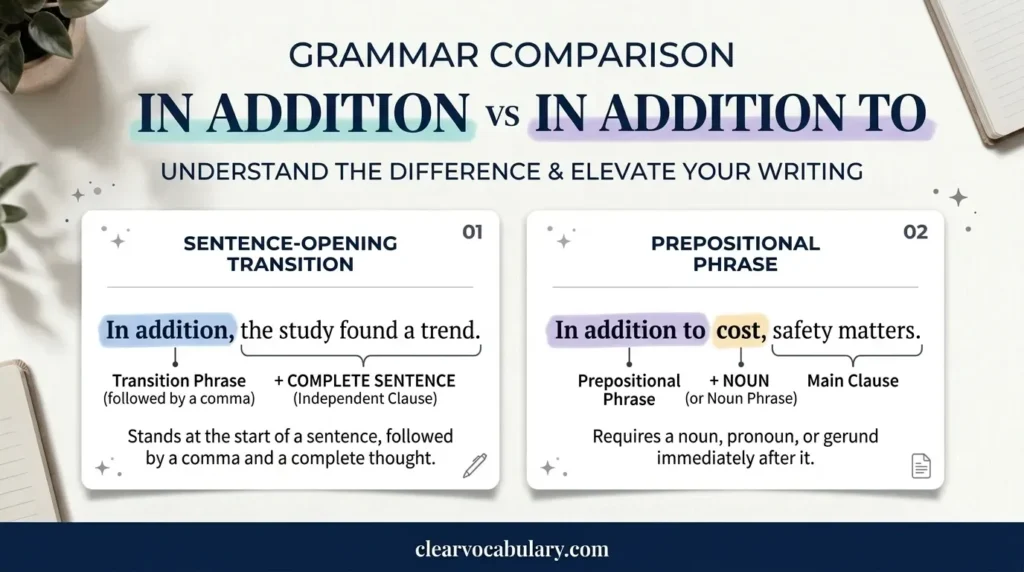
The most common problem is mixing up in addition and in addition to.
| Phrase | Part of Speech | Followed By | Example |
|---|---|---|---|
| in addition | adverbial phrase | A comma, then a full clause | In addition, the study had no control group. |
| in addition to | preposition | A noun or -ing form | In addition to cost, safety was a concern. |
| additionally | adverb | A comma, then a full clause | Additionally, the sample was small. |
| additional | adjective | A noun | An additional reason is time. |
| addition | noun | Used with in, an | The new wing is an addition to the school. |
Punctuation: Put a comma after a sentence-opening transition such as Moreover, or Additionally,. When the transition appears after a semicolon, use a comma after it too: “The plan is cheap; moreover, it is fast.”
Word family: add → addition → additional → additionally
Words That Do the Opposite
When your next point disagrees with the last one, use a contrast transition instead: however, nevertheless, on the other hand, or in contrast.
READ MORE 👉: Synonyms for Grumpy: 25+ Words for Every Kind of Bad Mood
Sentence Transformations
Original: In addition, urban parks reduce heat. In addition, they improve mental health. In addition, they support wildlife.
Alternative: Urban parks reduce heat. Moreover, they improve mental health. They also support wildlife.
The rewrite varies the connectors and removes the repeated “in addition.”
Original: In addition to the high cost, the plan has safety risks.
Alternative: Besides the high cost, the plan has safety risks.
Besides is a little more conversational but keeps the same grammar.
Original: The school offers music. In addition, it offers art.
Alternative: The school offers music as well as art.
Joining both items in one sentence is smoother than two sentences.
Common Mistakes
Using “in addition to” before a full clause. In addition to must be followed by a noun phrase or an -ing form, not a complete clause.
❌ Incorrect: In addition to the study was small, it lacked a control group.
✅ Correct: In addition to being small, the study lacked a control group.
You can also split the idea into two sentences: “The study was small. In addition, it lacked a control group.”
Confusing beside with besides. Beside means next to. Besides means in addition to.
❌ Incorrect: Beside the cost, the plan is risky.
✅ Correct: Besides the cost, the plan is risky.
Overusing transitions. Not every sentence needs one. A transition should show a real logical link, and using one before every point can sound mechanical.
Practice Questions
- Choose the correct option: ______ rising prices, the city faces a housing shortage. (In addition / In addition to)
- Choose the best word: The policy reduced costs. ______, it improved service. (In addition to / Moreover)
- Which is more formal for an academic essay: plus or furthermore?
- Choose the correct word: ______ the library, the campus offers study rooms. (Beside / Besides)
- Fix the sentence: The study was small, in addition it lacked controls.
Answer key
- In addition to. A noun phrase (rising prices) follows it.
- Moreover. A full clause follows, so you need a transition adverb.
- Furthermore. Plus is informal.
- Besides. It means “in addition to.” Beside means next to.
- The study was small. In addition, it lacked controls. The original is a comma splice. A semicolon also works: “The study was small; in addition, it lacked controls.”
FAQs
What is the best synonym for in addition in an essay?
Additionally is the closest direct synonym. Moreover and furthermore are also common choices, with a slightly stronger, more argumentative tone.
Is “also” acceptable at the start of an essay sentence?
It is common in modern writing, but some instructors consider it less formal. Placing it before the main verb is the safer choice.
What is the difference between moreover and furthermore?
They are very similar and often interchangeable. Moreover usually adds a point that strengthens the previous one, while furthermore simply continues the argument.
Can I use “plus” in an academic essay?
It is better avoided in formal essays because it is informal. Choose additionally, furthermore, or as well as instead.
What is the difference between “in addition” and “in addition to”?
In addition begins a new clause and takes a comma. In addition to is a preposition, so it is followed by a noun or an -ing form.
How often should I use transition words?
Use them where they show a real connection between ideas. Not every sentence needs one, and repeating the same transition across paragraphs can feel mechanical.
Conclusion
In addition is a useful phrase, but it is not your only option. Use additionally, furthermore, or moreover to start a sentence, and as well as, along with, or apart from to join items within one. Check the grammar after the phrase, match the formality to your audience, and vary your transitions so your essay reads smoothly

Hi, I’m Sehrish Iqbal, the creator and writer behind clearvocabulary.com. I’m passionate about making English vocabulary easier to understand and use in everyday communication. Through clearvocabulary.com, I share clear explanations, useful synonyms, word meanings, spelling guidance, and practical examples to help readers choose the right words with confidence. My goal is to make learning vocabulary simple, accurate, and genuinely useful for students, professionals, and everyday English learners.


Pingback: Synonyms for Laughter: 25+ Words from Giggle to Guffaw