
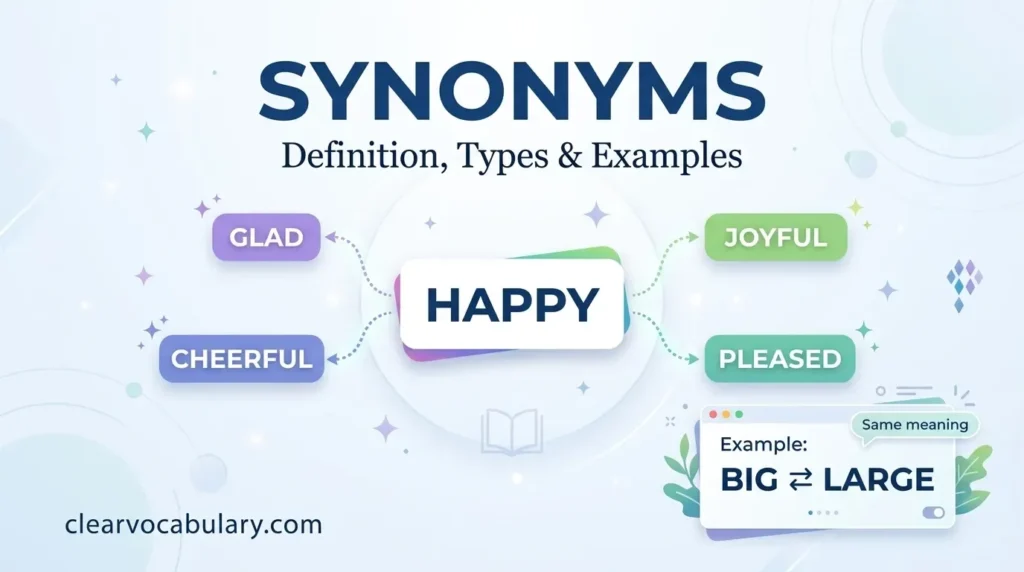

A synonym is a word that has the same or nearly the same meaning as another word. For example, big and large are synonyms, and so are happy and glad.
If you’re looking for a clear synonyms definition and examples, this guide covers what synonyms are, the different types, how they differ in tone and meaning, and how to use them correctly in your writing.
Quick Answer
- Definition: A synonym is a word or phrase that means the same or almost the same as another word in the same language.
- Simple examples: begin / start, quick / fast, smart / clever, buy / purchase.
- Important point: Most synonyms are not perfectly identical. They often differ in tone, formality, or context, so the best choice depends on the situation.
What Is a Synonym?
A synonym (noun) is a word that shares the same or a very similar meaning with another word. The word comes from the Greek synōnymos, built from syn- (“together, with”) and onyma (“name”), roughly meaning “having the same name.”
Synonyms help you avoid repeating yourself, make your writing more precise, and express shades of meaning. A writer who only uses good sounds repetitive, while one who chooses excellent, pleasant, or reliable sounds more exact.
Prototype Meaning
When most people hear “synonym,” they think of a simple word pair like big and large, two words you can often swap without changing the sentence much.
Connotative Meaning
The word “synonym” itself is neutral. But the synonyms it describes often carry different feelings. Thrifty sounds positive, while stingy sounds negative, even though both relate to careful spending. This is why connotation matters when choosing a synonym.
Synonym Examples
Here are common synonym pairs with example sentences:
| Word | Synonym | Example |
|---|---|---|
| happy | glad, cheerful | She felt glad when the results came in. |
| big | large, huge | They live in a large house. |
| fast | quick, rapid | He gave a quick reply. |
| smart | clever, intelligent | She is an intelligent student. |
| begin | start, commence | The class will start at nine. |
| buy | purchase | I need to purchase a new laptop. |
| tired | exhausted, weary | The long trip left him exhausted. |
| angry | furious, irritated | She was irritated by the delay. |
Types of Synonyms
1. Absolute (Perfect) Synonyms
Words with exactly the same meaning in every context. These are very rare. Examples sometimes given include begin/commence, but even these differ in formality.
2. Near Synonyms (Partial Synonyms)
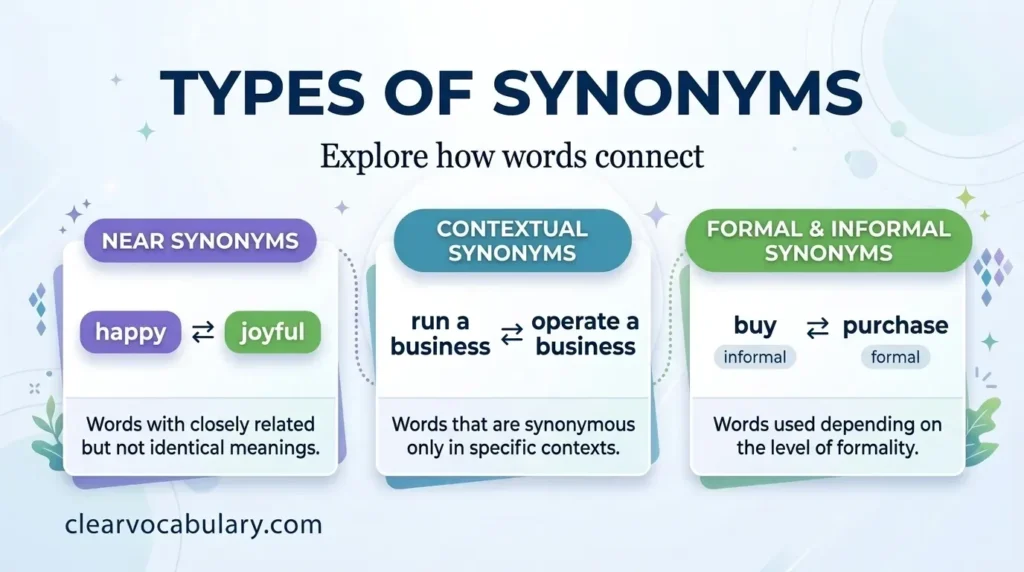
Words with similar but not identical meanings. This is the most common type. Happy and joyful are near synonyms, because joyful is stronger.
3. Contextual Synonyms
Words that are synonyms only in a particular context. Run and operate are synonyms in “run a business” / “operate a business,” but not in “run a race.”
4. Formal and Informal Synonyms
The same meaning, but a different register.
| Informal | Formal |
|---|---|
| buy | purchase |
| help | assist |
| start | commence |
| ask | inquire |
| get | obtain |
Synonyms and Connotation
Synonyms can share a meaning but differ in feeling:
- slim (positive) / thin (neutral) / skinny (often negative)
- confident (positive) / arrogant (negative)
- curious (positive) / nosy (negative)
Example: “He is determined” is a compliment, while “He is stubborn” is usually criticism, though both describe someone who won’t give up.
Which Word Should You Use?
- Everyday conversation: choose simple, common words (start, buy, help).
- Formal or academic writing: choose more formal options (commence, purchase, assist).
- Emotional writing: pick words with the right intensity (upset → distressed → devastated).
- Precision: choose the more specific word when you can (walk → stroll, stride, trudge).
Avoid replacing a simple word with a rare synonym just to sound impressive. Clear, natural wording is almost always better.
Sentence Transformations
Original: The movie was good.
Alternative: The movie was excellent.
(Stronger and more specific.)
Original: She was sad after the news.
Alternative: She was heartbroken after the news.
(Much more intense.)
Original: Please help me with this form.
Alternative: Please assist me with this form.
(More formal.)
Grammar and Word Forms
| Word | Part of Speech | Word Forms | Grammar / Use | Example |
|---|---|---|---|---|
| synonym | noun | plural: synonyms | Countable noun | “Large” is a synonym of “big.” |
| synonymous | adjective | synonymously (adverb) | Used with with: “synonymous with” | Her name is synonymous with quality. |
| synonymy | noun | uncountable | Technical, used in linguistics | Synonymy refers to similarity in meaning. |
Remember: synonyms must belong to the same part of speech. Quick (adjective) is a synonym of fast (adjective), but not of quickly (adverb).
Word Formation
The word follows a standard Greek-derived pattern:
syn- + onym → synonym → synonymous → synonymy
The -onym ending (from Greek onyma, “name”) appears in related terms like antonym (opposite name), homonym (same name), and pseudonym (false name).
Pronunciation
| Word | Syllables | Pronunciation |
|---|---|---|
| synonym | 3 | /ˈsɪn.ə.nɪm/ |
| synonymous | 4 | /sɪˈnɒn.ɪ.məs/ (UK) · /sɪˈnɑː.nə.məs/ (US) |
The stress in synonym falls on the first syllable (SIN-uh-nim), but in synonymous it moves to the second (sih-NON-ih-mus).
Common Collocations and Expressions
- a synonym for / a synonym of
- a close synonym
- a perfect synonym
- synonymous with (e.g., “synonymous with success”)
- find a synonym / use a synonym
- a thesaurus of synonyms
READ MORE 👉: Sneaky Synonyms: 25+ Better Words for Sneaky (With Examples)
Common Mistakes
❌ Incorrect: Quick and quickly are synonyms.
✅ Correct: Quick and fast are synonyms.
Quick is an adjective and quickly is an adverb, so they aren’t the same part of speech.
❌ Incorrect: Synonyms always mean exactly the same thing.
✅ Correct: Most synonyms have similar meanings but differ slightly in tone or use.
❌ Incorrect: I need a synonym to “big.”
✅ Correct: I need a synonym for “big.”
The usual preposition is for or of, not to.
❌ Incorrect: The word skinny is the same as slim, so I’ll use it in a compliment.
✅ Correct: Slim is positive, while skinny can sound negative.
Antonyms of Synonym
The opposite of a synonym is an antonym, a word with the opposite meaning.
| Word | Antonym |
|---|---|
| happy | sad |
| big | small |
| fast | slow |
| begin | end |
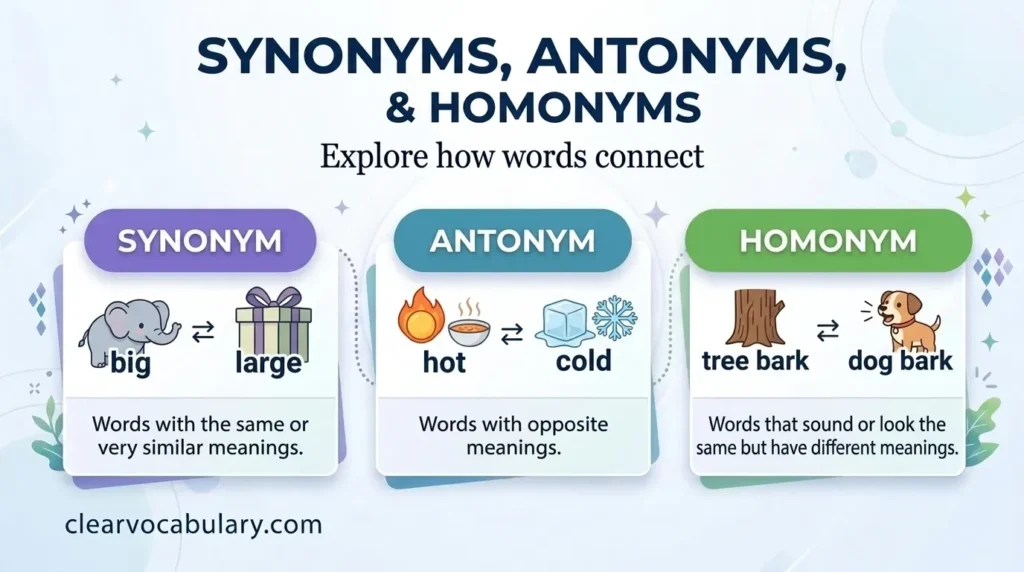
Don’t confuse these with homonyms (words that sound or look alike but have different meanings, like bat the animal and bat the sports equipment).
Synonym vs Antonym vs Homonym
| Term | Meaning | Example |
|---|---|---|
| Synonym | Same or similar meaning | big / large |
| Antonym | Opposite meaning | hot / cold |
| Homonym | Same sound or spelling, different meaning | bark (tree) / bark (dog) |
Practice: Choose the Correct Word
- Which word is a synonym of rapid? (slow / quick / late)
- Choose the most formal synonym for buy: (get / grab / purchase)
- Which pair are synonyms? (hot–cold / small–tiny / run–walk)
- Which word best replaces good in “The meal was ___,” if you mean extremely good? (fine / excellent / okay)
Answers
- quick: it has nearly the same meaning as rapid.
- purchase: it is the formal option.
- small–tiny: both describe small size, while the other pairs are opposites or different actions.
- excellent: it expresses a stronger degree than good.
FAQs
What is the definition of a synonym?
A synonym is a word that has the same or nearly the same meaning as another word in the same language.
What are some examples of synonyms?
Common examples include big/large, happy/glad, fast/quick, smart/clever, and start/begin.
Are synonyms always exactly the same?
No. Most are near synonyms that differ in intensity, formality, or connotation.
What is the difference between a synonym and an antonym?
A synonym has a similar meaning (big/large), while an antonym has the opposite meaning (big/small).
Why are synonyms important in writing?
They help you avoid repetition, add variety, and choose words that fit your tone and audience more precisely.
Can a word have more than one synonym?
Yes. Many words have several, and which one fits depends on the meaning in context. For example, light has different synonyms in “light bag” (lightweight) and “light color” (pale).
How do I find synonyms for a word?
Use a thesaurus or dictionary, then check example sentences to be sure the meaning, tone, and grammar fit your context.
Conclusion
A synonym is a word with the same or a very similar meaning as another word, such as big and large. Truly identical synonyms are rare, so the best choice depends on tone, formality, and context. When you pick a synonym, check its connotation and make sure it fits your sentence naturally.




Pingback: Synonyms for Antique: 15+ Better Words (With Examples)